

Usbellows logo.png

EJMA Logo

US Bellows is a Standards Subscriber | Exp: Dec 31, 2026 | See ejma.org to check verification process
Celebrating over 20 years of EJMA membership
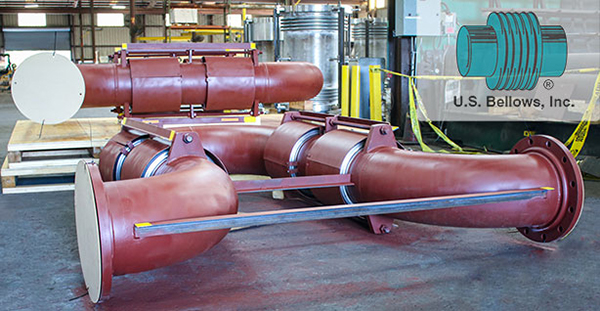

78” Dia. Universal Expansion Joint Custom-Designed for One of the Oldest Scientific Innovators in the Engineering Industry

March 29, 2021

78” Dia. Universal Expansion Joint Custom-Designed for One of the Oldest Scientific Innovators in the Engineering Industry

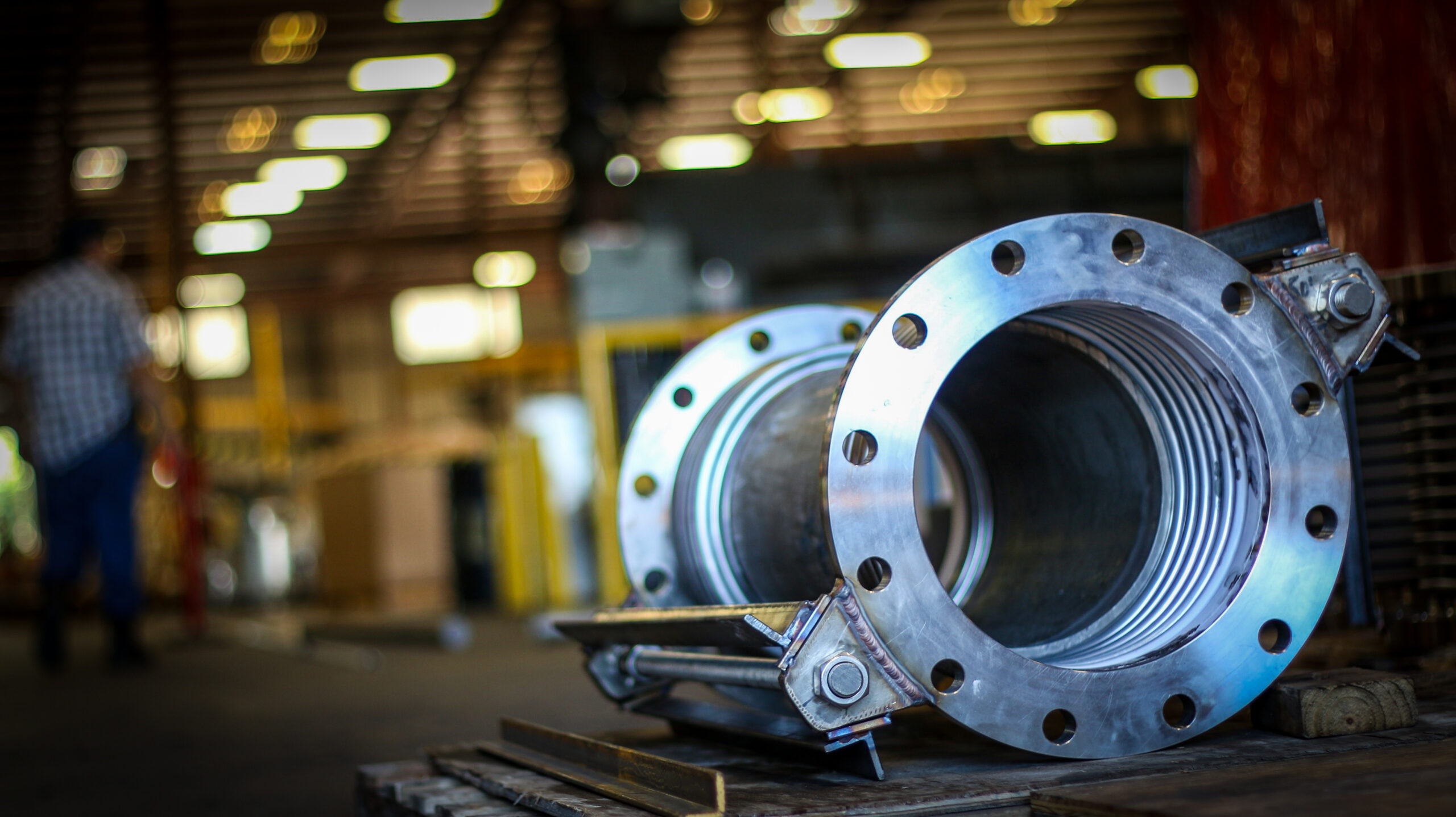
US Bellows custom-designed universal expansion joints for one of the oldest scientific innovators in the engineering industry. Large diameter steam pipelines are a part of almost every plant and are associated with innovations in areas like nanotechnology, fuel cells, biomaterials from renewable resources, materials for personal protections (which have been especially important in the time of COVID), emerging video display technologies, and semiconductors. These plants manufacture polymers such as neoprene, nylon, chlorofluorocarbons, synthetic pigments. In this case, the universal expansion joint bellows and liner are fabricated from A240 Gr. 321, the pipe, tie rods, and flanges are fabricated from A240 Gr. 304 stainless steel. They are designed for low pressure (8 PSI) and range from 36” pipe x 60” long up to 78” pipe x 117” long. Per our QC requirements and/or client specifications, the expansion joints were dye-penetrate examined and soap, air bubble tested prior to shipment.

Us bellows universal expansion joint 137373 fab sm
78″ Universal Expansion Joint in Fabrication
Read More

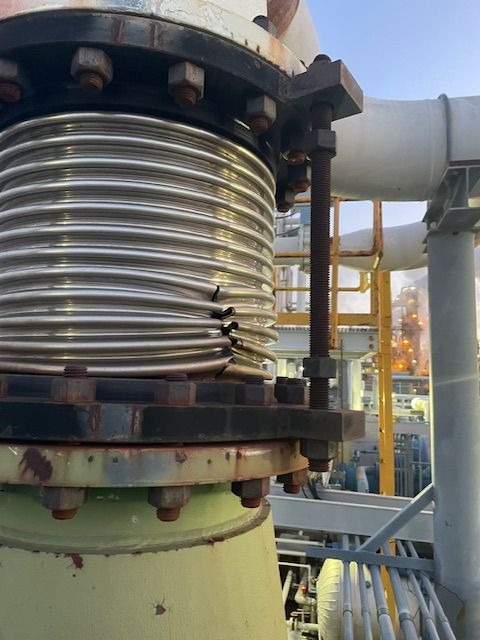
US Bellows Custom-Designed Tied Universal Expansion Joints for Service at a Chemical Plant

February 9, 2021

U.S. Bellows Custom-Designed Tied Universal Expansion Joints for Service at a Chemical Plant.

Universal expansion joints such as these are used in chemical plants that manufacture petrochemicals (such as ethylene and styrene monomer), polymers, and building products (PVC profiles for windows, doors, and decking). The units range in length from 26” to 48” and in diameter from 8” to 20”. The bellows were fabricated from 321 stainless steel, the weld ends, pipe spools, and flanges from 304 stainless steel, and the tie rods and hex nuts from carbon steel. They are designed for temperatures ranging from -150°F to 800°F, operating pressures ranging from 50 to 240 PSIG, and 0.25” to 2.25” of lateral deflection. The expansion joints were air, soap, and bubble tested, 100% dye-penetrant tested, and hydro-tested before shipment. The universal pipe expansion joint consists of two bellows separated by a pipe section or spool. The primary purpose of this arrangement is to have a unit that will accept large amounts of lateral deflection. The amount of lateral deflection they can accept is a function of the amount of angulation each bellows can absorb and the distance between the bellows. For a given bellows element, the amount of lateral deflection capability can be increased or decreased by simply changing the length of the center spool.

Read More

Gimbal Expansion Joints for Crude Oil Pipelines in Canada

January 12, 2021

Gimbal Expansion Joints Fabricated for Crude Oil Pipelines in Canada

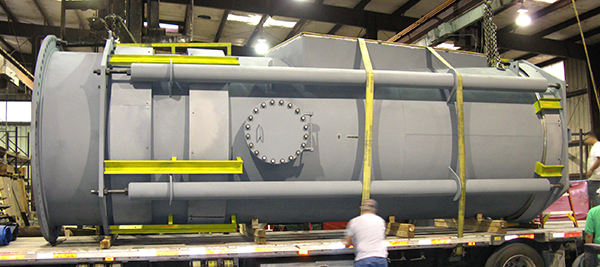
US Bellows custom-designed and fabricated universal gimbal expansion joints for 24” diameter crude oil pipelines at a power plant in Canada. The bellows are fabricated from A240 316 stainless steel bellows, the flanges are A105N carbon steel, and the plates are A516 70 carbon steel. The expansion joints are designed for a 10 degrees angular rotation at 285 PSIG up to 100 degrees F. They are designed for an angular spring rate of 4900 in-lb/dec and vertical offset of 10-1/4”. The units measure 43” x 43” x 110” and 38” x 38” x 79”.

Us bellows gimbal ej 3d model

3D Modeling was done so that our engineers can check the “fit-up” to confirm the design, perform stress analysis, or other modeling benefits prior to fabrication. We performed hydro tests, completed NDE reports, and supplied material test reports per the client requirements.

Read More

Expansion Joint Failures Due to Excessive Stress in the Piping System

June 10, 2020

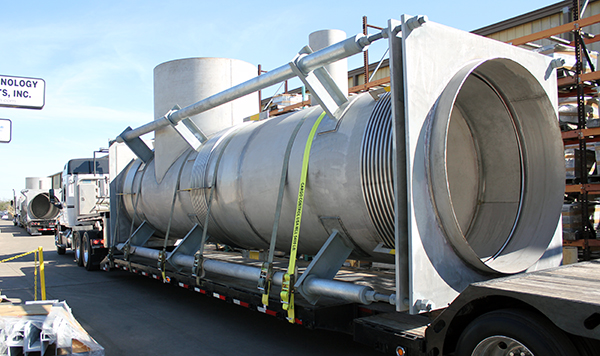
US Bellows has spoken to many customers who complain about the premature failure of their expansion joints. In the vast majority of these cases, the issue is not a poorly made expansion joint but another issue in the piping system that places excess stress on the expansion joint.

Universal Expansion Joint Failure (non-PT&P supports)
Fabric Expansion Joint Belt Material, Separating and Leaking (non-PT&P supports)

Expansion joints are placed into piping systems for the following reasons:

  • Thermal Growth (Piping Engineer) – The preferred method for absorbing thermal growth is an expansion loop, bend, or z. However, when there is not enough room in the system, an expansion joint can be used to absorb large amounts of thermal growth in a limited space.
  • Alignment and Vibration (Rotating Equipment Engineer) – Some rotating equipment engineers will use expansion joints to solve alignment and vibration issues to keep stress off of sensitive rotating equipment.

Thermal growth will move to the path of least resistance. Expansion joints are designed to be the path of least resistance with a spring rate that is much lower than expansion loops and bends. This is also what makes expansion joints the weakest element in the piping system. The issue with expansion joints is that they can be sensitive to excess movement and are very sensitive to torsion. As a result, when the required movements in the piping system or overall process parameters change, it can adversely impact expansion joints. This can be caused by a lack of preventative maintenance, process changes to obtain greater output, poor installation, etc. The following are some of the scenarios PT&P has seen:

  • Construction team using expansion joints for alignment – In order to save time, some construction teams will use an expansion joint to solve an alignment issue. This causes the following potential issues:
    • Excess movement on expansion joint – If the expansion is compressed to solve an alignment issue, then it will be required to compress further beyond its initial design specification to absorb thermal growth. This can significantly reduce the life of the expansion joint.
    • Excess stress in the piping system – If the expansion joint has limit rods, the use of the expansion joint for alignment may leave no room for the expansion joint to absorb thermal growth. In this case, the tremendous force associated with thermal growth will move to another part of the piping system.

Spring Support MaintenanceWhen a spring support is not maintained, the stress and movements in the piping system can be altered significantly. For example, PT&P worked with a large chemical plant that was experiencing repeated expansion joint failures on a specific expansion joint. Upon review, the cause of the failure was that a constant spring supporting a long vertical run of piping was not being maintained. This was causing an issue for the expansion joint, which was on a horizontal run of piping that was feeding the vertical piping. The chart below shows an example of the impact of an expansion joint designed for 1” of axial movement when it is required to also support 0.5” of lateral movement. The requirement to support 0.5” of lateral movement reduces rates cycle life from 100,000+ cycles to 2096 cycles!

Impact of expansion joint design failure

  • Change in Process Parameters – The picture below is from a customer who experienced in-plane squirm because they raised the pressure in the piping system beyond the rated pressure of the expansion joint. Changes in pressure and temperature can move the system beyond the capability of the expansion joint. The picture below shows an in-plane squirm caused by an increase in process pressure in the piping system.

Expansion joint in plane squirm

  • Issues with Pipe Stress Analysis – One of the challenges with expansion joint design in pipe stress analysis is that pipe stress software does not provide detailed specifications for expansion joints the way it does for spring supports and other components. As a result, a design that places excess stress on an expansion joint can pass pipe stress analysis. For example, Caesar will not keep a designer from placing excess torsional force on an expansion joint (Pipe Stress Case Study).

US Bellows recommends a strong maintenance program to avoid these issues. This includes the following:

  • Maintain Records of Expansion Joints – It is critical to know why the expansion joint was placed in the system and its intended movements.
  • Regular Inspection of Expansion Joints – Expansion joints should be inspected for cracks, corrosion, and proper movement. Given the design parameters, the expansion joint should be checked for proper positioning in hot and cold positions to ensure it is being used as intended and there are no issues in the system that are going to impact the expansion joint.
  • Ensure Installation Dimensions prior to Installation – To ensure that construction teams do not use expansion joints for alignment, measurements of the installation should be taken prior to installation to ensure that proper alignment has been done without the expansion joint.


Read More

Externally Pressurized Expansion Joint for a Reformer Unit in Saudi Arabia

October 14, 2019

Usbellows externally pressurized expansion joint 139221


 Type:  Externally Pressurized Expansion Joints
 Size:  59 9/16″ Long | 3″ Nominal Pipe Size
 Material:  304 Stainless Steel | Chrome-Moly
 Design:  1020°F Operating Temp. @ 140 psig | 11.75″ Axial
 Testing:  100% Dye-Penetrant | X-Ray | Hydro-tested

This externally pressurized expansion joint was designed by US Bellows for a reformer unit at a refinery in Saudi Arabia. It is 59 9/16″ long with a nominal pipe size of 3″. The bellows were fabricated from 304 stainless steel and the pipe, flanges and hardware from chrome-moly. The unit is designed for an operating temperature of 1020°F at 140 psig. 11.75″ of axial compression and 1.25″ of extension. The expansion joint was 100% dye-penetrant tested, x-ray tested the bellows, and hydro-tested prior to shipment

Read More

Custom Single Expansion Joints for an Asphault Facility in Saudi Arabia

September 16, 2019

Usbellows single expansion joint 157836


 Type:  Single Expansion Joints
 Size:  19 11/16″ Long | 12″ Nominal Pipe Size
 Material:  316 Stainless Steel | Carbon Steel
 Design:  220°F Operating Temp. @ 75 PSIG | 0.6″ Axial & Lateral
 Testing:  100% Dye-Penetrant

US Bellows custom-designed these single expansion joints for an asphalt facility in Saudi Arabia. They are 19 11/16″ long and a nominal pipe size of 12″. The bellows and liners were fabricated from 316 stainless steel, with the flanges and tie rods from carbon steel. They are designed for an operating pressure of 75 PSIG at 220°F and 0.6″ axial compression and lateral deflection. The units were 100% dye-penetrant tested and hydro-tested prior to shipment.

Read More

Custom Designed Rectangular Expansion Joints for a Chemical Plant in Texas

February 5, 2018

Custom Designed Rectangular Expansion Joints for a Chemical Plant in Texas

Type: Rectangular Expansion Joint
Size: 91″ x 130″ x 24″
Design: 304 Stainless Steel
Material: 482°F at 14.2 psig & 1″ Axial Compression
Testing: Soap & Air and 100% Dye-Penetrant

These rectangular expansion joints was custom designed by US Bellows for a chemical plant in Texas. It has dimensions of 91″ x 130″ x 24″. It was completely fabricated from 304 stainless steel. The units are designed for an operating temperature of 482°F with an operating pressure of 14.2 psig and 1″ of axial compression. The expansion joints were soap & air tested and 100% dye penetrant tested prior to shipment.

Read More

Single Expansion Joint for a Chemical Plant in Texas

January 22, 2018

Single Expansion Joint for a Chemical Plant in Texas

Type: Single Expansion Joint
Size: 39″ Dia. | 24″ OAL
Material: 304 Stainless Steel | CS
Design 400°F at 35 psig & 2″ Axial Compression
Testing: 100% Hydro-tested at 57 psig

US Bellows designed this single metallic expansion joint for a chemical plant in Texas. The unit has a 39″ diameter and is 24″ overall length. The bellows were fabricated from 304 stainless steel with carbon steel flanges. It is designed for an operating temperature up to 400°F at 35 psig, with 22″ of axial compression. The expansion joint was hydro-tested at 57 psig prior to shipment.

Read More

Custom Universal Hinged Expansion Joint Completed in less than 12 weeks for a Refinery in Texas

December 4, 2017

152767a1

Type: Universal Hinged Expansion Joint
Size: 86″ Height, 234″ Long, & 42″ OD
Material: Inconel 625/Chrome-Moly/Carbon Steel
Design 1025°F at 45 psig, 3/4″ of Axial, & 12.5″ of lateral
Testing: 100% Radiographic Examined, Pneumatic Tested at 61 psi, Leak Tested at 51 PSIG, & Dye-Penetrant

US Bellows custom-fabricated this universal hinged expansion joint with oversized bellows, movement indicators, and test ports, in less than 12 weeks for a refinery turnaround in Texas. The unit is 86″ in height, 234″ long, and has a 42″ OD. The bellows were fabricated from Inconel 625, the piping from chrome-moly, the hinge hardware from carbon steel, and the covers from 304 stainless steel. It is designed for an operating temperature of 1025°F at 45 PSIG, with 3/4″ of axial compression and 12.5″ of lateral deflection. The unit was post-weld heat treatment and 100% radiographic examined the circumferential and long seams after the post-weld heat treatment, plus pneumatically tested at 61 psi, the bellows were leak tested to 15 PSIG between the plies, and dye-penetrant tested prior to shipment.

Read More

Single Expansion Joints Custom Designed for a Power Generation Application

September 20, 2016
Single Expansion Joints Custom Designed for a Power Generation Application
Type: Single Tied Expansion Joint
Size: 4” in diameter by 9-3/4;” in OAL, to 8” in diameter by 10-7/8” in OAL
Material: 304 Stainless Steel Bellows / Carbon Steel
Design: 400°F at 400 psig
Testing: hydro-tested at 600 psig

U.S. Bellows custom designed these single tied expansion joints for a power generation application in Virginia. The expansion joints vary in size from 4” in diameter by 9-3/4” in OAL, to 8” in diameter by 10-7/8” in OAL. The bellows are fabricated from 304 stainless steel and the rest of the components from carbon steel. The expansion joints are designed for 400°F at 400 psig and are capable of 0.39” of lateral movement. A hydro-test at 600 psig was performed on the units prior to shipment

Read More