

Usbellows logo.png

EJMA Logo

US Bellows is a Standards Subscriber | Exp: Dec 31, 2026 | See ejma.org to check verification process
Celebrating over 20 years of EJMA membership
25 Years of Proven Performance — US Bellows Delivers Again

May 20, 2026

Expansion joint elbow

When a major energy provider needed to replace a critical elbow pressure balanced expansion joint at one of its Nevada power generation facilities, it turned to a trusted manufacturer.

1000000862 (1)

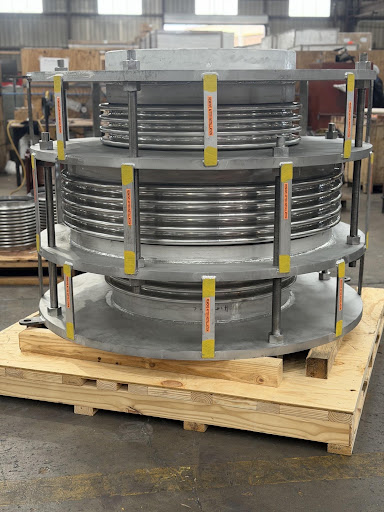
US Bellows re-engineered and refurbished this elbow-pressure balanced expansion joint, which had lasted more than 25 years.  The original unit, manufactured in 1975, is for a GE steam turbine used in the cross-over pipe section to manage thermal expansion while minimizing loads on the turbine.  US Bellows refurbished and replaced the bellows 25 years ago. After the bellows has a full-service life the client turned to us for another replacement—and we turned it around in three weeks.

The Challenge The expansion joint required custom fabrication to exact specifications, with a three-week deadline to minimize downtime at an active gas-fired power plant.

Img 5277

The US Bellows Difference Expansion joints are a technically demanding, artisanal product line requiring rare skills, thin-gauge superalloy welding, and custom machinery. Here’s what made it possible:

  • Scale & Capacity: US Bellows shipped nearly 4,500 expansion joints last year, backed by a 15% shop expansion and new equipment including a CNC plasma table, bellows shear, Davi roller, additional in-house designed punch equipment, clean-room operations, and additional cranes.
  • Workforce Flexibility: Our expansion joint team can draw on 40+ additional trained welders and 30+ cut shop and layout personnel when needed — ensuring we can surge capacity to meet urgent deadlines.  Our ability to be vertically integrated with our other divisions from a manufacturing standpoint gives us the optimal set up for fastest time to market in these scenarios.
  • Engineering Expertise: Two dedicated industrial engineers with master’s degrees drive on-floor scheduling and process efficiency, with the entire production process mapped for rapid response.
  • Digital Work Instructions: Deployed across all key production steps, enabling precision, consistency, and fast execution — even on complex custom fabrications.
  • Enhanced Quality Control: Detailed drawing review checklists before fabrication reduce revisions and reworks, so we get it right the first time.

As an EJMA-certified manufacturer, all of our expansion joints are designed and fabricated in accordance with EJMA standards and ASME B31.1 Power Piping Code for power applications — ensuring every unit meets the rigorous demands of power generation environments.

Pxl 20260407 143934331 (1)

Why the Elbow Pressure Balanced Expansion Joint Matters

In today’s power landscape — driven by AI data centers, industrial electrification, and aging grids — turbines must operate with near-zero downtime. Even a few millimeters of unintended movement from thermal expansion in steam lines can cause casing distortion, rotor misalignment, and bearing failure.

The Elbow Pressure Balanced Expansion Joint (EPBEJ) is engineered to prevent exactly that — while solving a challenge the inline design cannot: changes in piping direction.

  • Force Neutralization at the Elbow: A balancing bellows positioned after the elbow cancels out pressure thrust in both the axial and lateral directions via tie rods — so the turbine flange experiences zero pressure-related loads, even through a 90° turn.
  • Zero-Anchor Load: The turbine only “feels” the minimal spring rate of the bellows — negligible compared to the thousands of pounds of thrust generated by pressure acting on directional changes in high-pressure steam lines.
  • Direction Change Without Penalty: The elbow design absorbs thermal growth across a piping bend, eliminating the need for separate directional expansion joints or complex guided pipe loops at header-to-turbine connections.
  • Reduced Civil Costs: The self-balancing design eliminates the need for massive concrete thrust anchors at elbow locations — historically among the most heavily loaded anchor points in a turbine hall.
  • Compact Routing in Tight Layouts: Where piping must turn to reach a turbine nozzle, the EPBEJ replaces what would otherwise require multiple components — an elbow, two expansion joints, and intermediate anchoring — with a single, integrated assembly.
  • Reliability in Cycling: As peaking plants ramp up and down daily to balance renewables, the EPBEJ absorbs constant expansion and contraction cycles at directional transitions that would otherwise fatigue turbine nozzle connections and elbow welds alike.

A Legacy of Quality The original elbow pressure balanced expansion joint served this client for 50+ years. When the time came for a replacement, they came back to us. That’s the US Bellows standard — products built to last, and a team built to deliver.

60% of our work at US Bellows is replacement units for operating facilities all over the world. We are not always the OEM — but we are always the manufacturer that delivers.


At US Bellows, we build lasting partnerships with the power industry — one precision-engineered solution at a time.

Read More

5 Questions to Ask Before Ordering a Replacement Expansion Joint

May 14, 2026

Expansion joints are engineered solutions, not off-the-shelf components. When one fails, replacing it like-for-like without evaluating system conditions, operating history, and installation constraints is the fastest way to repeat the failure.

The following questions provide a practical framework for ensuring the correct selection.

1000482833

Question 1: Do You Have the Original Design Specifications or Drawings?

The most reliable way to specify a replacement expansion joint is by referencing original design documentation, including drawings, datasheets, or nameplate data. While pressure and design temperature are the primary controlling factors, a complete specification requires the full STAMPED criteria: Size, Temperature, Application, Movement, Materials, Pressure, Ends, and Delivery. Missing any of these can lead to delays or incorrect selection.

Material selection follows directly from these numbers:

Joint Type Temperature Limit Pressure Range Typical Applications
Fabric  Upto 2000°F Low (+/-3psi) Exhaust ducting, HVAC, low-pressure gas
Rubber Upto 350°F Medium Water treatment, pump discharge lines
Metal – Stainless Steel  Upto 1200°F High Refineries, chemical plants, steam lines
Metal – Nickel Alloy Up to 2800°F Extreme  Steel plants, acid plants, aerospace

1000482836

Question 2: How Long Did the Previous Joint Last, and What Was the Failure Mode?

Service life is one of the most diagnostic data points available when specifying a replacement. It tells you if the original product selection was correct, or whether there is a systemic issue that a new joint will not solve.

Joint lasted 15–20 years: The original specification was appropriate. Failure is the result of normal fatigue or corrosion. A like-for-like replacement is the correct approach.

Joint failed in under 12 months: There is an underlying cause that replacement alone will not fix.

Understanding the Failure Mode

  • The most frequent cause of premature failure in metal bellows is piping misalignment. Expansion joints are designed to accommodate minor axial, lateral, and angular misalignment, but that tolerance is not a substitute for correct pipe alignment. 
  • Physical handling damage is the second most common cause. Bellows are manufactured from thin-wall metal (typically 0.015″ to 0.065″ wall thickness). A dent or crease before the joint enters service creates a stress riser that accelerates failure.  

Image 3

Question 3: Were There Any Upset Events During or Near the Joint’s Failure?

Design conditions represent normal operation, but failures often occur during transient or abnormal events, especially those occurring shortly before or at the time of failure.

Before placing your order, check whether any of the following occurred:

  • Overpressurisation – A pressure spike above MAWP can cause the bellows convolutions to balloon permanently outward, a condition known as squirm. 
  • Water hammer – Rapid valve closure or pump startup creates pressure transients that can shock-load the bellows.
  • Flow-induced vibration – High-velocity flow or proximity to rotating equipment, pumps, compressors, turbines, cycles the bellows at frequencies that rapidly consume fatigue life. 

Flag any upset events when placing your order. The engineering team may recommend design modifications based on the actual service history.

Question 4: Are the Existing Dimensions Accurate to the Original Design?

Incorrect dimensional assumptions are a common cause of replacement failures. A key mistake is assuming that the installed joint dimensions reflect the original design intent. In many cases, they do not. 

Before ordering, verify the following:

  • Face-to-face (F-F) dimension between mating flanges 
  • Pipe outside diameter (OD)
  • Flange bolt-circle diameter (BCD) and bolt-hole pattern
  • Tie rod length and stop nut positions

Critical Check – Confirm whether the current dimensions match the original drawings, or if they reflect field modifications. Designing to incorrect field dimensions can introduce unintended stresses into the new joint.

Question 5: Is the Original Material Selection Still Appropriate for the Current Service?

Operating conditions change over a system’s life. A joint specified for moderate-temperature steam service may now be running a corrosive fluid at elevated pressure. 

Corrosive environments- Standard 304 or 316 stainless steel performs well in neutral applications. In high-chloride, acid, or caustic service, these alloys are susceptible to stress corrosion cracking. Specialty nickel alloys such as Inconel 625 or Hastelloy C-276 are frequently required. 

Vibration-sensitive applications- Rubber joints provide effective isolation in pump discharge and water service lines. Metal joints with internal flow liners are preferred for high-velocity gas applications.

Changed pressure or temperature ratings- If the line now operates beyond the original design envelope, a direct replacement is a code compliance issue. 

Address the Root Cause & Strengthen Your Piping System with US Bellows 

The most expensive maintenance pattern US Bellows engineers encounter is repeated bellows replacement without addressing the root cause of failure in the piping support system.

If original specifications or documentation are unavailable, the existing expansion joint can be sent for detailed examination. This enables accurate measurements and reverse engineering, allowing the engineering team to recommend the most appropriate solution.

In many cases, the root cause lies beyond the joint itself, in system alignment, supports, or operating conditions. US Bellows’ in-house field service team inspects complete piping systems to identify these issues and deliver long-term solutions. Schedule a consultation with a US Bellows engineer or request a quote with your specifications.


Read More

153″ Fabric Neoprene Expansion Joint for an Air Re-circulation/Ventilation Application at a Gas Turbine Facility in Hungary

May 11, 2026

153" Neoprene Expansion Joint for an Air Recirculation/Ventilation Application at a Gas Turbine Facility in Hungary

Type: Neoprene Expansion Joint
Size: 153″ x 55″ x 21″
Design: EPDM Reinforced Fabric Cloth | A572 Grade 50
Material: 200°F, +/- 100″ WC, & 1″ Axial
Testing: Dye-penetrant examination

For this project, U.S. Bellows designed and manufactured a custom EPDM neoprene expansion joint for an air recirculation and ventilation application at a gas turbine facility in Hungary.

The unit measures 153″ long x 55″ wide x 21″ face-to-face and was engineered to absorb movement and vibration within the ventilation system while maintaining reliable operation under demanding service conditions. 

Designed for operating temperatures up to 200°F and pressures of ±100 inches water column, the expansion joint accommodates 1 inch of axial compression and lateral deflection to support thermal movement and system flexibility.

The flexible fabric belt was constructed from neoprene-reinforced fabric cloth, selected for its durability and resistance to heat and environmental exposure. The supporting framework was fabricated from A572 Grade 50 carbon steel to provide the structural integrity required for the application and coated after welding. 

Due to US Bellows’ engineering expertise and proven performance in critical power generation applications, the customer selected U.S. Bellows as the sole-source supplier for this expansion joint scope.

This project also reflects the long-term confidence customers place in US Bellows. Our team has worked strategically with this client for more than a decade, supporting evolving expansion joint requirements across critical applications and international projects.

This project highlights U.S. Bellows’ continued commitment to delivering custom-engineered fabric expansion joint solutions for demanding power-generation and industrial-ventilation applications worldwide.

Read More

Gimbal Expansion Joints for Crude Oil Pipelines in Canada

April 29, 2026

Gimbal Expansion Joints Fabricated for Crude Oil Pipelines in Canada

U.S. Bellows custom-designed and fabricated 24-inch universal gimbal expansion joints for crude oil pipelines at a power plant in Canada, delivering a robust solution for managing angular movement and system stress.

The bellows were manufactured from ASTM A240 Type 316 stainless steel, providing excellent corrosion resistance and durability. The flanges were fabricated from A105 carbon steel, and the gimbal assemblies were constructed from A516 Grade 70 carbon steel, ensuring structural strength and reliability under demanding operating conditions.

These expansion joints were engineered to accommodate 10° of angular rotation at 285 psig and temperatures up to 100°F. The design includes an angular spring rate of 4,900 in-lb/degree and allows for a vertical offset of 10-1/4 inches, supporting system flexibility while maintaining load control. The overall dimensions of the units are 43″ x 43″ x 110″ and 38″ x 38″ x 79″.

Us bellows gimbal ej 3d model

Advanced 3D modeling was utilized during the design phase to verify proper fit-up within the system, perform Finite Element Analysis (FEA) on critical components, and provide the customer with detailed models for integration into their plant design prior to fabrication.

To ensure quality and compliance, each unit underwent hydrostatic testing, non-destructive examination (NDE), and was delivered with complete Material Test Reports (MTRs) in accordance with the client’s specifications.

This project highlights U.S. Bellows’ capability to deliver high-performance, custom-engineered expansion joints supported by advanced analysis, rigorous testing, and value-added engineering services.

Read More

66″ Diameter Hinged Expansion Joints Designed for a Chemical Plant

April 13, 2026

132483a1


Type: Hinged Expansion Joint
Size: 66″ in diameter and 39-3/8″ OAL
Material: Incoloy 825 / 321 stainless steel
Design 73 PSIG at 986°F with 4.25 degrees of angular rotation
Testing: Dye Penetrant, X-Ray, PMI, Hydrotest

These single hinged expansion joints were custom designed by US Bellows for a chemical plant in Saudi Arabia to manage the critical piping systems. The units are 66″ in diameter and 39-3/8″ OAL. The bellows were fabricated from Incoloy 825 with the weld ends, hinges, liner, and cover from 321 stainless steel. The expansion joints were designed for an operating pressure of 73 PSIG at 986°F with 4.25 degrees of angular rotation. All units were dye-penetrant tested and x-ray tested on each bellows and pipe longitudinal weld seams, PMI tested on each alloy component, and ultrasonic tested on each alloy steel plate prior to shipment. Hinged  expansion joints contain hinges or pivots which allow the unit to bend in a single plane.

We’ve supplied this type of expansion joint for both methanol and ammonia plants. They are also used in piping systems for air, steam, gas turbines, reformer ducts, and burners. These units are designed to restrict axial deflection in extension or compression. The hinge mechanism is designed to contain full-pressure thrust. Also, because of the hinge mechanism’s design, shear loads, such as from the weight of adjacent piping, can be accepted by this pipe expansion joint, relieving the piping designer of having to provide additional supports and anchors required by the single type.

Product Overview

US Bellows designs and manufactures single hinged expansion joints engineered to absorb angular rotation in critical piping systems. Compliant with EJMA (Expansion Joint Manufacturers Association) standards, these units are built to handle extreme operating conditions — including high temperature, high pressure, and corrosive media — across petrochemical, power generation, and industrial process applications.

Featured Project: Saudi Arabia Chemical Plant

This custom-engineered single hinged expansion joint was manufactured for a chemical plant in Saudi Arabia serving critical piping infrastructure. The units measure 66″ in diameter with a 39-3/8″ overall length. Bellows were fabricated from Incoloy 825, with weld ends, hinges, liner, and cover constructed from 321 stainless steel. The joints were designed for an operating pressure of 73 PSIG at 986°F (530°C), with an angular rotation capacity of 4.25°. Prior to shipment, all units underwent dye-penetrant and radiographic (X-ray) testing on every bellows and pipe longitudinal weld seam, Positive Material Identification (PMI) on each alloy component, and ultrasonic testing on all alloy steel plate — ensuring full traceability and compliance with the project’s quality requirements.

How Single Hinged Expansion Joints Work

Single hinged expansion joints incorporate a hinge and pivot mechanism that permits angular rotation in a single plane while mechanically restraining axial movement in both extension and compression. Unlike unrestrained expansion joint types, the hinge assembly is rated to absorb full pressure thrust loads, eliminating the need for main anchors in many piping configurations. Because the hinge mechanism also accepts shear loads — including the dead weight of adjacent piping — fewer external pipe supports and guides are required, reducing installed system cost and structural complexity. This behavior is consistent with EJMA’s guidance on restrained expansion joint systems. To accommodate full angular rotation, single hinged expansion joints are typically installed in pairs or sets of three with appropriate anchor and guide arrangements, as outlined in EJMA standards.

Applications

US Bellows has supplied single hinged expansion joints for methanol and ammonia plants, steam and gas turbine exhaust systems, reformer and process gas ducting, combustion air and burner systems, and a wide range of high-temperature gas and air piping applications. These units perform reliably where fixed supports cannot manage thermal growth and where the pressure thrust forces must be fully restrained at the joint itself. US Bellows differentiates through full in-house fabrication, custom metallurgy selection, and rigorous third-party testing documentation delivered with every order.

Materials of Construction

Bellows are available in Incoloy 825, 321 SS, 316L SS, Inconel 625, Hastelloy C-276, and other high-performance alloys depending on process chemistry and temperature range. End fittings, liners, and hinge hardware are material-matched to the process environment and fabricated to customer specification, with full PMI verification on all alloy components as standard practice.

Why Choose US Bellows

US Bellows delivers EJMA-compliant design and documentation with full in-house fabrication from raw plate through final assembly. Every unit is custom-engineered for the specific operating conditions of the application — including non-standard diameters, pressures, and temperatures. Comprehensive NDE including dye-penetrant, radiographic, ultrasonic, and PMI testing is standard on all alloy components. US Bellows has a proven global supply record serving methanol, ammonia, refinery, and power generation facilities, and units are available with ASME Code stamping and third-party inspection upon request.

PT&P REF. ORIGINAL POST 06182019

Read More

Efficient Thermal Movement Solutions for Airport Piping

April 7, 2026

Supporting a Large International Airport in Florida’s Modernization of a Concourse Without the Need for Extra Guides

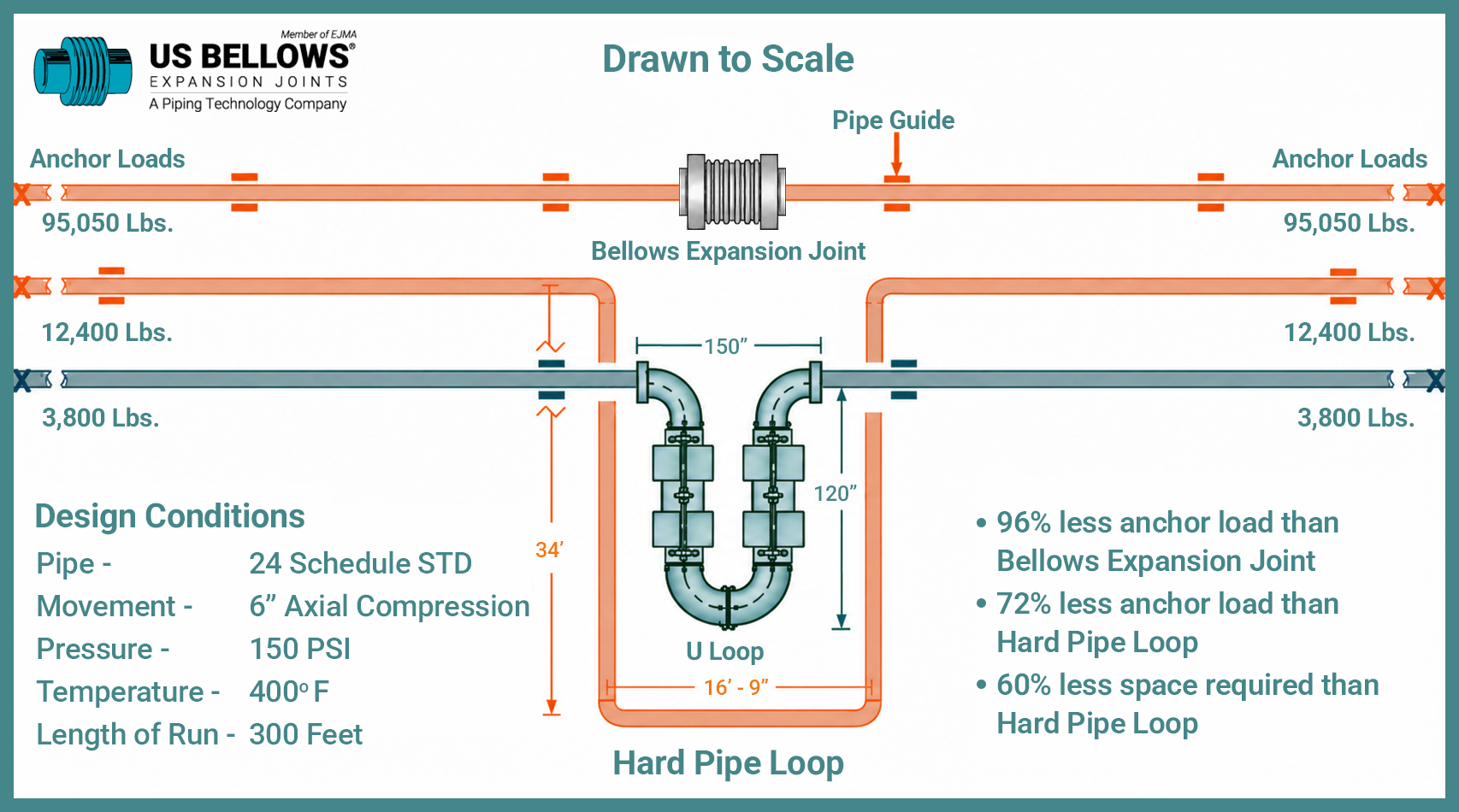
Nested U-loops are vital for piping systems that undergo thermal expansion and contraction over long distances. When traditional expansion joints require too much supplementary infrastructure, our custom-engineered U-loops step in. We accommodate extreme thermal movement while minimizing the need for additional structural supports.

What is a Nested U-Loop?

U loop expansion joint overview

A nested U-loop is a specialized piping configuration that helps to absorb thermal expansion. 

Unlike standard inline expansion joints that often require a complex system of anchors and guides to function properly, nested U-loops manage movement organically. These configurations are essential for:

  • Managing Extensive Thermal Movement: Absorbing high degrees of expansion and contraction across long straight pipe runs, as well as large lateral movements.
  • Reducing Structural Requirements: Eliminating the need for additional pipe guides and structural supports by having the expansion joint contain the pressure thrust.
  • Streamlining Installation: Providing a reliable, low-maintenance solution for tight or constrained installation footprints.

US  Bellows, a division of Piping Technology & Products, engineers and manufactures nested U-loops and conducts comprehensive pipe stress analyses to meet exact project needs. If you are routing chilled-water lines or high-temperature steam, we design loops that meet your specific thermal, spatial, and load requirements.

Case Study: Custom Nested U-Loops for Large Florida Airport

Protect modern airport infrastructure with expansion joints from US Bellows.

For the ongoing modernization of a concourse, US Bellows supplied customized nested U-loops. This large airport is currently expanding to increase capacity and drastically enhance the passenger experience.

The Challenge: During Phase 2 of the project, mechanical contractors were tasked with installing chilled-water piping on the facility’s roof. The design featured 500 feet of straight pipe with no expansion joints and no existing way to manage thermal expansion and movement. Using traditional expansion joints across this massive span would have required the airport to install more guides and supports, increasing costs and installation time.

The Solution: Our engineering team provided the necessary design data for the expansion joints, enabling the contractor to perform a comprehensive pipe stress analysis to calculate and address the exact thermal movement in the chilled water return lines. Our engineering team worked with the contractor to work around their hardware and support spacing to prevent any contact during operation. Based on this analysis, we designed a solution consisting of just four nested U-loops.

The Result: The four nested U-loops effectively addressed all thermal movement across the 500-foot straight pipe run. By avoiding traditional expansion joints, the airport bypassed the need for additional guides and supports. 

This critical infrastructure directly supports the concourse’s new amenities, including a dedicated sensory room to provide a calming space for travelers with autism and sensory sensitivities, as well as the infrastructure required for two additional passenger boarding bridges.

Designed for Commercial Infrastructure Demands

In major commercial infrastructure and airport expansions, efficiency and reliability are key. Piping systems face constant environmental variables:

  • Thermal Expansion: Long pipe runs expand and contract with temperature changes; the system must accommodate these changes.
  • Space Constraints: Rooftop and utility corridor installations often lack the structural backing for heavy, traditional anchor/guide setups.

Our custom nested U-loops deliver the flexibility contractors need. We minimize installation complexity and protect your facility’s critical systems.

Additional Solutions for Commercial Applications

In addition to nested U-loops and pipe stress analysis, PT&P and US  Bellows offer a full range of products for large-scale infrastructure projects:

  • Standard Expansion Joints: Fabric, metal, and rubber joints to absorb movement and vibration.
  • Pipe Shoes and Saddles: To support long spans and prevent damage to insulation.
  • Variable Spring Hangers: For locations requiring vertical travel management.
  • Pipe Anchors and Guides: To absorb piping loads and direct pipe movement safely.

Each product is made to meet your project’s specific load, movement, and environmental needs.

Why Project Managers Trust US Bellows & Piping Technology

When you work with us, you get a team that solves hard problems. We engineer solutions. We offer:

  • Comprehensive Engineering: Real-time help from seasoned engineers, including advanced pipe stress analysis.
  • Custom Design: We build and optimize what competitors deem too complex to handle.
  • Proven Quality: We meet strict industry standards for safety and performance.
  • Fast Response: We answer questions, provide feedback, and fix field issues quickly.

For Project Managers, this means less rework, fewer supports to install, and more confidence. Your project stays on track.

Get the Right Solutions for Your Next Project

Talk to a US Bellows engineer today. Discuss your long pipe runs, thermal movement challenges, and tight spaces. We will design a custom solution for you.

Read More

Boost Duct System Flexibility with Metal Expansion Joints

March 31, 2026

Metal expansion joints manage thermal expansion and vibration in complex ductwork. They provide the necessary capacity for the thermal growth of a piping system, including axial, lateral, and angular movements. 

In certain cases, the thrust pressure of a pipe expansion joint must be restrained with tie rods, hinges, or gimbals while still allowing the bellows to move through its design deflections.

These components maintain necessary flexibility within the piping and ducting infrastructure. At US Bellows, we handle a wide variety of project demands. We are currently supplying a 30-inch ductwork system with metal expansion joints for a Canadian uranium mining and exploration company (see below, pictures from the job in progress).

Orano canada uranium mining plant 30 inch ductwork system from us bellows

Tailored Approaches for Complex Assemblies

Custom ductwork assemblies can include fabricated elbows, tees, and straight sections made from carbon steel or stainless steel. US Bellows can manufacture these components in diameters of 42 inches or larger. To accommodate varying environmental factors, we fabricate these in carbon or stainless steel. 

For an oil and natural gas company in North Texas, we manufactured a 48-inch assembly of SS-304H and Incoloy 800HT Bellows, featuring refractory-lined ductwork that required specialized materials to withstand extreme internal conditions. (pictured top right) In total, we provided over 180 linear ft of refractory-lined ductwork, hardware, and expansion joints. We also fabricated the supports for the ductwork.

For a leading global provider of performance chemicals in La Porte, our project at an acid plant involved replacing five lines of ductwork and metal expansion joints during a turnaround to keep the facility fully operational. The lines were made of both carbon steel and stainless steel, depending on the media and the process. For this ductwork and expansion joints, we provided over 350 linear ft of piping along with the supports and hardware. Pictured below right: product on the way to the plant.

For Piping Engineers: Precision and Proven Design

Piping engineers require system components that meet their exact specifications to handle extreme internal conditions. Metal pipe expansion joints withstand varied design temperatures and pressures while providing the capacity to absorb the piping system’s thermal growth. 

These joints expertly handle the required thermal movements. When pressure thrust must be restrained, engineers can use tailored designs featuring tie rods, hinges, or gimbals. 

US Bellows further supports engineering teams with finite element analysis, comprehensive product testing, and custom engineering services. We also offer complimentary live webinars and online courses that provide P.E. credits, so your engineering team is at the forefront of the industry.

For Turnaround Planners: Predictability and Speed

Turnaround planners depend on exact timelines to execute successful plant shutdowns. Using the right expansion joints means systems come back online without delays. To support these tight schedules, US Bellows maintains a large inventory of stock bellows to meet urgent needs. 

During both planned and unplanned shutdowns, turnaround teams can rely on our quick-turn services and rapid replacement capabilities. Our clients consistently note that our work is always completed exactly when promised, so turnaround schedules don’t change.

For Maintenance Managers and Directors: Problem Resolution and Support

Maintenance leaders focus on maximizing uptime and extending the lifespan of their equipment. Using metal expansion joints prevents unexpected system failures caused by thermal expansion and duct misalignment. When maintenance is needed, US Bellows offers expert on-site services available 24 hours a day, 7 days a week.

For Plant Managers: Overall Operational Excellence

Plant managers need complete confidence that their facility will operate safely year-round. By using custom-fabricated assemblies built from durable carbon steel or stainless steel, plans can safely manage complex ducting systems reaching diameters of 42 inches or larger. US Bellows offers decades of experience, ASME Section VIII-Certification, and over 20 years of EJMA membership to every single project.
FAQ: Metal Expansion Joints and Custom Ductwork

For an oil and natural gas company in North Texas, US Bellows manufactured a 48-inch assembly of SS-304H and Incoloy 800HT Bellows, featuring refractory-lined ductwork that required specialized materials to withstand extreme internal conditions.

How do I select the right material for a metal expansion joint in custom ductwork?

Selection depends primarily on operating temperature, pressure, and chemical exposure. If the ductwork handles abrasive materials or operates at lower temperatures, carbon steel may be suitable, whereas specialized alloys are needed for more extreme chemical environments.

How do I determine the necessary movement capacity for a custom ductwork expansion joint?

Calculate the total axial expansion (length and change), lateral offset (misalignment), and angular rotation the duct will experience due to thermal fluctuations. A safe design often requires custom prefabricated joints that account for these movements, plus a safety factor to prevent fatigue failure under cyclic thermal loading.

Enhance Your Custom Ductwork with US Bellows

Our on-call engineering and manufacturing team guarantees a response to your request within 48 hours. Need Help? Please refer to our guide How to Select an Expansion Joint

Reach out to request a quote or schedule a meeting

Read More

Fabric Expansion Joint Designed for a High-Temperature Duct Application

March 30, 2026

A rectangular fabric expansion joint designed and manufactured by US Bellows

Type: Fabric Expansion Joints
Size: 67″ Long x 67″ Wide x 14″ Tall
Material: 3-Layer Fabric Belt with Kaowool Insulation
304 Stainless Steel Angle Flanges
Design Operating Temp: 2012°F at +/- 100″ Water Column
1″ of Lateral Deflection
Testing: 100% Dye Penetrant Testing & Q.C. Inspection

Fabric Expansion Joints in High Temperatures

Fabric expansion joints are often used in ducts that carry hot gasses at low pressures. The major design parameters include the temperature and flow rate of the gases, as well as the quantity and abrasiveness of any solids entrained within the gas stream.

This fabric expansion joint utilizes a ceramic fiber insulating material, also called an insulation pillow, to shield against high temperatures protecting the belting material. Refractory is also used in the construction of this joint but is designed so that it does not interfere with movement.

Our experienced engineers understand that every component of an expansion joint contributes to its performance rating, including its ability to withstand specific temperatures and meet required service life in operating hours.

View Fabric Expansion Joints Product Section.

Fabric Expansion Joints in Green Tech

Fabric expansion joints play a critical role in systems supporting power and refining plants focused on renewable and carbon-neutral applications. We have partnered with both new market entrants and our long-term clients transitioning legacy fossil fuel assets to greener technologies. These applications include biomass processing for biochar, carbon black production, clean hydrogen, styrene, and cement facilities, where reliable expansion joint performance is essential to system integrity and efficiency.

Looking for a fabric expansion joint, but not sure what size or material you need? Schedule time with an engineer to get your questions answered.


Did you know that US Bellows is a Piping Technology Company?
We are proud to be a one-stop solution from expansion joints to pipe supports and engineering services. We work hard to simplify your supply chain, and ensure system reliability with quality assurance.

PT&P REF. ORIGINAL POST 03182020

Read More

The Buyer’s Roadmap: How To Buy a Single Expansion Joint

March 26, 2026

Img 0129 (1)In a complex piping system, the smallest component often carries the heaviest burden. A single expansion joint (or single bellows expansion joint) is a precision-engineered tool designed to absorb axial movement, both compression and extension, caused by thermal changes.

Selecting the wrong expansion joint is a technical error and a safety risk. Follow this five-step checklist to ensure your system remains stable and efficient. 

Consider STAMPED during the buying process: Size (diameter), T-Temperature, A-Application (determines need for tie-rods, liners, and other accessories), M-Movement and Materials, P-Pressure, E-Ends (flange/pipe/threaded), and D-Delivery.

Step 1: Calculate Your Movement Requirements

Axial movement is the change in pipe length due to thermal fluctuations. Before purchasing, you should calculate the required movement using the thermal expansion formula:

Thermal Expansion Formula

Pro Tip: While it’s tempting to choose a joint with a massive safety buffer, an over-specified axial rating can unnecessarily increase costs. Aim for a balance of safety and economic efficiency.

If you are dealing with a system that has significant lateral movement, a single expansion joint may not be sufficient, and you will need to consider other options, such as universal expansion joints. Angular movements can be acceptable for single expansion joints.

When planning your piping system, calculating the exact amount of axial movement is your first and most critical step. Overestimating or underestimating thermal growth can lead to catastrophic buckling or equipment damage. Wondering what this looks like at scale or the math behind it?

More Resources

Step 2: Define Design Conditions & Media

The bellows must withstand your system’s worst-case scenario.

  • Temperature: Ensure the bellows and end fittings are compatible with the maximum system temperature.
  • Pressure: The design pressure rating must meet or exceed the maximum operating pressure. Exceeding this limit leads to catastrophic bellows “squirm” or rupture.
  • Media Type: Are you moving liquids, gases, or abrasives? If your media contains solids or is highly corrosive, you may need a specialized liner or alloy.

Your system’s media dictates everything from material choice to joint lifespan. Standard water is one thing, but what happens when you introduce specialized coolants, abrasive catalysts, or high-purity medical gases? You must match your bellows material to the exact chemistry and temperature of your fluid to prevent premature degradation.

More Resources

Step 3: Choose Your End Fittings

End fittings determine how the joint integrates into your existing infrastructure:

Fitting Type Best For…

Key Benefit

Weld Ends Permanent installations Strong, leak-proof, and maintenance-free
Flanges Systems requiring frequent service Easy installation and removal
Threaded Ends Small-diameter piping Simple, tool-based connection

While the bellows flex, your end fittings keep everything securely connected. Selecting the right materials for your flanges and liners can make or break your budget and your system’s structural integrity.

More Resources

  • Case Study: Single Expansion Joints for a Pipeline in Louisiana
    • Read this case study to see strategic material selection in action. See how we engineered the bellows and internal liner from 304L stainless steel for maximum corrosion resistance, while using carbon steel flanges to maintain structural strength and cost efficiency.

Step 4: Don’t Overlook Tie Rods & Control Rods

In high-pressure systems, internal pressure creates pressure thrust: a force that wants to pull the pipe anchors apart.

  • Tie Rods: These are essential for containing pressure thrust. Without them, the force can cause the bellows to over-extend and fail.
  • Control Rods: These limit the joint’s movement to a specific range, preventing damage from over-compression or over-extension.

The Rule of Thumb: Unless your anchors are specifically designed to handle full pressure thrust, always specify tie rods.

When using single expansion joints to absorb straight-line axial movement, you cannot afford to ignore internal system pressure. Without the right constraining hardware, such as control or tie rods, unmanaged pressure thrust can cause your bellows to overextend or transfer massive forces directly onto your equipment, overloading your anchors and causing catastrophic leaks.

More Resources

  • Blog Article: How Expansion Joints Prevent Expensive Delays in Airport Operations
    • Discover the high stakes of line pressure thrust in massive utility tunnels. This resource highlights how properly engineering your expansion joints protects expensive pumps, turbines, and anchors from the severe forces of line pressure thrust and thermal stress, ensuring that a pipe doesn’t rupture and shut down critical infrastructure.

Step 5: Select Performance Accessories

To extend the life of your expansion joint, consider these add-ons:

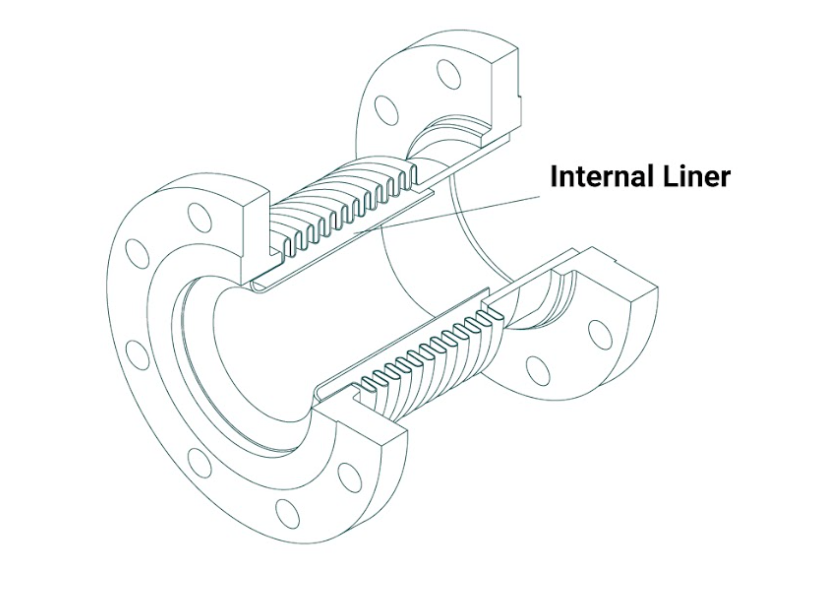
  • Internal Liners: These reduce turbulence and protect the bellows from abrasive wear in high-velocity systems.
  • External Covers: Also known as shrouds, these protect the delicate bellows from weld spatter, mechanical impact, and environmental debris.

Sometimes a standard expansion joint isn’t enough for extreme environments. Adding the right performance accessories, like active leak detection and thermal insulation, can turn a potential unscheduled shutdown into a safely managed maintenance window, protecting your most valuable assets.

More Resources

  • Blog Article: Refinery Reliability: The Critical Role of Expansion Joints in FCCU
    • Discover how multi-ply and single testable bellows with active “sniffers” (pressure gauges) provide critical leak detection by monitoring the space between plies. You can also learn how internal refractory linings create “Cold Wall” designs that protect outer shells from abrasive catalysts and extreme temperatures exceeding 1200°F
  • Case Study: Hinged Expansion Joints Custom-Designed for a High-Density Polyethylene Production Process
    • See how US Bellows customized single expansion joints for a demanding chemical plant process. This case study shows performance accessories in action, highlighting how engineers integrated a 304 stainless steel internal liner to protect the internal bellows, along with carbon steel external covers and hardware, enabling safe operation at 145 psig.

Engineering Excellence with US Bellows

When your infrastructure is on the line, off-the-shelf isn’t always enough. US Bellows combines decades of manufacturing experience with cutting-edge engineering to deliver custom solutions.

With our virtual expansion joint inspections, we use digital data collection to offer faster turnarounds and more consistent records, ensuring your system’s health is documented and protected.

Eliminate the Guesswork in Your Pipe Design 

Specifying the wrong expansion joint can lead to costly downtime or catastrophic system failure. Don’t leave your thermal expansion calculations to chance. 

Our engineering team is ready to review your system specs and provide a precision-engineered solution that meets your exact pressure and temperature requirements. Request a consultation with a US Bellows engineer.

Single Expansion Joint FAQ

What happens if I install an expansion joint without tie rods?

If the system pressure is high and the anchors are insufficiently reinforced, the thrust from the pressure can cause the expansion joint to extend fully, potentially damaging the bellows or pulling the piping off its supports.

When should I use a stainless steel bellows versus a nickel alloy?

Stainless steel (like 304 or 316) is excellent for general corrosion resistance. However, in high-chloride environments, corrosive environments, or at extreme temperatures (above 1200°F), nickel alloys such as Inconel® or Hastelloy® may be required to prevent stress corrosion cracking. 

These are only a couple of considerations, and each application is different and unique. Reach out to US Bellows to discuss your application, and our team of engineers can help you choose the material that best suits your application. 

Does insulation affect expansion joint performance?

Yes. If you insulate over an expansion joint, the insulation must be designed to be “removable” or flexible. Rigid insulation can pack into the bellows’ convolutions, preventing bellows movement and causing issues with the equipment or pipe supports.

Read More

Flanges and Expansion Joints: An Essential Relationship in Piping Design

March 16, 2026

Flanges from US BellowsMetal flanges are a cornerstone of modern industrial piping systems, but their role extends beyond just connecting pipes. They are an essential, pressure-resistant component of expansion joints, which manage thermal movement and stress in piping systems. Industrial piping designers need to understand and focus on the cooperative relationship between metal flanges and expansion joints.  

The Role of Flanges in Piping Systems

Metal flanges, in layman’s terms, are rings with holes (for bolting) that create secure, leak-proof connections between pipes, valves, and other equipment. They are essential for:

  • Reliability & Durability: Made from high-strength materials such as carbon and stainless steel, flanges withstand extreme pressures and temperatures.
  • Leak Prevention: When paired with gaskets and properly bolted, they form a tight seal, preventing the escape of fluids and gases.
  • Maintenance & Flexibility: Flanged connections allow for easy piping assembly and disassembly, simplifying inspections, repairs, and system modifications.

How Flanges Enable Expansion Joints

Metal flanges add to the functionality of expansion joints because they:

  1. Provide a Secure Connection: Flanges ensure the expansion joint is securely fastened to the adjacent piping. This prevents it from being dislodged by the forces it’s designed to absorb.
  2. Facilitate Installation and Replacement: Using flanges on an expansion joint makes installation and future replacement much simpler and faster than a welded connection. This reduces downtime and labor costs during maintenance.
  3. Ensure System Safety: A well-matched flange connection on an expansion joint ensures that the component can safely handle the system’s pressures and temperatures without leaks.

Real-world example: Single Flanged Expansion Joints for a Leading Manufacturer

Common Challenges and Solutions. Even with their durable design, flange connections on expansion joints can face issues. Misalignment and thermal stress are two common culprits. If pipes aren’t correctly aligned before the flange connection is made, it introduces stress on the joint; also, repeated thermal cycles can loosen bolts over time.

To prevent these issues, it is essential to:

  • Ensure total alignment during installation.
  • Implement a schedule for periodic bolt retightening in systems that undergo thermal cycles.

By understanding the vital relationship between metal flanges and expansion joints, engineers can design more reliable piping systems. These two components work together to ensure that a system can safely handle the stresses of industrial operations.

Flanges, Welds, and Expansion Joints

Flanges from US BellowsWhile flanges are designed to resist stress, piping systems often undergo significant movement due to temperature fluctuations. This is where expansion joints come in. An expansion joint is a flexible component designed to accommodate thermal expansion and contraction, as well as vibration.

A key point is that the bellows of an expansion joint will either have metal flanges or welded pipe ends to connect to the rest of the piping system. With a flanged connection, assembly and disassembly are easy. Unlike a permanent weld, which requires extensive work and downtime for changes or repair, a flanged joint can be unbolted, allowing for simple inspection, maintenance, and replacement. 

When integrated with an expansion joint, flanges can extend beyond static connection points, delivering the versatility they are known for in demanding chemical processing and other mixed-media environments. Here’s a chart that illustrates the difference between a permanent weld (welded attachments) and a flanged connection (flanged attachments).

Weld vs. Flange: A Critical Choice

Consideration

Welded Attachments

Flanged Attachments

Strength Creates a permanent joint that offers durability and strength. The strength of the joint connection depends on the weld quality. Depends on proper bolt tightening and gaskets, may be impacted by vibrations and stress
Upfront Cost & Weight Lower for carbon steels and common stainless steels. The weight will be lower than that of Flange connections. Higher. As the diameter of the pipe increases, the weight and cost of the Flanges increase
Leak Prevention Eliminates Leak Paths Associated with Gaskets Potential for leaks due to gasket degradation or improper installation
Maintenance Limited ease of maintenance, requires pipe cutting and re-welding for repairs or changes Easily disassembled for inspections, replacement, or repair, reduced labor and maintenance costs
Installation Cost and Time Higher initial costs and time due to the need for fitting,  welding, and QC inspections of the welds. Quicker installation and lower up-front costs
Primary Applications Preferred for corrosive media where a permanent seal works best Good for environments where welding is not allowed, and regular maintenance is required

Perfect Your Piping Design and Performance….Partner with US Bellows

Are you seeking the ideal expansion joints to complement your flanged piping? Partner with US Bellows. Our expert team specializes in designing and manufacturing top-quality expansion joints that complement your flanged connections.

 Get a Quote on Custom Expansion Joints

Read More
1 2 3 19