

Usbellows logo.png

EJMA Logo

US Bellows is a Standards Subscriber | Exp: Dec 31, 2026 | See ejma.org to check verification process
Celebrating over 20 years of EJMA membership
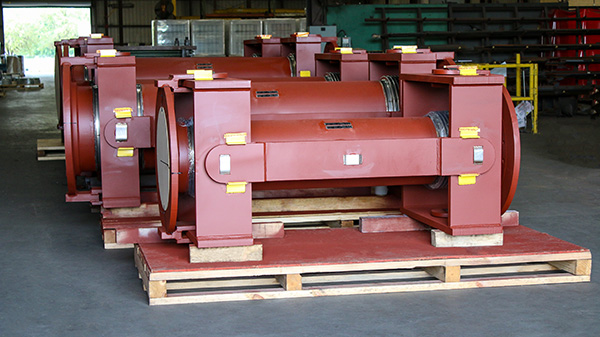
Eliminating Thermal Stress in High-Purity Food & Beverage Processing

November 10, 2025

How Single Expansion Joints Eliminate Thermal Stress in High-Purity Food & Beverage Piping

Single expansion joints are critical, precise components that maintain system integrity and operational flow across diverse food and beverage processing lines, particularly where temperature variance, high pressure, and stringent hygiene requirements intersect.

This focused approach to piping challenges in sanitary food processing is like installing shock absorbers on a high-speed assembly line. While the piping system operates under intense thermal stress and continuous cycles, the expansion joints absorb destructive forces, ensuring that critical components maintain their precision and longevity.

Single expansion joints are essential for managing axial movement —lengthening and shortening of pipes due to temperature changes. Constructed from materials such as stainless steel, which offers superior corrosion resistance and hygiene, these components ensure the reliability of complex production infrastructure.

Engineering for Uncompromised Hygiene

In a high-purity setting, the need to eliminate thermal stress is inseparable from maintaining absolute hygienic integrity. The expansion joint itself must not introduce a point of failure or contamination.

  • CIP/SIP Endurance: The most significant source of thermal shock in high-purity environments comes from Clean-in-Place (CIP) and Steam-in-Place (SIP) systems. These rigorous sanitation processes involve frequent, rapid, and extreme temperature swings. Single expansion joints are specifically engineered to withstand thermal shock without permanent deformation, metal fatigue, or structural failure.
  • Surface Finish and Design: To meet stringent FDA and 3-A Sanitary Standards, the metal bellows and components of the expansion joint are manufactured with a smooth internal surface finish. This design is crucial for minimizing the potential for bacterial growth, product accumulation (hold-up), or micro-crevices where contaminants could harbor. By accommodating movement, the joints also prevent the pipe misalignment that could otherwise create difficult-to-clean dead legs or pockets.
  • Leak Prevention: By effectively managing stress, the joints prevent the forces that would otherwise cause fatigue or rupture in the pipe walls, flanges, or welds. This elimination of leaks is paramount, as a leak in a food-grade line is an immediate path for product loss and microbial contamination.

In essence, these expansion joints serve a dual, mission-critical purpose: safeguarding the physical structure from heat damage and protecting the product purity from contamination caused by system failure.

Uptime vs. Thermal Expansion: Solving the Food &Beverage Piping Dilemma

Here is how these joints align specifically with piping operations in key food and beverage industries:

  • Dairy Production: Piping systems must handle a vast temperature range, from high-temperature short-time (HTST) pasteurization processes to subsequent refrigeration cycles. Single expansion joints accommodate these varying milk temperatures, preventing immense stress on pipelines, pumps, and other critical equipment caused by thermal expansion and contraction.

Improve hygiene and compliance with engineered solutions from PT&P.

  • Breweries and Wineries: These facilities involve significant thermal cycles. Expansion joints are vital in managing the stresses associated with brewing kettles (high heat), fermenters (controlled temperature), and chilling lines (low temperature). By absorbing movement, they protect equipment and maintain the integrity necessary for precise fermentation processes.

Save valuable floor space in brewery production and keep processing flowing efficiently with expansion joints from US Bellows.

  • Confectionery: In systems that transfer high-viscosity products such as heated syrups and chocolate, temperature must be meticulously controlled to maintain fluidity. Single expansion joints ensure that the piping structure remains secure, accommodating the stresses generated by heat transfer lines without risking leaks or ruptures that would result in product loss.

Meet stringent hygiene standards of confectionary production with US Bellows expansion joints.

  • Meat Processing: Operations heavily rely on steam lines for cooking and sanitation. These steam lines experience extreme temperature spikes and are essential for maintaining food safety. The expansion joints use tie rods and robust bellows to reliably absorb the significant axial movement inherent in high-heat steam delivery, protecting the surrounding infrastructure.

Improve high-purity meat processing with expansion joints from US Bellows.

  • Beverage Bottling: As products move through filling and packaging lines, piping must accommodate frequent temperature changes, particularly during rapid filling operations. Expansion joints maintain alignment and accommodate thermal stresses, preventing premature equipment failure in high-speed, continuous-flow production environments.

Increase uptime and reliability in beverage processing with expansion joints from US Bellows.

  • CIP (Clean-in-Place) / SIP (Steam-in-Place) Systems: These rigorous cleaning processes are characterized by frequent, rapid temperature swings. CIP/SIP systems are non-negotiable for hygiene, but the thermal shock they impose can severely damage standard piping. Single expansion joints are engineered to endure these rigorous cleaning cycles, maintaining system integrity and ensuring that the smooth internal surfaces minimize the potential for bacterial growth or product accumulation.

Improve the rigorous CIP and SIP processing for hygiene, with single expansion joints from US Bellows.

Choose US Bellows to Ensure Safety and Performance in High-Purity Production

US Bellows delivers mission-critical piping solutions that safeguard your protection, uptime, and regulatory compliance. As a plant manager, you prioritize two things: uninterrupted output and unwavering hygiene standards. Our custom-engineered single expansion joints, manufactured from the highest-quality stainless steel for superior corrosion resistance, are designed to address thermal expansion.

US Bellows offers a clear return on investment by providing:

  • Maximum Uptime and Equipment Longevity: By reliably accommodating axial movement, our joints protect costly pumps, valves, and surrounding equipment from damaging stresses, significantly extending their lifespan and preventing the catastrophic consequences of pipe ruptures or leaks.
  • Uncompromised Hygiene and Compliance: Unlike traditional, bulky solutions such as pipe loops, our expansion joints are compact and feature smooth internal surfaces, meeting the stringent hygiene standards of the food and beverage sector by minimizing areas where product can accumulate. They are resilient enough to withstand frequent, rigorous CIP/SIP cleaning cycles.
  • Customized Engineering and Rapid Support: We provide engineered solutions tailored to your specific operational needs, customizable to various pipe sizes and movement requirements. This precision integration, coupled with rapid turnaround times, means you save valuable floor space and keep your complex production flowing efficiently.

Choose US Bellows and our parent company, Piping Technology & Products, to transform potential thermal risk into reliable, consistent performance. Talk to one of our engineering experts today.

Read More

The Dual Mandate: Designing Expansion Joints that Satisfy Both EJMA and ASME

November 7, 2025

Metal Expansion joints from US Bellows

The Foundation: Understanding the Role of Bellows Design Standards

Expansion joints are the critical, yet often most stressed, components in any piping system, designed to absorb thermal movement, vibration, and pressure changes. Ensuring their reliable performance requires strict adherence to codified design principles. In the industrial world, two organizations primarily govern the design and application of metallic bellows expansion joints: the Expansion Joint Manufacturers Association (EJMA) and the American Society of Mechanical Engineers (ASME).

While both organizations strive for safety and reliability, they approach design, particularly fatigue-life calculations, with distinct philosophies. EJMA provides the fundamental industry-specific guide, establishing the nomenclature, formulas, and best practices verified by manufacturers’ testing. ASME, on the other hand, is the overarching pressure equipment code that governs piping systems (e.g., ASME B31.3) and pressure vessels (ASME Section VIII).

EJMA vs. ASME: The Critical Difference in Cycle Life and Safety

The most significant and often confusing difference between EJMA and ASME design calculations lies in their respective fatigue curves used to predict the service life (or cycle life) of the bellows element.

Feature EJMA Standards (The Practical Guide) ASME Code (e.g., B31.3 Appendix X)
Design Philosophy Focuses on practical cycle prediction based on extensive manufacturer testing.  Focuses on conservative safety margins required by pressure vessel and piping codes.
Fatigue Curve It is a “best fit” curve representing the expected average cycle life. A more conservative curve that results in an expansion joint design in line with ASME piping codes.
Safety Factor No inherent safety factor is included in the cycle-life calculation itself, so designers are expected to add their own margin. Design margins and safety factors are inherently included in the curve, resulting in a much lower calculated cycle life for the same bellows.
Calculated Cycle Life Significantly higher. Provides the most practical estimate of bellows’ lifespan. Significantly lower. Provides a guaranteed minimum life based on stringent code requirements.

In short, a bellows designed to EJMA standards may have an estimated cycle life of 7,000 cycles. In comparison, the same bellows, calculated using the latest ASME B31.3 Appendix X cycle-life calculation, might yield only 1,150 cycles. This difference is not a flaw in either standard, but a reflection of the margin of safety built into the ASME code to guarantee system integrity.

Compliance and Integration: Where the Standards Align

Despite differences in cycle-life calculation, the two standards are not entirely independent; they often overlap and rely on each other to complete a design. In fact, ASME B31.3 code incorporates the EJMA standard into its design but modifies it to fit within its own framework.

    • Shared Foundation: Both EJMA and ASME derive their fatigue curves from the same initial set of empirical test data collected from bellows manufacturers.
    • Structural Components: EJMA standards require that all external hardware (such as tie rods, hinges, and gimbals) necessary to manage pressure thrust and movement be designed using accepted methods based on elastic theory, which often means meeting the allowable stresses and design principles outlined in ASME B31.3 and BPVC.
    • Material Properties: Material allowable stresses, which are foundational to any pressure design, are typically derived from ASME Boiler and Pressure Vessel Code (BPVC) Section II, Part D.
    • Buckling/Squirm: Factors of safety for structural instability, such as column squirm (typically 2.25), are explicitly mandated by EJMA equations, aligning with requirements in piping codes such as ASME B31.3.
    • Hydrotesting: ASME B31.3: Requires testing the expansion joint at the unit’s design temperature, which may result in a higher test pressure. 

A piping system built in the US or in many global markets will require the expansion joint assembly to be designed to the EJMA standard for the bellows element while ensuring the entire joint’s construction, materials, and structural attachments comply with the applicable ASME code (e.g., B31.3, B31.1, or Section VIII).

US Bellows Delivers Bellows Performance and Safety

When navigating the differences between EJMA’s optimized design and ASME’s stringent compliance, you need a partner with genuine expertise.

At US Bellows and our parent company, Piping Technology & Products (PT&P), we engineer solutions that balance performance and compliance.

As a longstanding member of the Expansion Joint Manufacturers Association (EJMA) and a leading ASME-certified fabricator (Section VIII), our teams can interpret and apply the complexities of both code systems. PT&P is the only company globally to combine deep, proprietary pipe stress engineering expertise with in-house manufacturing of expansion joints and pipe supports. This means our experts design your bellows with the practical, proven cycle-life assurance of EJMA, while guaranteeing full compliance with mandatory ASME safety margins. Request a quote today to learn more.

Read More

Inspection Checklist: 5 Signs a Single Expansion Joint is Approaching End-of-Life

November 4, 2025

Single expansion joints are the unsung heroes of your piping system, quietly absorbing thousands of cycles of thermal movement. Because they’re designed to flex, they endure fatigue over time. While they are built for durability, they aren’t meant to last forever. Proactive visual inspection is your best tool for preventing catastrophic failures that lead to costly unplanned downtime.

For maintenance and inspection teams, knowing what to look for is crucial. Here are five practical visual signs that a single expansion joint is nearing the end of its service life and needs to be replaced.

1. Bellows Thinning or Cracking (Fatigue Failure)

Bellows thinning

This is the most direct sign of bellows failure, resulting from the cumulative stress of cycles.

  • What to Look For: Examine the bellows convolutions (the curved ridges) for fine, hairline cracks, especially in the crests (tops) or roots (bottoms), as well as the weld seam of the metal folds. In high-cycle or vibration applications, you might see pitting or thinning of the metal surface due to constant stress, bending, and work-hardening. Particularly on stainless steel, look for rusty-brown streaks or spots, which can be an early sign of a pinhole leak.
  • Why it Matters: Cracks indicate the material has reached its fatigue limit. Once a crack starts, it will propagate more for each additional cycle under pressure, leading to an immediate, full-system leak or rupture.

2. Squirm or Localized Bulging of the Bellows

Squirm bellows

“Squirm” is a term used to describe a lateral instability or buckling of the bellows convolutions under high internal pressure.

  • What to Look For: Instead of the convolutions being evenly spaced and uniform, look for one or more convolutions that appear swollen, distorted, or significantly wider than the others. In severe cases, the bellows may be forced out of a straight line, resembling a snake or an “S” curve.
  • Why it Matters: This catastrophic deformation occurs when the bellows convolutions can no longer withstand the internal pressure. The bellows’ deformation indicates it can no longer absorb movement correctly, and imminent failure often occurs shortly before a complete rupture.

3. Missing or Damaged Hardware (Tie Rods, Limit Rods, Covers)

Damaged hardware

While a single expansion joint is primarily designed for axial movement, it may incorporate limit rods or external hardware to provide safety or protection in the event of anchor/equipment failure.

  • What to Look For:
    • Limit Rods: Check that the rods and the nuts/washers at the ends are intact. If a nut is missing or the nuts are visibly strained against the stop plates, it may indicate the joint is being forced beyond its designed movement capacity and should be inspected.
    • Hardware: Check that the lugs and hardware are not bent, and look for cracks in the attachment welds.
    • External Covers: If the joint has an external cover (which protects the delicate bellows from external damage, weld splatter, or insulation material), look for dents, missing bolts, or signs that the cover has been broken: this suggests improper installation or external impact.
  • Why it Matters: Damaged or missing hardware is often evidence of a pre-existing problem in which the piping system has exceeded the joint’s movement limit, placing immense, unseen stress on the expansion joint.

4. Misalignment & Non-Axial Deflection

Misalignment bellows

Single expansion joints are designed mainly to absorb axial movement (lengthening and shortening along the pipe axis). They cannot handle significant lateral (sideways) or angular (bending) movement.

  • What to Look For: Visually inspect the joint’s ends. Does the pipe going into the joint line up perfectly with the pipe coming out? If the bellows appear to be bent, sagged, or leaning at an angle, or if the flanges are not parallel, the joint is misaligned and suffering from dangerous non-axial stress. This often occurs during installation errors or when pipe anchors or guides have been compromised or failed.
  • Why it Matters: Forcing a single expansion joint to absorb lateral or angular movement dramatically reduces its fatigue life, sometimes to just a fraction of its intended rating, and makes it highly vulnerable to premature failure.

5. Evidence of Corrosion on the Bellows

Corrosion bellows

Corrosion degrades the bellows material, quickly reducing its ability to handle pressure and movement.

  • What to Look For: Look for heavy surface rust (on carbon-steel components) or signs of stress-corrosion, cracking (delicate, mud-crack-like patterns, often near welds on stainless steel). This can be caused by exposure to moisture or chemicals (such as chlorides from cleaning agents or insulation). Internally, check for scale or media buildup, which can restrict movement and cause erosion.
  • Why it Matters: Corroded metal is thinner and weaker, compromising the bellows’ structural integrity. A bellows that has lost half its wall thickness due to corrosion will fail at a fraction of its original design pressure, regardless of its cycle life.

Your Next Step: Call the Experts at US Bellows

Catching these signs early allows for a scheduled, controlled replacement rather than an emergency shutdown. If your inspection reveals any of the five warning signs above, it’s time to consult with an expert.

US Bellows provides rapid assessment, custom design, and quick manufacturing of single expansion joints to replace worn or failed components. Don’t wait for a rupture: partner with us to keep your systems operating safely and efficiently.

Contact US Bellows today for a professional assessment and replacement quote.


Read More

42″ SINGLE EXPANSION JOINTS FOR AN EXHAUST DUCT APPLICATION AT A TURBINE FACILITY IN Michigan

October 6, 2025

Usbellows single expansion joint 132974


 Type:  Single Expansion Joints
 Size:  42″ ID | 24″Face-To-Face
 Material:  Inconel 600 | 304 Stainless Steel | Carbon Steel
 Design:  350°F Operating Temp. @ 100 PSIG | 0.75″ Lateral
 Testing:  Hydro-tested

These single expansion joints were custom-designed by US Bellows for an exhaust duct application in the turbines of a pressurized water nuclear power plant in Michigan. The bellows were fabricated to meet the plant’s specific operating conditions, accommodating the required axial and lateral movements, and were constructed from high-performance alloys to withstand elevated temperatures and pressures typical of turbine exhaust systems. There is a clear resurgence in upgrading and servicing turbine facilities to meet datacenter demand, as AI-driven power loads outpace grid capacity. Operators are overhauling existing turbines and deploying new high-efficiency units to provide reliable, large-scale, and dispatchable power close to datacenter campuses.

For this project, the units have a 42” ID and are 27” face-to-face. The bellows were fabricated from Inconel 600, the liners from 304 stainless steel, and the cover, limit rods, and hardware from carbon steel with red oxide primer on all exposed carbon steel. It is important to note that our manufacturing and production abilities around mixed metallurgy are unique in that we can isolate and manage different metals in our production, but also have the experience, depending on the client’s needs. 

These units are designed for an operating temperature of 350°F at 100 psig, 0.625” of axial compression, and 0.75” of lateral deflection. The expansion joints were hydro-tested prior to shipment

Over 60-65% of the expansion joints we provided replace existing units.  US Bellows is not necessarily the OEM in all cases; however, we have the experience to manufacture, repair, or audit our designs and others as we are members of EJMA with deep expertise in expansion joint design and manufacturing for over 50 years, with an in-house Field service team. Our expansion joint engineers use the EJMA  (Expansion Joint Manufacturers Association) latest edition to maintain a calculations-based spreadsheet and a stand-alone engineering design software program for the ASME ( American Society of Mechanical Engineers) code section VIII-based calculations to design expansion joints.

Applications for expansion joints include:


Fossil Fuel Power Plant Chemicals and Petrochemical Stationary Engine Exhaust Pulp, Paper, Wood Pellets
Power (Nuclear/Fossil Fuel/Renewables) Heat Exchangers Municipal Water Districts Space Aviation/Aerospace Engine Exhaust
District Energy FCC Units Wastewater Treatment Truck Exhausts
Gas Turbines Navy Biofuels/Solid Waste Incineration Steel Mills/Blast Furnaces/Mining
Steam Distribution Kilns Solar/Environmental Applications Marine Piping and Exhaust
Geothermal Power Plants Furnace Sealing Bags HVAC Building and Heating Systems Liquefied Natural Gas Service (LNG)
Refineries Education/Labs Food Processing Cement Manufacturing

PT&P REF. ORIGINAL POST 11252019

Read More

Standard Pipe Support Components Available on Amazon

June 5, 2024

Need a standard product quickly? Or know what you need and don’t need a quote? Skip the line and order through Amazon. From forged carbon steel turnbuckles and light or heavy 2-bolt, 3-bolt pipe clamps, riser clamps to long tangent u-bolts, we stock standard sizes for your quick-turn orders.

*If you need assistance, we are always available 24×7 via our emergency service or just send an email to info@pipingtech.com.


Ptp fig30 forgedcsturnbuckle
Fig. 30 Forged Carbon Steel Turnbuckle
Ptp fig60 heavy 2 bolt pipe clamp
Fig. 60 Heavy Two-Bolt Pipe Clamp
Ptp fig70 light 3 bolt pipe clamp
Fig. 70 Light Three-Bolt Pipe Clamp
Ptp fig80 heavy 3 bolt pipe clamp
Fig. 80 Heavy Three-Bolt Pipe Clamp
Ptp fig90 riser clamp
Fig. 90 Riser Clamp
Ptp fig100 long tangent u bolt
Fig. 100 Long Tangent U-Bolt
Ptp fig90 riser clamp
Piping Technology & Products, Inc. Expansion Joint (85 PSI)
Ptp fig100 long tangent u bolt
Piping Technology & Products, Inc. Expansion Joint (150 PSI)
Ptp fig90 riser clamp
Piping Technology & Products, Inc. Expansion Joint (300 PSI)
Read More

Rectangular Expansion Joints Custom Designed for an Air Fan Ducting Application in Texas

January 8, 2024

Usbellows rectangular expansion joint 166850


 Type:  Rectangular Expansion Joints
 Size:  37-3/8″ Wide | 65″ Long | 16″ FTF
 Material:  304 Stainless Steel | Carbon Steel
 Design:  250°F Operating Temperature @ 5 psig
 Testing:  100% Dye-Penetrant

US Bellows custom-designed two of these rectangular expansion joints for an air fan ducting application at a chemical facility in Texas. They are 37-3/8″ wide, 65″ long, and 16″ face-to-face. The bellows and liner were fabricated from 304 stainless steel, with the rest of the components from carbon steel. The units are designed for an operating temperature of 250°F at 5 psig. The expansion joints were 100% dye-penetrant tested prior to shipment.

Rectangular expansion joints have many applications in which they are used. They can be used in blast furnaces in steel processing facilities, APH Air preheaters in refineries, and for ducting in large systems in many industries in petrochem, mining, LNG and steel mills. We have built over 400 such units over the last couple of years of varying metallurgy ranging from carbon steel to stainless to inconel. We currently have inconel units in production for a large LNG facility to meet the newly established FERC requirements around spillage, environmental considerations, and, most importantly, safety.

Manufacturing expansion joints involves a precise blend of scientific principles and manufacturing craftsmanship. Rectangular expansion joints present distinctive challenges, particularly in relation to edge welding requirements. Without the necessary expertise, there is a risk of encountering issues such as sugaring—a form of oxidation that arises when an inadequate amount of purging gas is utilized during welding.

It’s worth noting that circumferential welds in typical round expansion joints, which are both welded and formed simultaneously, do not face the same concerns. In contrast, rectangular expansion joints undergo a two-step process where they are first formed and then welded, introducing unique considerations.

We conduct thorough in-house testing for all our expansion joints, encompassing a comprehensive range of assessments:

  • Burst Testing
  • Dye Penetration testing
  • Fatigue/Cycle Testing
  • Hydrostatic testing
  • Helium Leak testing
  • Ultrasonic Testing
  • Radiography Testing
  • PMI Testing
  • Pneumatic Testing
  • Magnetic Particle Testing
  • Leak Detection Testing.

Rectangular expansion joints represent a subset of the assessments conducted for typical round expansion joints. Specifically, for rectangular expansion joints, we perform leak, hydro, and pneumatic testing.

PT&P REF. ORIGINAL POST 07222019

Read More

Fabric Expansion Joint Designed for a High-Temperature Duct Application

August 8, 2023

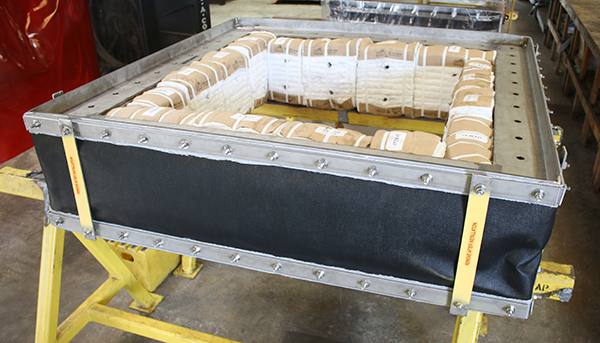
Usbellows fabric expansion joint 170218

Type: Fabric Expansion Joints
Size: 67″ Long x 67″ Wide x 14″ Tall
Material: 3-Layer Fabric Belt with Kaowool Insulation
304 Stainless Steel Angle Flanges
Design Operating Temp: 2012°F at +/- 100″ Water Column
1″ of Lateral Deflection
Testing: 100% Dye Penetrant Testing & Q.C. Inspection

Fabric Expansion Joints in High Temperatures

Fabric pipe expansion joints are often used in ducts that carry hot gasses at low pressures. The major design parameters are the temperatures and flow rates of the gasses and the amount and abrasiveness of solids suspended in the gasses.

This fabric expansion joint utilizes a bulky flexible material, also called an insulation pillow, to shield against high temperatures protecting the belting material. Refractory is also used in the construction of this joint but is designed so that it does not interfere with movement.

Our experienced engineers know that every element of this expansion joint plays a role in its rating for certain temperatures and the number of hours of operation. View Fabric Expansion Joints Product Section.

Fabric Expansion Joints in Green Tech

Fabric expansion joints are key in the systems supporting power and refining plants focused around renewable carbon-neutral product offerings. We have worked with the new entrants in the marketplace, but also helped our long-term clients transition their older fossil fuel-based assets to green technology. These plants include biochar from biomass processing, carbon black, clean hydrogen, styrene, and cement.

Looking for a fabric expansion joint, but not sure what size or material you need? Schedule time with an engineer to get your questions answered.


Did you know that US Bellows is a Piping Technology Company?
We are proud to be a one-stop solution from expansion joints to pipe supports and engineering services. We work hard to simplify your supply chain, and ensure system reliability with quality assurance.

PT&P REF. ORIGINAL POST 03182020

Read More

Pressure Balanced Tee Universal Expansion Joint for a Boiler Feed Pump Turbine Exhaust

July 11, 2023

Pressure Balanced Tee Universal Expansion Joint for a Boiler Feed Pump Turbine Exhaust

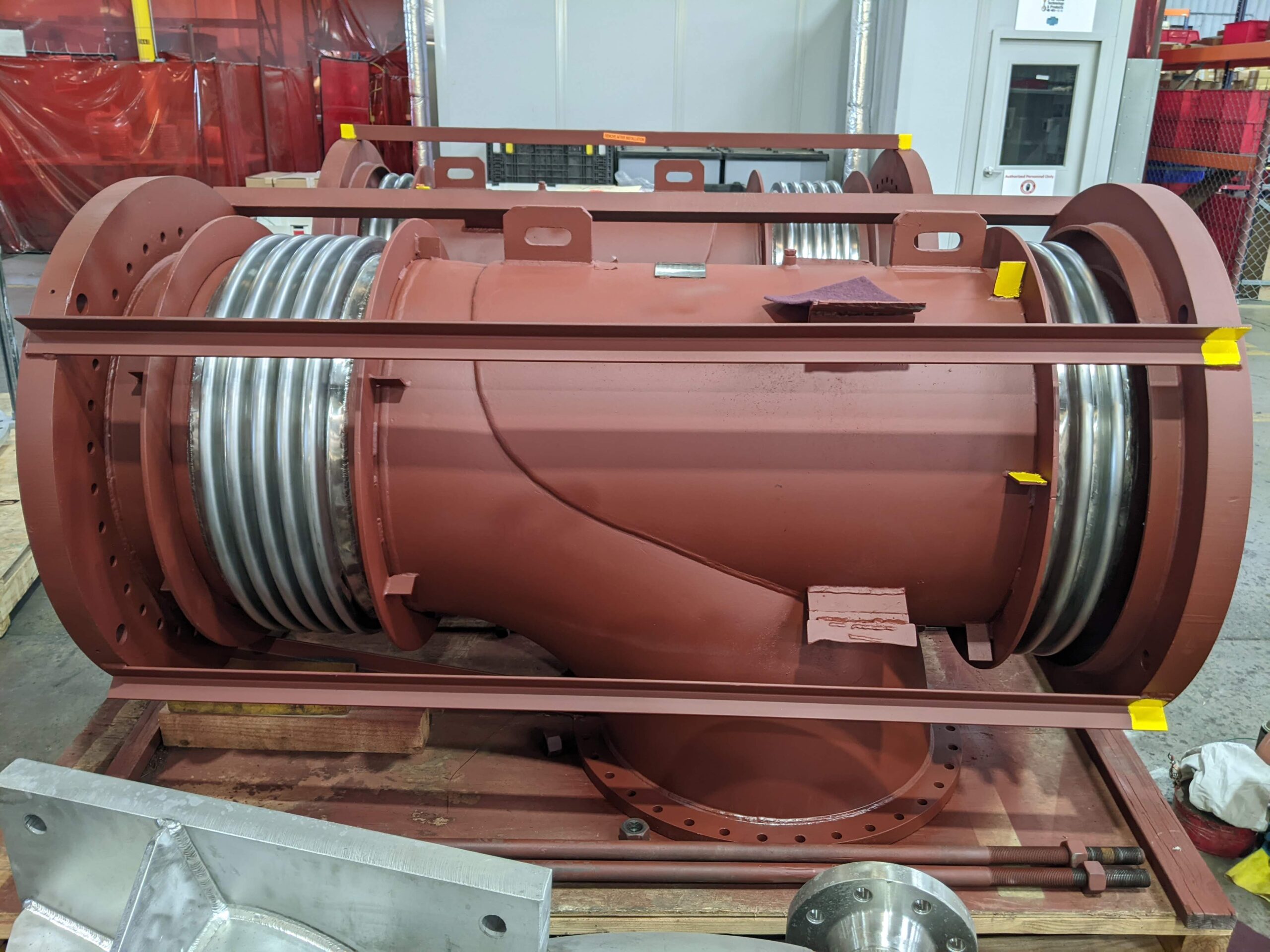
US Bellows custom-designed a pressure-balanced tee universal expansion joint for a boiler feed pump turbine exhaust within a power plant for a major electric utility provider in the Midwest with its founding roots in the 1880s, almost 140 years ago. Today they serve over 1.7M customers in the US, focusing on electricity generation, electric power transmission, and electricity distribution.

The expansion joint is 96″ in diameter and 288″ OAL and is designed for 2″ axial movement and 1/8″ lateral movement at both 15 PSIG and full vacuum (-14.7 PSIG) at 315 °F. The bellows, liner, and turning vanes are 304 stainless steel. The remainder of the assembly is fabricated from carbon steel. The expansion joint was dye penetrant examined, and a chemical cleaning of the interior surfaces was performed to remove any oil and grease. US Bellows also conducted a stress analysis and a pneumatic test at 23 PSIG.

Our US Bellows division is a member of the Expansion Joint Manufacturers Association (EJMA). EJMA is recognized as the world’s leading authority on the proper selection and application of metallic bellows-type expansion joints for safe and reliable piping and vessel installation. As a proud member, we design and manufacture our expansion joints to meet or exceed the guidelines and practices set forth by this association.

PT&P REF. ORIGINAL POST 03/02/2021

Read More

13 Foot Universal Expansion Joint Custom Designed with Incoloy Bellows and Manufactured in the USA for Service in a Chemical Plant

June 6, 2023

Usbellows universal expansion joint 150651v2


 Type:  Universal Expansion Joint
 Size:  157″ Long x 28″ Diameter
 Material:  Incoloy 825 |  321 SS | 304 SS
 Design:  Operating Temp: 842°F a t 190 psig
Movement 8.875″ Lateral Deflection
 Testing:  Dye Penetrant Examined | 100% X-Rayed Bellows
Longitudinal Seams | PMI Examined | Hydro-tested

This 13′ long universal expansion joint was custom designed for a chemical plant that manufactures products such as amines, glycol, polyurethanes (isocyanates and polyol), butanols, polyethylene, and hydrogen peroxide. The bellows were fabricated from Incoloy 825, the welds and liner from 321 stainless steel, and the cover tie rods from 304 stainless steel. The 157″ long unit is 28″ in diameter. It is designed for an operating temperature of 842°F at 190 psig and 8.875″ of lateral deflection. Prior to shipment, the units were 100% dye penetrant tested, and the bellows longitudinal seams were 100% X-rayed, PMI examined, and hydro-tested.

Piping Technology and Products and its subsidiaries are the only global provider of engineered supports and expansion joints in the world. Our manufacturing facilities and processes are set up to support the manufacturing of different materials should the project need it. For this project, the client requested the bellows be made of a combination of Incoloy and stainless steel. We have the experience to work with an extraordinarily broad range of materials, including high-strength steel, a full range of stainless steel, super alloys, thermoplastics, and insulation isolation materials.

PT&P REF. ORIGINAL POST 07142020

Read More

81″ Diameter Pressure Balanced Tee Expansion Joints Custom Designed for a Chemical Plant

February 7, 2023

81” Diameter Pressure Balanced Tee Expansion Joints Custom Designed for a Chemical Plant

Type: Pressure Balanced Tee Expansion Joints
Size: 352″ OAL | 81″ Dia. | 90″ Centerline to Bevel End
Material: 304 Stainless Steel | CS
Design 392°F at 15 PSIG | 6″ Axial Compression
Testing: 100% Dye Penetrant | Air Soap and Bubble test

US Bellows custom-designed pressure-balanced tee expansion joints for a chemical plant in Texas. The units were 352″ overall length, 81″ diameter, and 90″ center line to the bevel-end of the tee. All assemblies were fabricated from 304 stainless steel.

They were designed for an operating temperature of 392°F at 15 PSIG, with 6″ of axial compression and 1.25″ of lateral deflection. The expansion joints were 100% dye-penetrate tested, as well as air soap and bubble tested prior to shipment.

We can also design and manufacture refractory lined expansion joints for these types that are able to expand and contract as conditions move from hot to cold. These units can be installed in refineries, power plants, and various green energy facilities where no other option is practical.

Our team of engineers and manufacturing staff are ready and willing to assist in helping solve any design and/or manufacturing challenges. We can also refurbish existing units to help decrease the time operations are shut down. We assure you that our 24×7 web-based emergency and quick-turn-around service can help when you need it most.

View Expansion Joint Product Section

PT&P REF. ORIGINAL POST 04192019

Read More