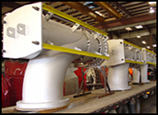


In many applications, a tied expansion joint is used to accommodate lateral movement while restraining pressure thrust within the assembly. However, when greater flexibility is needed due to space limitations, vibration, or equipment movement, a braided flexible metal hose can provide a simpler and more practical alternative.
What Is a Braided Flexible Hose?
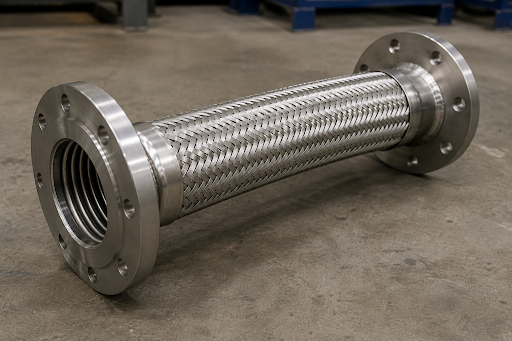
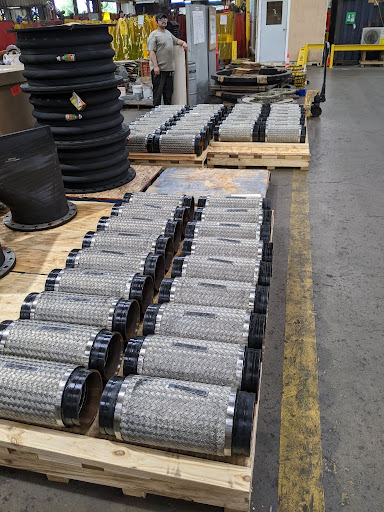
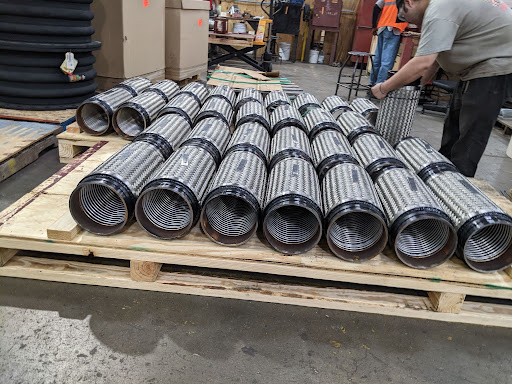
A braided flexible hose generally consists of a corrugated metallic hose core surrounded by one or more layers of metallic wire braid. The corrugated hose provides flexibility, allowing the assembly to bend or move laterally, while the external braid provides reinforcement and contains the pressure thrust generated by internal pressure.
The braid serves as the primary structural element of the assembly. When the corrugated hose is pressurized, the pressure acting over its effective area generates a thrust, the same force a tied expansion joint must manage. The braid restrains that thrust and limits axial extension of the hose, performing a function similar to the tie rods on a tied metallic expansion joint.
Braided Hose vs. Tied Expansion Joint
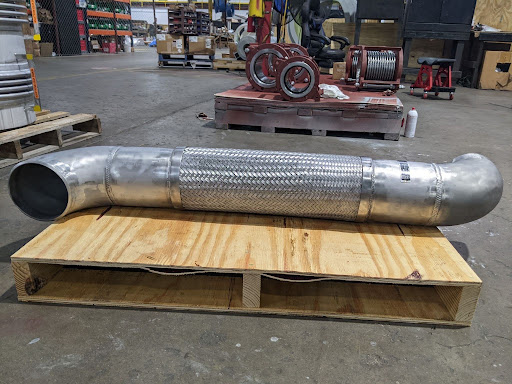
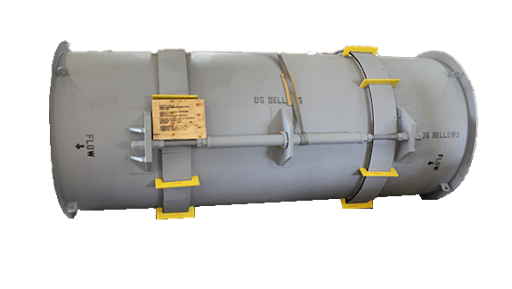
A tied expansion joint and a braided flexible hose can serve similar functions, particularly where lateral movement is required while pressure thrust must be restrained. A tied expansion joint uses tie rods connected to the assembly through tie-rod lugs; the rods restrain pressure thrust while allowing the intended lateral or angular movement. A braided flexible hose achieves the same result differently: the corrugated hose provides flexibility by bending along its length, while the external braid resists pressure thrust and limits axial movement.
When Braided Flexible Hose Can Be Preferred
For the right application, braided hose offers several practical advantages over a tied expansion joint.
- Simpler Construction – A tied expansion joint can include tie rods, lugs, guides, gussets, and other structural hardware. A braided hose generally consists of just the braid and weld collars that are faster to manufacture, install, inspect, and replace.
- Compact Installation – Flexible hose assemblies are well suited to installations where space is genuinely tight. Aerospace piping is a good example: there’s often no room for tie-rod hardware and its required movement envelope, so a properly routed flexible hose delivers the needed movement in a far more compact arrangement.
- Vibration Isolation – One of the most common reasons for selecting a braided flexible hose is to isolate equipment vibration. Rotating and reciprocating equipment like pumps, compressors, and turbines transmits vibration into connected piping. A properly designed flexible hose absorbs that movement and reduces how much mechanical vibration reaches the rest of the system.
- Small Lateral Movements – When only a relatively small amount of lateral movement is required, a flexible hose is often more practical than a tied expansion joint. The hose accommodates movement through bending distributed over its flexible length. Increasing the available length and choosing the right installation configuration let it accommodate movement without overstressing the corrugations. For larger movements, an engineered expansion joint remains the more controlled, compact solution.
- Installation Misalignment – A flexible hose can absorb limited misalignment between equipment and piping, useful when field conditions make perfect alignment difficult. It should not, however, be used to correct severe misalignment or poor installation practice, since permanent misalignment consumes part of the hose’s available flexibility and can shorten service life.
- Easier Replacement – Flexible hose assemblies are typically straightforward to remove and replace, which is valuable where the flexible connection is a maintainable component or where equipment is periodically pulled for service.
When a Tied Expansion Joint Is the Better Choice
Braided flexible hose is not a universal replacement for a tied expansion joint. A tied expansion joint design is generally preferred when the application requires:
- Larger, controlled lateral movement
- A short overall assembly length
- Precisely defined movement capability
- High axial or lateral structural loads
- Large pipe diameters
- Specific spring-rate requirements
- Engineered movement under thermal expansion
- Specialized liners, covers, or flow-control features
Getting the Flexible Length Right
A common mistake in flexible hose design is making the hose too short. Flexible hose accommodates lateral movement through bending, not by stretching axially. If the hose is too short, its bending radius becomes tighter, and the corrugations see higher stress, which can significantly reduce fatigue life. A longer flexible length spreads that movement over a larger section of hose. The same movement-calculation discipline applies to expansion joints; see our buyer’s roadmap for calculating movement requirements for the equivalent process on the tied-joint side.
Installation Considerations
Even a correctly designed flexible hose can fail prematurely if installed incorrectly. The hose should be installed so that movement occurs in the intended plane without introducing excessive torsion. Torsion is especially damaging because corrugated hose is designed to flex through bending, not twisting.
Pressure Thrust and Piping Loads
One of the major advantages of both braided hose and tied expansion joints is their ability to contain pressure thrust. In an untied bellows expansion joint, internal pressure creates thrust that must normally be resisted by anchors or other structural components. A tied expansion joint uses tie rods to contain that thrust within the assembly; a braided hose’s braid does the same job, restraining axial extension of the corrugated core and transferring pressure-induced forces between the end fittings. Thrust restraint doesn’t mean zero load on connected equipment; however, hose stiffness, bending forces, weight, dynamic loads, and installation geometry all still need to be considered and may still call for properly sized pipe supports nearby.
Typical Applications
Braided flexible hose assemblies are commonly used for:
- Pump suction and discharge connections
- Compressor connections
- Vibration isolation
- General equipment connections
- Skid piping
- Small thermal movements
- Limited lateral movement
- Piping misalignment
- Connections where equipment must be periodically removed
- Space-constrained installations – aerospace piping is a prime example, where a conventional expansion joint would be unnecessarily complex
These assemblies show up across data centers, oil & gas, petrochemical, and other process industries; which product gets specified usually comes down to available space and required movement rather than the industry itself.
Design Standards
Flexible metal hose assemblies are designed and manufactured using recognized industry practices for metallic hoses. Organizations such as NAHAD provide guidance on fabrication, testing, installation, and application. The piping system itself may also fall under an applicable piping code, such as ASME B31.1 or ASME B31.3. This differs from metallic bellows expansion joints, which are commonly designed using EJMA methodology alongside applicable piping or pressure design requirements. One practical consequence: braided hose doesn’t have an equivalent standard for estimating service life the way EJMA-designed tie rods do, so inspection and replacement intervals are typically set by application experience rather than a published life calculation.
Selection Guide
The decision between a braided flexible hose and a tied expansion joint should be based on the actual function the piping system needs. At a glance:
| Choose Braided Flexible Hose When | Choose a Tied Expansion Joint When |
| Movement is relatively small | Larger lateral movement is required |
| Vibration isolation is important | Movement must occur within a short, defined length |
| A flexible equipment connection is needed | Movement and spring forces must be accurately controlled |
| Space or installation simplicity is important | The application involves larger piping or significant system loads |
| Pressure thrust needs to be internally restrained | Engineered accessories such as liners or covers are required |
| A simple, replaceable assembly is preferred | A specific spring rate is required |
Frequently Asked Questions
Does a braided flexible hose allow the same movement as a Tied Expansion joint?
This is a common misconception worth clearing up: neither a braided flexible hose nor a tied expansion joint accommodates axial (straight-line stretching) movement; both are restrained against that by design. What they allow is lateral and angular movement: the hose through bending along its flexible length, the tied joint through controlled bellows deflection.
How long does a braided flexible hose last compared to a tied expansion joint?
There’s no industry standard or code for calculating a braided hose’s expected life cycle the way EJMA methodology allows for tied, engineered expansion joints. In practice, tie rods and bellows designed to EJMA guidelines are generally expected to outlast a braided hose in continuous service, so periodic inspection and a planned replacement interval are recommended for hose assemblies.
Which industries use braided flexible hose most?
It shows up across data centers, oil & gas, petrochemical, and general process industries, plus space-constrained fields like aerospace where there simply isn’t room for tie-rod hardware. The deciding factor is usually available space and required movement, not the industry itself.
Talk to a PTP Piping Specialist
Not sure whether your application calls for a braided flexible hose or a tied expansion joint? Schedule time with an engineer for a review, or explore our full range of expansion joint solutions to see tied, universal, hinged, and gimbal designs in detail.
Ready to move forward? Request a quote, and our engineering team will follow up with pricing and lead time for your application.