

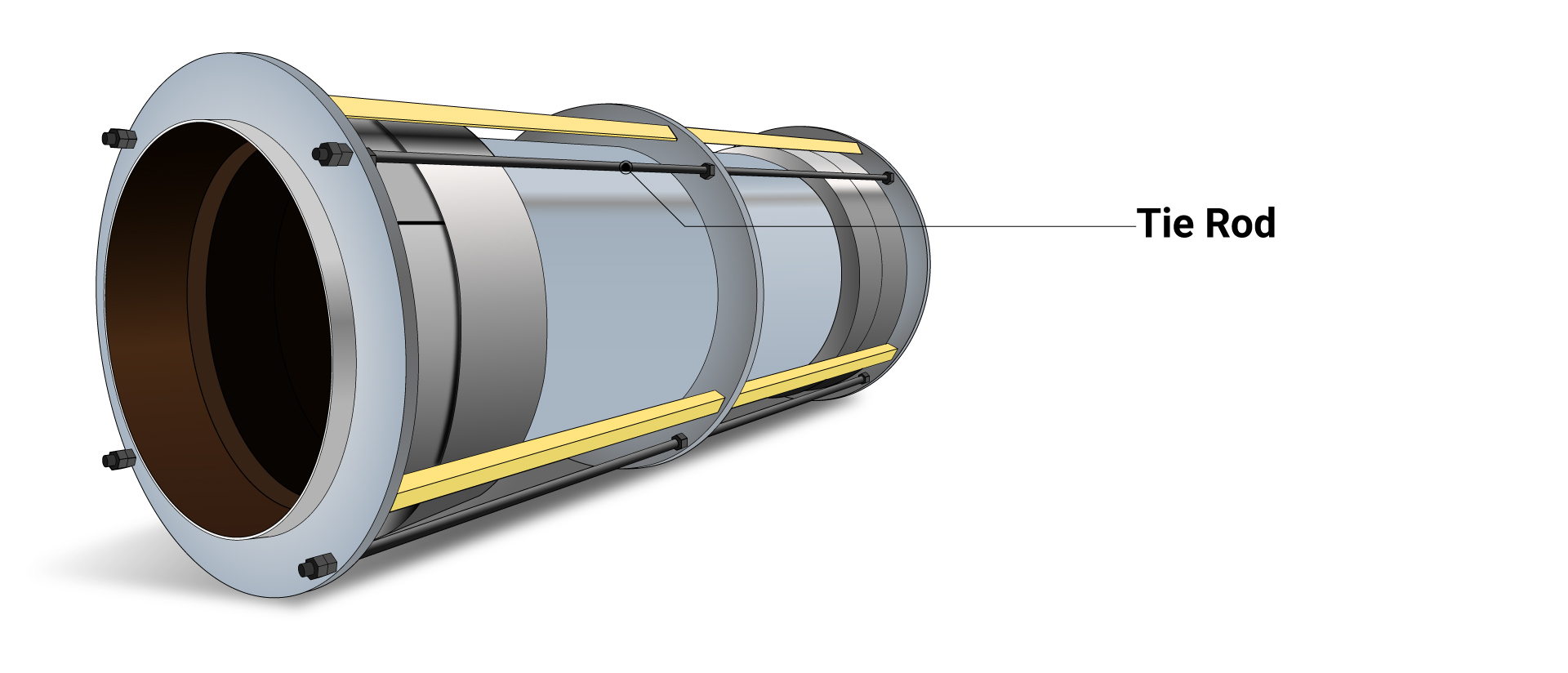
A common question when designing piping systems is “What do tie rods do to protect the infrastructure?” In systems that use pipe expansion joints, the primary purpose of tie rods is to resist the high thrust forces from internal line pressure.
For those wondering what a tie rod does during active operation, it prevents the bellows from moving axially while still allowing lateral deflection. Understanding the tie rod’s purpose is key because it eliminates the need for large, expensive main-pipe anchors. The tie rod’s function is to make sure the expansion joint operates within its design limits and to prevent premature mechanical fatigue and failure of both the expansion joint and mechanical equipment.
What is the Purpose of Tie Rods on an Expansion Joint?
Tie rods are vital components of expansion joints. Their job is to maintain full pressure thrust from the bellows and the pipeline. This prevents the pressure force of the pipeline from pushing and over-stressing the piping system anchors or equipment.
Tie rods help restrain this force. They allow the expansion joint to move side-to-side without requiring large, expensive main anchors.
Pressure Control and Movement
Tie rods are engineered to manage the significant internal pressure forces within a piping system. By connecting the ends of the expansion joint, they create a continuous support.
This absorbs the pressure thrust and, at the same time, prevents the bellows from overextending. This delivers the required flexibility in the system and protects the surrounding equipment and pipe supports from damaging forces.
The only forces that the piping system would need to worry about are the spring rate forces of the expansion joint, i.e, the force required to move the expansion joint laterally.
Note that you must use two tie rods for angular rotation to happen. You should place these rods at a 90-degree angle opposite the direction of rotation.
The Advantage of Using Tie Rods for Your Expansion Joints
Tie rods restrain pressure thrust while allowing for lateral deflection, which is crucial for piping systems that experience lateral movement.
There’s also another important aspect to consider: the economic advantage of using tie-rods on an expansion joint. As explained previously, adding tie-rods to an expansion joint restrains the pressure thrust of the pipe. This allows the piping designer to eliminate bulky anchors that are overdesigned to handle the full pressure load, and may eliminate many guides since the tied expansion joint is self-supporting.
While the upfront cost of a tied universal expansion joint is higher compared to a single expansion joint, you need to consider the cumulative costs of guides that would be needed in the single expansion joints to prevent them from buckling, plus the anchors for the pipe ends. Those additions make single expansion joints the more costly choice.
Not sure about whether your expansion joint needs tie rods or how adding tie rods could affect your piping system? Schedule time with our engineers or download a catalog.