

Usbellows logo.png
EJMA Logo

US Bellows is a Standards Subscriber | Exp: Dec 31, 2026 | See ejma.org to check verification process
Celebrating over 20 years of EJMA membership

The Dual Mandate: Designing Expansion Joints that Satisfy Both EJMA and ASME

November 7, 2025

Metal Expansion joints from US Bellows

The Foundation: Understanding the Role of Bellows Design Standards

Expansion joints are the critical, yet often most stressed, components in any piping system, designed to absorb thermal movement, vibration, and pressure changes. Ensuring their reliable performance requires strict adherence to codified design principles. In the industrial world, two organizations primarily govern the design and application of metallic bellows expansion joints: the Expansion Joint Manufacturers Association (EJMA) and the American Society of Mechanical Engineers (ASME).

While both organizations strive for safety and reliability, they approach design, particularly fatigue-life calculations, with distinct philosophies. EJMA provides the fundamental industry-specific guide, establishing the nomenclature, formulas, and best practices verified by manufacturers’ testing. ASME, on the other hand, is the overarching pressure equipment code that governs piping systems (e.g., ASME B31.3) and pressure vessels (ASME Section VIII).

EJMA vs. ASME: The Critical Difference in Cycle Life and Safety

The most significant and often confusing difference between EJMA and ASME design calculations lies in their respective fatigue curves used to predict the service life (or cycle life) of the bellows element.

Feature EJMA Standards (The Practical Guide) ASME Code (e.g., B31.3 Appendix X)
Design Philosophy Focuses on practical cycle prediction based on extensive manufacturer testing.  Focuses on conservative safety margins required by pressure vessel and piping codes.
Fatigue Curve It is a “best fit” curve representing the expected average cycle life. A more conservative curve that results in an expansion joint design in line with ASME piping codes.
Safety Factor No inherent safety factor is included in the cycle-life calculation itself, so designers are expected to add their own margin. Design margins and safety factors are inherently included in the curve, resulting in a much lower calculated cycle life for the same bellows.
Calculated Cycle Life Significantly higher. Provides the most practical estimate of bellows’ lifespan. Significantly lower. Provides a guaranteed minimum life based on stringent code requirements.

In short, a bellows designed to EJMA standards may have an estimated cycle life of 7,000 cycles. In comparison, the same bellows, calculated using the latest ASME B31.3 Appendix X cycle-life calculation, might yield only 1,150 cycles. This difference is not a flaw in either standard, but a reflection of the margin of safety built into the ASME code to guarantee system integrity.

Compliance and Integration: Where the Standards Align

Despite differences in cycle-life calculation, the two standards are not entirely independent; they often overlap and rely on each other to complete a design. In fact, ASME B31.3 code incorporates the EJMA standard into its design but modifies it to fit within its own framework.

    • Shared Foundation: Both EJMA and ASME derive their fatigue curves from the same initial set of empirical test data collected from bellows manufacturers.
    • Structural Components: EJMA standards require that all external hardware (such as tie rods, hinges, and gimbals) necessary to manage pressure thrust and movement be designed using accepted methods based on elastic theory, which often means meeting the allowable stresses and design principles outlined in ASME B31.3 and BPVC.
    • Material Properties: Material allowable stresses, which are foundational to any pressure design, are typically derived from ASME Boiler and Pressure Vessel Code (BPVC) Section II, Part D.
    • Buckling/Squirm: Factors of safety for structural instability, such as column squirm (typically 2.25), are explicitly mandated by EJMA equations, aligning with requirements in piping codes such as ASME B31.3.
    • Hydrotesting: ASME B31.3: Requires testing the expansion joint at the unit’s design temperature, which may result in a higher test pressure. 

A piping system built in the US or in many global markets will require the expansion joint assembly to be designed to the EJMA standard for the bellows element while ensuring the entire joint’s construction, materials, and structural attachments comply with the applicable ASME code (e.g., B31.3, B31.1, or Section VIII).

US Bellows Delivers Bellows Performance and Safety

When navigating the differences between EJMA’s optimized design and ASME’s stringent compliance, you need a partner with genuine expertise.

At US Bellows and our parent company, Piping Technology & Products (PT&P), we engineer solutions that balance performance and compliance.

As a longstanding member of the Expansion Joint Manufacturers Association (EJMA) and a leading ASME-certified fabricator (Section VIII), our teams can interpret and apply the complexities of both code systems. PT&P is the only company globally to combine deep, proprietary pipe stress engineering expertise with in-house manufacturing of expansion joints and pipe supports. This means our experts design your bellows with the practical, proven cycle-life assurance of EJMA, while guaranteeing full compliance with mandatory ASME safety margins. Request a quote today to learn more.

Read More
U.S. Bellows 101

November 27, 2017

** Turn up your speakers to hear the audio. Please be patient as the screen will become visible shortly after the speaker begins the presentation. You may click the monitor icon below each video to view the webinar in full-screen mode.

NOTE: PDH credits are NOT offered for our recorded webinars.

Read More

Expansion Joint Webinar

** Turn up your speakers to hear the audio. Please be patient as the screen will become visible shortly after the speaker begins the presentation. You may click the monitor icon below each video to view the webinar in full-screen mode.

NOTE: PDH credits are NOT offered for our recorded webinars.

Read More

Engineering, Design and Fabrication of 119″ Expansion Joints, Duct Work and Supports

June 25, 2012

115705b11 (1)


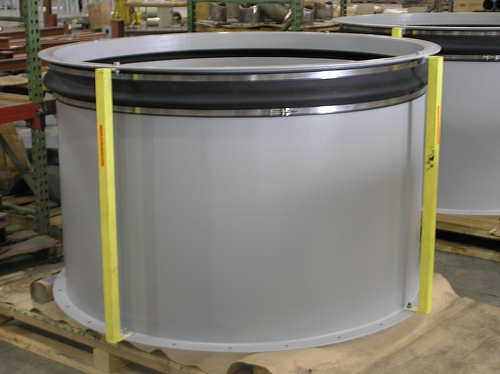
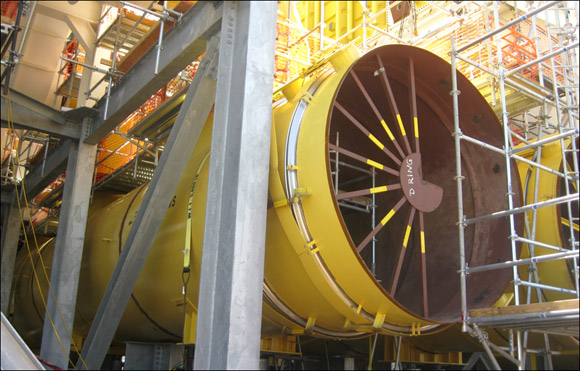
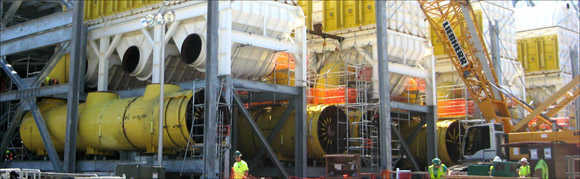
US Bellows provided the total engineering, design, and fabrication package for this project including expansion joints, elbows, duct work, saddle supports, F-type variable spring supports, slide plates, and pipe anchors.

115705a1

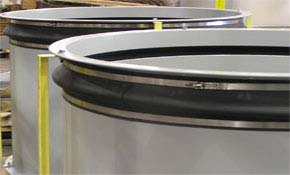
A total of twelve, 119″ dia. double-slotted hinged expansion joints, thirty-six, 72″ dia. elbows, and twelve, 119″ dia., 55″ long header ducts were fabricated for a power plant in Mississippi. The expansion joint assemblies were designed for .5° angular movement, 3/8″ lateral, 1-1/2″ axial compression. The design conditions were 5 psig at 300°F. The duct work was fabricated from A-36 carbon steel material and the bellows were fabricated from 304 stainless steel. A dye penetrant exam, soap and air test, and spot x-ray on all duct seam welds were performed prior to shipping.

Read More

How do you install an expansion joint?

December 1, 2011

The necessary steps for installing all expansion joints shall be pre-planned. The installers shall be made aware of these steps as well as the installation instructions furnished by the manufacturer. The most critical phases of the expansion joint installation are as follows.

  • Care shall be exercised to prevent any damage to the thin bellows section, such as dents, scores, arc strikes and weld spatter.

  • No movement of the expansion joint (compression, extension, offset, rotation and especially torsion) due to piping misalignment, for example, shall be imposed which has not been anticipated and designed into the movement capability of the expansion joint. If such movements are imposed, they can result in system malfunction, damage to the bellows or other components in the system. Specifically, cycle life can be substantially reduced, forces imposed on adjacent equipment may exceed their design limits, internal sleeve clearances may be adversely affected, and the pressure capacity and stability of the bellows may be reduced.

  • Any field pre-positioning shall be performed in accordance with specific instructions which include both the direction and magnitude of the movement.

  • Anchors, guides and pipe supports shall be installed in strict accordance with the piping system drawings. Any field variances from planned installation may affect proper functioning of the expansion joint and must be brought to the attention of a competent design authority for resolution.

  • The expansion joint, if provided with internal sleeves, shall be installed with the proper orientation with respect to flow direction.

  • After the anchors or other fixed points are in place and the piping is properly supported and guided, the expansion joint shipping devices should normally be removed in order to allow the expansion joint to compensate for changes in ambient temperature during the remainder of the construction phase.

Read More

How do you perform a burst test?

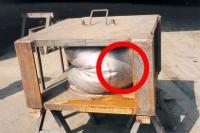
The burst test is primarily conducted on bellows. Normally, hydraulic pressure is slowly increased until failure occurs. Based on the burst test results, a safety factor is applied. This establishes the ultimate pressure rating.

Burst Testing
Burst Testing
Read More

What is burst testing?

The objective of the burst test is to determine the ultimate pressure resistance. This test is primarily conducted on bellows. Normally, hydraulic pressure is slowly increased until failure occurs. Based on the burst test results, a safety factor is applied. This establishes the ultimate pressure rating.

Burst Testing
Burst Testing
Read More

Two Expansion Joints for an Air Intake on a Generator Unit at a Packaged Power facility in Houston.

July 11, 2006
87025a1


87025b expjt (1) These 59″ x 39.5″ fabric expansion joints were fabricated using a 1/8″ thick neoprene sheet. The joints were then bonded to the carbon steel angles and plates, and secured using stainless steel band clamps, with T-bolt latches. The carbon steel angles and plates were primed and finished at U.S. Bellows, Inc.’s paint production facility.

The expansion joints were designed to facilitate any vibration and movement during the generator units’ normal operation.

Read More

Expansion Joint Exhaust Assembly for an Oil Refinery in Texas

March 14, 2003
Expansion Joint Exhaust Assembly for an Oil Refinery in Texas

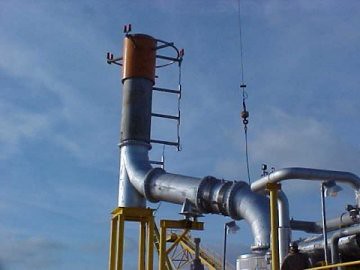
US Bellows designed and fabricated this expansion joint exhaust assembly for an oil refinery in Texas. This expansion joint is offset for an offshore platform and weighs approximately 8,000 lbs. It has a design pressure and temperature of 1 PSIG and 1000 degrees, respectively. The air test was conducted to detect any leaks.

Read More

Expansion Joints for an Engineering and Construction Firm in Singapore

November 8, 1999

36" Expansion Joints for an Engineering and Construction Company in Singapore36" Expansion Joints for an Engineering and Construction Company in Singapore36" Expansion Joints for an Engineering and Construction Company in Singapore36" Expansion Joints for an Engineering and Construction Company in Singapore

In October 1999, US Bellow, the expansion joint subsidiary of Piping Technology & Products, Inc., fabricated three expansion joints for an E&C company in Singapore. The expansion joints manufactured included one 36″ single hinged expansion joint, one 36″ double hinged expansion joint and one 36″ double gimbal expansion joint. These expansion joints will be used at a compressor in Singapore. Due to the critical applications of these expansion joints, they were tested per ASME Sect. VIII Div. 1 Appendix 26. The bellows together with the hinge assembly were hydro-tested. Additionally, a dry nitrogen test between the two plies was conducted to ensure that each of the two plies would withstand the design pressure. Gimbal expansion joints allow for restrained angular movement of attached piping in two planes. Expansion joints, in general, allow for axial, lateral, angular and torsional movement in piping systems.

Read More