

The quality of an expansion joint is determined long before fabrication begins. It is determined by the accuracy and completeness of the information a customer provides at the specification stage. Incomplete data forces assumptions, and these assumptions often lead to joints that fail early, require rework, or arrive dimensionally incompatible with the system for which they were built.
US Bellows works across metal, rubber, and fabric expansion joints for refineries, power plants, chemical facilities, LNG plants, and data centers. The specification process is the same regardless of application, every successful design begins with the same core inputs.
What the System Carries Determines What the Joint Must Be
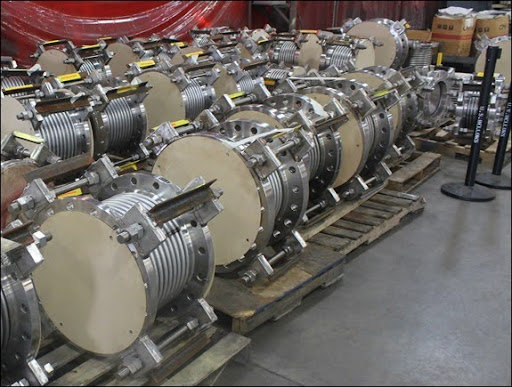
Pressure and temperature are the two parameters that determine the material selection of the expansion joint. The table below outlines the operational limits and typical applications for each joint type.
| Joint Type | Max Temperature | Pressure Range | Typical Applications |
| Fabric | 1,500°F+ | ±3 PSI | Exhaust ducting, HVAC, low-pressure gas |
| Rubber | 300–350°F | Moderate, Up to 300 PSI (smaller diameters) | Water treatment, pump discharge lines |
| Metal | 2,000°F+ (depending on insulation) | Highest rated | Refineries, chemical plants, steam systems |
Equally important is the media, what is flowing through the pipe. Corrosive fluids, acids, and certain gases may be incompatible with rubber, fabric, and standard stainless steel alloys. Specifying the wrong material for the media leads to chemical degradation before the joint reaches its rated service life. For hazardous gas applications, hydrogen fluoride, carbon monoxide, or acid gas, additional design codes and testing requirements apply that cannot be accommodated after the fact. Customers must disclose the media at the point of inquiry.
The Dimensions and Connection Details
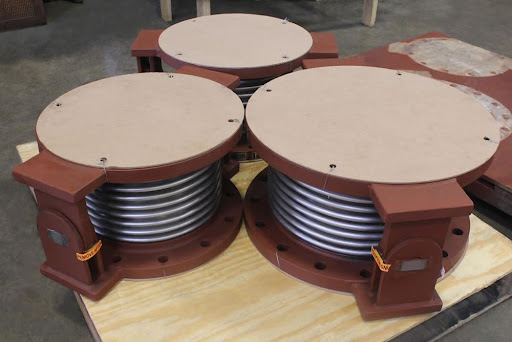
Manufacturers need the pipe diameter, wall thickness, schedule, and end connection type. End connections come in many forms (i.e, threaded connections, couplings) but the two main ones are:
- Welded pipe ends — the joint is welded directly into the pipe run and cannot be removed without cutting
- Flanged ends — bolted connections that allow the joint to be unbolted and removed for maintenance access
Overall length is equally critical. In replacement applications, the face-to-face dimension is fixed by the existing installation and must be measured from the line, not from a drawing. In new installations, the available space between anchors, turbines, elbows, and nozzles defines the physical envelope the joint must fit within.
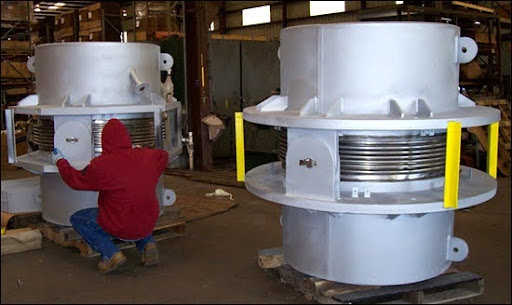
How the Pipe Moves and the Force Required to Drive It
Metal Expansion joints absorb three types of movement, each of which affects joint selection:
- Axial — compression and extension along the pipe axis; handled by a single joint in any material
- Lateral — transverse displacement; fabric and rubber accommodate this within a single unit, metal requires a universal or double configuration.
- Angular — rotation about a fixed point; typically ±10° for metal, up to 30° for fabric and rubber
- Torsional – Metal Expansion joints are not recommended for Torsional Motion. Rubber and fabric can handle this motion.
Customers must also state the expected number of thermal cycles. A joint designed for 1,000 cycles that is cycling daily will reach its fatigue limit within three years. For engineers running pipe stress analysis, the spring rate, the force required to compress the bellows by one inch, is an essential output that feeds directly into the piping model.
Another equally important detail for Pipe stress analysis and expansion joint is, whether the expansion joint will contain the pressure thrust of the line. This can be done via tie-rods, hinges, gimbal or a Pressure balanced EJ. If you are unfamiliar with this, contact us and we can discuss the options for your Piping design.
The Parameter Most Customers Under-Specify and What It Costs
Flow velocity is among the most frequently omitted parameters in expansion joint specifications, and consistently the most damaging when wrong.
US Bellows was engaged by an LNG plant experiencing repeated internal liner failures under bi-directional flow. Robotic inspection and X-ray analysis revealed widespread buckling throughout the metallic bellows installation. FEA and computational fluid dynamics identified the cause: liquid nitrogen running at 65 feet per second, far beyond the liner’s yield threshold. US Bellows recommended capping velocity at 10 feet per second and fabricated replacement bellows to that specification.
Less visible is turbulence caused by nearby equipment. A butterfly valve positioned immediately upstream of a bellows disrupts flow sufficiently to induce vibration even at low velocity. Customers should disclose all valves, fittings, and equipment in proximity to the intended bellows location.
The Code That Governs the Design Also Determines the Testing
The applicable piping design standard should be stated at the inquiry stage:
- ASME B31.1 — power piping; references EJMA as the governing document for bellows design
- ASME B31.3 — process piping for oil, gas, and chemical facilities; includes Category M criteria for critical and hazardous service
- ASME Section 8 Division 1 — pressure vessel applications; uses a distinct set of design equations independent of EJMA
The applicable code determines whether X-ray, ultrasonic, or additional NDE testing is required. Customers who specify the applicable code from the outset avoid discovering mandatory testing requirements after fabrication has begun.
For critical installations where bellows failure would force a plant shutdown, US Bellows recommends two precautions: ordering a spare joint to minimise replacement downtime, and specifying two-ply testable bellows with a test port that detects inner ply failure before a complete breakdown occurs.
What Ships With Every Expansion Joint
Every expansion joint undergoes a leak test before dispatch. Every expansion joint that we fabricate will have at minimum the following records:
- Material Traceability Record (MTR) for pressure retaining parts
- Certificate of Conformance(COC)
- Non-destructive examination (NDE) reports
- Leak or pressure test report
Customers requiring review of quality documentation before shipment should state this at the order stage. All products carry a warranty of one year after installation or 18 months after shipment, whichever occurs first, provided the joint is installed and operated as intended.
Complete specifications at inquiry don’t just start the process right, they keep it right, from first design to final performance
Submit a specification inquiry or schedule a consultation with a US Bellows engineer.