

If you work with piping systems, you have probably heard engineers mention EJMA, B31.1, or B31.3. For anyone new to expansion joints or anyone trying to spec, purchase, or inspect one, these codes and standards are not just industry terminology. They are the rulebook that determines whether a joint passes inspections and performs safely over its intended service life. This article breaks down the major codes and standards that apply to expansion joints, what each one covers, and how they work together.
Metal expansion joints occupy an unusual position in piping systems. They are flexible components within otherwise rigid, code-governed piping, and they are expected to accommodate thermal expansion, vibration, and misalignment under pressure. A joint that is undersized, poorly welded, or rated for the wrong cycle life does not just underperform but can also fail under pressure during operation.
This is why expansion joints are subject to overlapping layers of requirements: an industry-specific design standard, an overarching piping or pressure vessel code, and often material and testing standards layered on top. Knowing which applies, and when more than one applies at the same time, is essential to a compliant, safe design.
EJMA: The Industry’s Foundational Design Standard
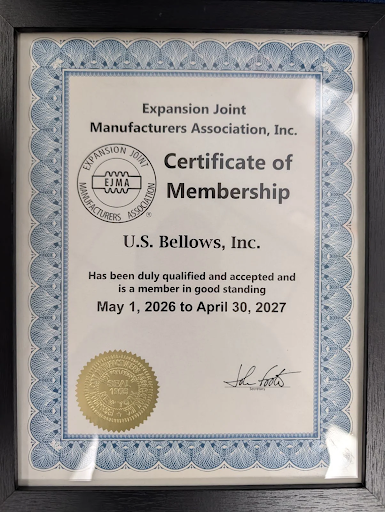
The Expansion Joint Manufacturers Association (EJMA) Standards are the primary technical reference for metal bellows expansion joint design. EJMA is a trade association document, not a government or ASME-issued code. It compiles decades of manufacturer testing data, design equations, and best practices into one reference. US Bellows has been an EJMA member since 2002, one of 14 member companies worldwide.
Among the topics EJMA’s Standards cover:
- Design equations for bellows geometry, pressure capacity, and spring rates
- Fatigue life (cycle life) prediction based on empirical test data
- Guidance on multi-ply bellows, reinforced designs, and various bellows configurations
- Manufacturing tolerances, bellows fabrication, and QC practices
- Best practices for installation, shipping, and maintenance of bellows
The standard has continued to develop. More recent editions refine equations related to multiple plies, pressure calculations, membrane stresses, temperature effects, and harmonization with current ASME codes. EJMA is not a legally enforceable code. It does not dictate manufacturing, material stress allowables, examination, or quality assurance requirements. Those are set by codes such as ASME B31.3 or a customer’s own specification.
In short, EJMA defines how to design the bellows. It does not define the quality-control requirements needed to prove that it was built correctly. That is where ASME comes in.
ASME B31.3: Process Piping Code
For process piping, the kind found throughout refineries, chemical plants, and industrial facilities, ASME B31.3 is the governing code. B31.3 specifies requirements for materials, design, fabrication, assembly, erection, examination, inspection, and testing of piping systems.
Metallic Bellows expansion joints have a dedicated section: Appendix X. The overall approach adopts the EJMA Standards, with Code Committee modifications that turn EJMA’s industry recommendations into enforceable Code requirements for B31.3 piping. EJMA and ASME B31.3 are not competitors, but they are layered. A joint is generally engineered per EJMA’s design methodology, then verified against the Code requirements in B31.3 Appendix X for the overall assembly.
Fatigue life is where this layering becomes practical for engineers. Bellows vendors often quote two different cycle lives for the same bellows: one calculated per EJMA, and one per ASME B31.3 Appendix X. The B31.3 number is typically lower because EJMA’s fatigue curve is a best-fit average based on test data, while ASME’s curve builds in the design margins expected of a pressure equipment code.
B31.3 also drives requirements beyond the design calculations. Appendix X requires radiographic or dye-penetrant examination of the bellows tube for all metallic bellows, a requirement EJMA does not mandate. B31.3 also imposes its own hydrotesting requirements, testing the joint at the unit’s design temperature, which can require a higher test pressure than expected.
ASME B31.1: Power Piping
Where B31.3 governs process, chemical, and refinery piping, ASME B31.1 (Power Piping) governs piping in power generation facilities: steam lines and similar high-temperature, high-pressure service typical of power plants. Metal expansion joints used in these systems are often specified against B31.1. The applicable design margins and testing requirements can differ, so confirm which code governs a given system before assuming B31.3 rules apply.
ASME Section VIII: Pressure Vessels
Metal expansion joints are not limited to piping. They also appear on pressure vessels and heat exchangers, accommodating differential thermal expansion between shells and tubes. This was historically covered by Section VIII, Division 1, Appendix 26, for bellows expansion joints on vessels operating above 15 psig, which took a different design approach than B31.3’s Appendix X.
As part of ASME’s Section VIII Reshape initiative, the design methodology for thin-walled bellows expansion joints in Appendix 26 was recognized as essentially identical to the method in Division 2, paragraph 4.19. Starting with the 2023 edition, the common design calculations were consolidated into Division 2, with Division 1 referring to that method. Division 1 still governs inspection, testing, and material and certification requirements, but now refers to Division 2 for the underlying calculation methods, as part of ASME’s broader effort to unify calculations across both divisions.
For a bellows on a pressure vessel today, the governing calculations are in Division 2, while Division 1 (Part UEB) covers fabrication, inspection, and certification requirements. Confirm which Code edition a project is built to, since older equipment may still be certified under the legacy Appendix 26 rules.
Supporting Material and Testing Standards
Beyond the three main piping and vessel codes, several supporting standards apply to metal expansion joint projects:
- ASME B16.5 and B16.47: flange dimensional standards, since metal expansion joints are almost always flange-connected into a piping system
- ASME B&PV Section V: nondestructive examination methods (radiography, dye-penetrant testing), directly relevant to the bellows tube inspection required under B31.3 Appendix X
- ASME B&PV Section IX: welding qualification requirements for the shop welds that join bellows elements, end connections, and reinforcing members
They are the standards a metal bellows is fabricated and inspected against once the EJMA and ASME design work is complete.
Putting It Together: What This Means for Your Project
For specifying, purchasing, or inspecting a metal expansion joint, a few practical points apply:
- Identify the governing piping code first: B31.3, B31.1, or Section VIII. This determines which Appendix and which testing and examination rules apply.
- Do not assume EJMA compliance equals Code compliance. EJMA governs the bellows design methodology. The applicable ASME code governs materials, fabrication, examination, and testing of the finished assembly.
- Confirm NDE and welding requirements up front. Radiographic or dye-penetrant examination of the bellows tube, along with Section IX-qualified welding, separates a Code-compliant metal joint from one that only looks compliant.
- Check for secondary standards or customer specifications relevant to expansion joint fabrication, quality, and testing.
Navigating overlapping codes is specialized work. If it is unclear which standards apply to an application, or a joint needs to be engineered to satisfy multiple codes at once, that is worth discussing with an expansion joint manufacturer early in the design process.
Note: Always consult the current edition of the applicable code and a qualified engineer for project-specific design decisions.
Talk to a Professional
Unsure which codes and standards apply to your expansion joint project? Schedule time with an engineer for a review of your application, or explore our full range of expansion joint solutions to see tied, universal, hinged, and gimbal designs.
Ready to move forward? Request a quote, and our engineering team will follow up with pricing and lead time for your application.