

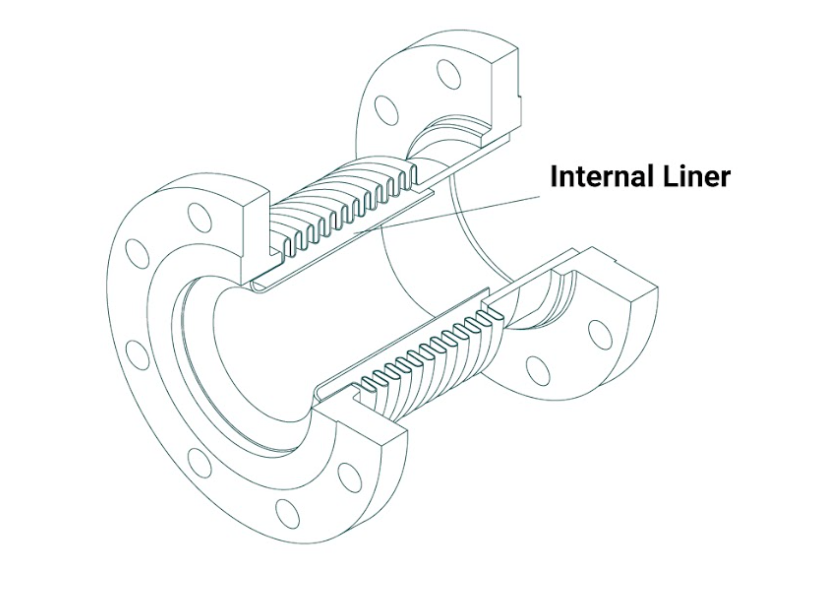
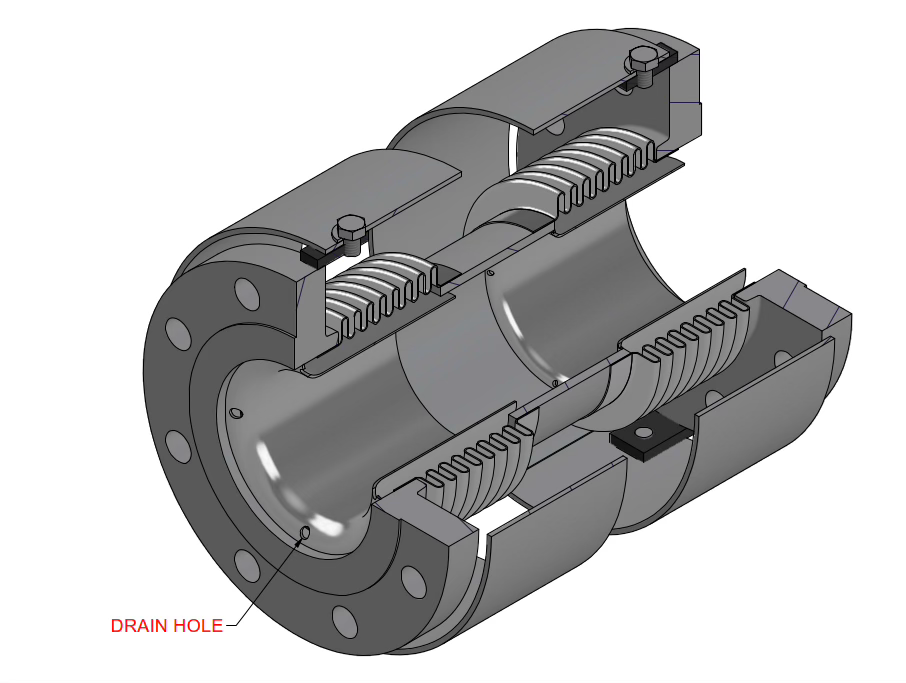
An internal liner gives the flow a smoother path and shields the thin bellows from direct exposure to the process flow. One design question comes with it: what happens to liquid that gets into the space between the liner and the bellows? A drain hole gives that liquid a way out instead of leaving it trapped in the cavity.
This article covers where liners with drain holes apply, why drainage matters, and how drain holes compare with purge connections.
Where the Liquid Gets Trapped
- The internal liner leaves a gap between its outer surface and the bellows.
- Liquid can enter that gap with the process flow.
- In a vertical installation, the liner arrangement can form a pocket where condensate or process liquid collects.
- Once collected, the liquid has no natural way out.
The design specifications address this directly: “If the stagnant flow medium trapped behind the sleeve is undesirable, drain holes in the sleeve, purge connections, or packing shall be specified.”
Typical Applications
- Vertical installations: the liner may create a pocket that retains liquid.
- Steam and condensate systems: condensation can form during normal operation, startup, shutdown, or temperature changes. One example of a liner in steam service is a 118-inch universal expansion joint built with a 304 stainless steel bellows and liner for a power plant.
- Exhaust and flue-gas systems: moisture can condense as the process temperature drops.
- Wet-gas service: liquid droplets or condensate can enter the space behind the liner.
- Washed or flushed systems: water or cleaning fluids can enter the liner and bellows cavity.
- Corrosion, deposit, or freezing-prone services: trapped liquid can harm the bellows.
Why Drainage Matters
- Trapped liquid can stay in contact with the bellows for long periods.
- Depending on the process and environment, that can contribute to localized corrosion, deposit buildup, freezing concerns, or other deterioration.
- Bellows corrosion, internal and external, is another big factor and is listed among the common causes of expansion joint failure.
- The inspection guide says internal corrosion is often exacerbated by stagnant flow or condensate buildup in the convolutions.
- Adequate drainage lowers the likelihood of these conditions.
Drain Holes, Purge Connections, and Packing
The design specification lists all three as ways to deal with trapped medium behind a sleeve.
| Drain Hole | Purge Connection | |
| Addresses | Stagnant medium trapped behind the sleeve | Sediment collecting between the liner and bellows |
| Location | In the sleeve | Threaded connector at the upstream end connection |
| How it works | Gives the trapped medium a path out | Injects clear gas or liquid to blow material out, periodically or continuously |
See the purge connector page for details.
Liner Question for Your Pipeline?
If your joint is vertical, sees steam or wet gas, or gets washed down, send us the orientation, media, and operating conditions. We will advise whether a drain hole, purge connection, or neither fits. Schedule time with an engineer to review your application, or request a quote for a liner-equipped joint.
Upcoming Live Webinar
Sign-up for a Live Technical Webinar…
U.S. Bellows - Expansion Joints In-depth Webinar
Date: Thursday, October 15, 2026 - Register for 10:00 am OR 2:00 pm
*Note: Time Zone is CDT * Central Daylight Savings Time / GMT -5h
Live Webinars are 1 PE/PDH Credit for TX Professional Engineers
Get to know U.S. Bellows from introducing our team and manufacturing capabilities to exploring design details in technical drawings for large-scale projects. View case studies that lead to the creation of new standards and designs. Learn about cost-saving measures for expansion joint failures and how to prevent future problems.
Upcoming Webinars:
October 8th: Pipe Clamp Design, Application & Installation Webinar 10:00 am OR 2:00 pm
October 22nd: Field Service: Problem Resolution Live Webinar 10:00 am OR 2:00 pm
October 29th: Fabric Expansion Joints Webinar by U.S. Bellows, Inc. 10:00 am OR 2:00 pm
View video recordings from past webinars…
Online Course
Expansion Joint Application and Design
Our Expansion Joint course was developed for the following disciplines…
- Piping system designers that may decide to use expansion joints
- Expansion joint designers use the information provided by piping system designers to determine the best design to meet the requirements.
- Designers that use modern software systems to evaluate different options
- Engineers / Managers: field, maintenance, process, operations, construction, surveyors
*This online course is approved for 8 hrs. P.E. Credits
Register Now