

Expansion joints are engineered solutions, not off-the-shelf components. When one fails, replacing it like-for-like without evaluating system conditions, operating history, and installation constraints is the fastest way to repeat the failure.
The following questions provide a practical framework for ensuring the correct selection.
Question 1: Do You Have the Original Design Specifications or Drawings?
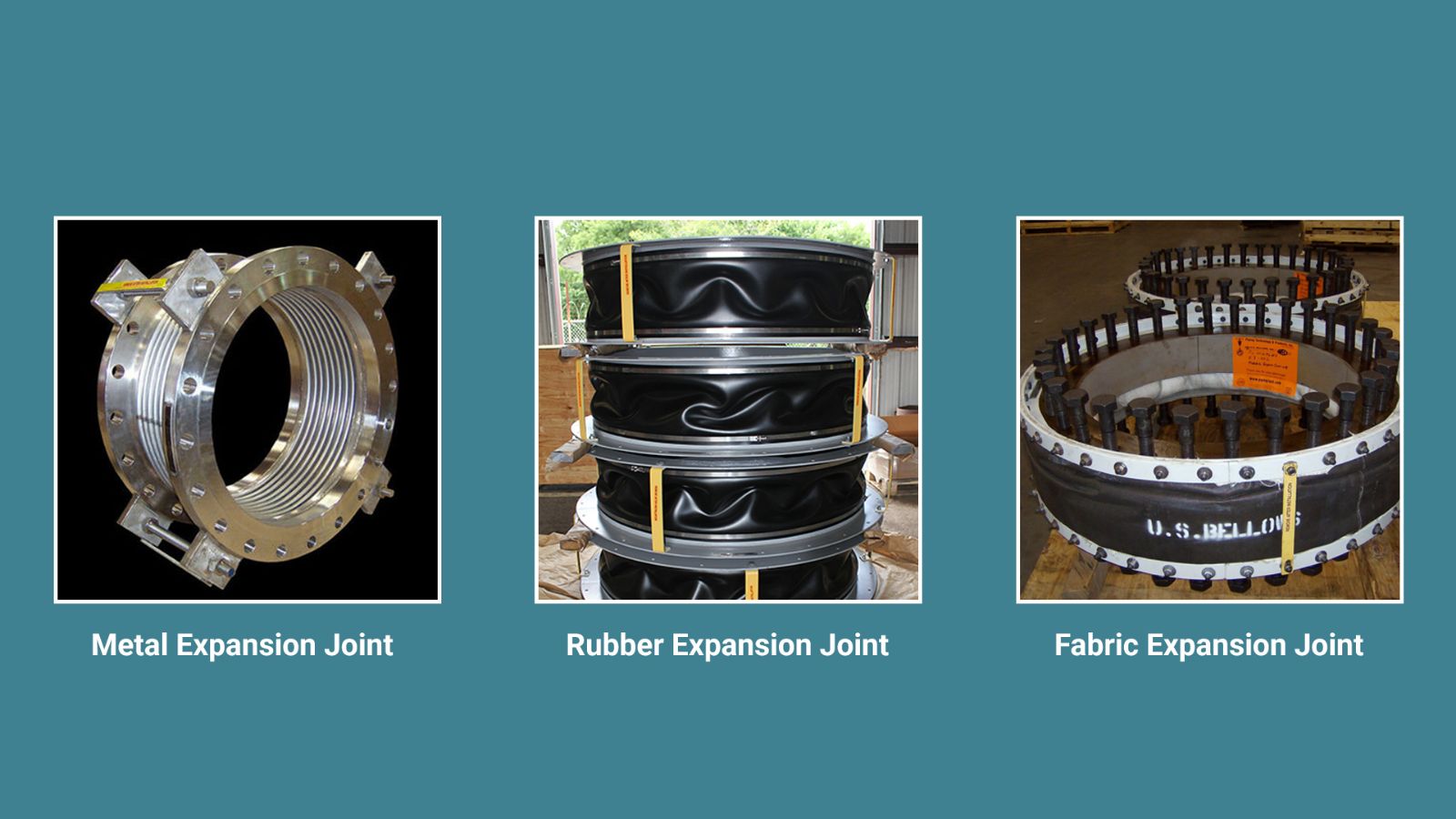
The most reliable way to specify a replacement expansion joint is by referencing original design documentation, including drawings, datasheets, or nameplate data. While pressure and design temperature are the primary controlling factors, a complete specification requires the full STAMPED criteria: Size, Temperature, Application, Movement, Materials, Pressure, Ends, and Delivery. Missing any of these can lead to delays or incorrect selection.
Material selection follows directly from these numbers:
| Joint Type | Temperature Limit | Pressure Range | Typical Applications |
| Fabric | Upto 2000°F | Low (+/-3psi) | Exhaust ducting, HVAC, low-pressure gas |
| Rubber | Upto 350°F | Medium | Water treatment, pump discharge lines |
| Metal – Stainless Steel | Upto 1200°F | High | Refineries, chemical plants, steam lines |
| Metal – Nickel Alloy | Up to 2800°F | Extreme | Steel plants, acid plants, aerospace |
Question 2: How Long Did the Previous Joint Last, and What Was the Failure Mode?
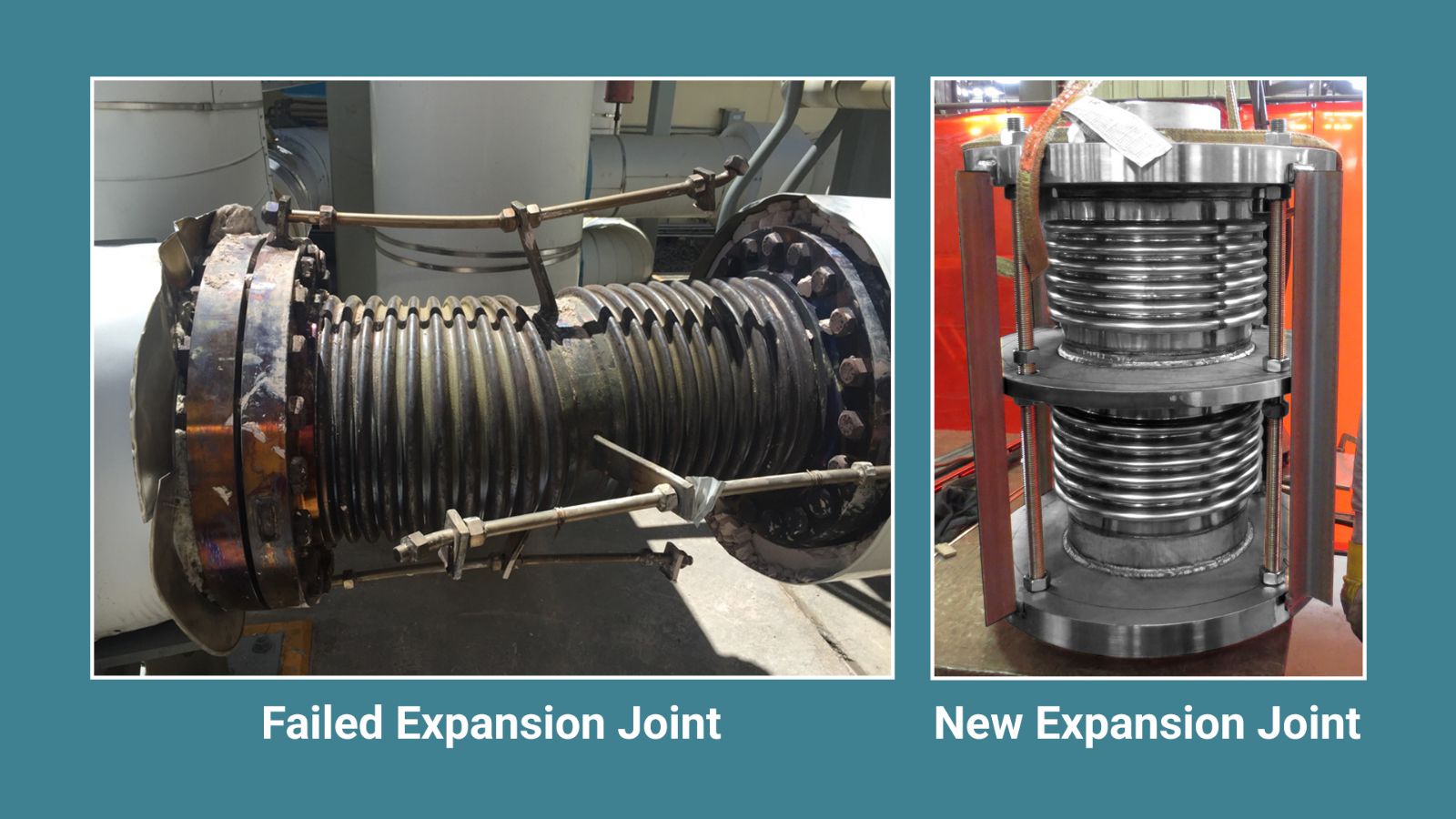
Service life is one of the most diagnostic data points available when specifying a replacement. It tells you if the original product selection was correct, or whether there is a systemic issue that a new joint will not solve.
Joint lasted 15–20 years: The original specification was appropriate. Failure is the result of normal fatigue or corrosion. A like-for-like replacement is the correct approach.
Joint failed in under 12 months: There is an underlying cause that replacement alone will not fix.
Understanding the Failure Mode
- The most frequent cause of premature failure in metal bellows is piping misalignment. Expansion joints are designed to accommodate minor axial, lateral, and angular misalignment, but that tolerance is not a substitute for correct pipe alignment.
- Physical handling damage is the second most common cause. Bellows are manufactured from thin-wall metal (typically 0.015″ to 0.065″ wall thickness). A dent or crease before the joint enters service creates a stress riser that accelerates failure.
Question 3: Were There Any Upset Events During or Near the Joint’s Failure?
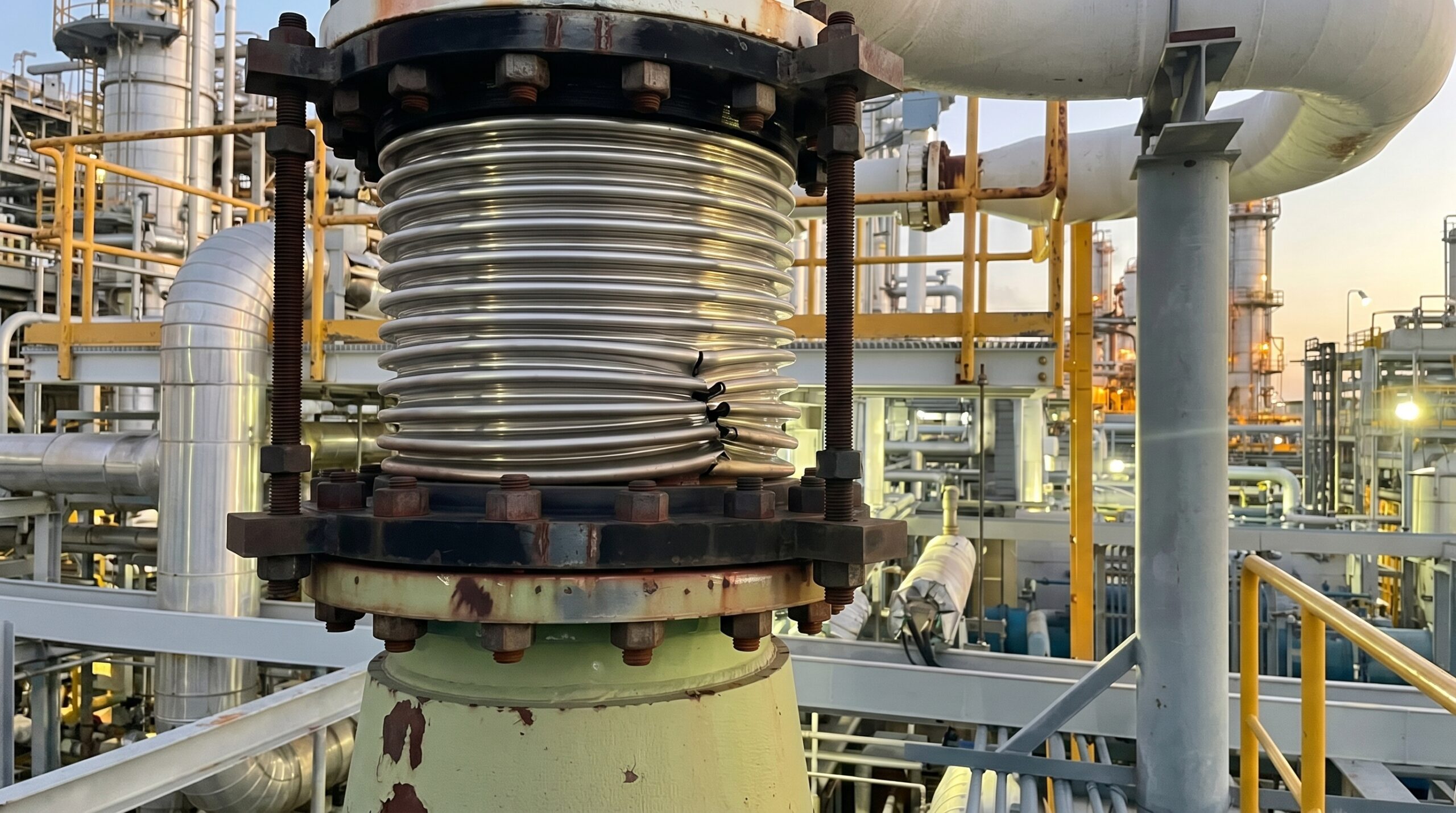
Design conditions represent normal operation, but failures often occur during transient or abnormal events, especially those occurring shortly before or at the time of failure.
Before placing your order, check whether any of the following occurred:
- Overpressurisation – A pressure spike above MAWP can cause the bellows convolutions to balloon permanently outward, a condition known as squirm.
- Water hammer – Rapid valve closure or pump startup creates pressure transients that can shock-load the bellows.
- Flow-induced vibration – High-velocity flow or proximity to rotating equipment, pumps, compressors, turbines, cycles the bellows at frequencies that rapidly consume fatigue life.
Flag any upset events when placing your order. The engineering team may recommend design modifications based on the actual service history.
Question 4: Are the Existing Dimensions Accurate to the Original Design?
Incorrect dimensional assumptions are a common cause of replacement failures. A key mistake is assuming that the installed joint dimensions reflect the original design intent. In many cases, they do not.
Before ordering, verify the following:
- Face-to-face (F-F) dimension between mating flanges
- Pipe outside diameter (OD)
- Flange bolt-circle diameter (BCD) and bolt-hole pattern
- Tie rod length and stop nut positions
Critical Check – Confirm whether the current dimensions match the original drawings, or if they reflect field modifications. Designing to incorrect field dimensions can introduce unintended stresses into the new joint.
Question 5: Is the Original Material Selection Still Appropriate for the Current Service?
Operating conditions change over a system’s life. A joint specified for moderate-temperature steam service may now be running a corrosive fluid at elevated pressure.
Corrosive environments- Standard 304 or 316 stainless steel performs well in neutral applications. In high-chloride, acid, or caustic service, these alloys are susceptible to stress corrosion cracking. Specialty nickel alloys such as Inconel 625 or Hastelloy C-276 are frequently required.
Vibration-sensitive applications- Rubber joints provide effective isolation in pump discharge and water service lines. Metal joints with internal flow liners are preferred for high-velocity gas applications.
Changed pressure or temperature ratings- If the line now operates beyond the original design envelope, a direct replacement is a code compliance issue.
Address the Root Cause & Strengthen Your Piping System with US Bellows
The most expensive maintenance pattern US Bellows engineers encounter is repeated bellows replacement without addressing the root cause of failure in the piping support system.
If original specifications or documentation are unavailable, the existing expansion joint can be sent for detailed examination. This enables accurate measurements and reverse engineering, allowing the engineering team to recommend the most appropriate solution.
In many cases, the root cause lies beyond the joint itself, in system alignment, supports, or operating conditions. US Bellows’ in-house field service team inspects complete piping systems to identify these issues and deliver long-term solutions. Schedule a consultation with a US Bellows engineer or request a quote with your specifications.
Upcoming Live Webinar
Sign-up for a Live Technical Webinar…
Fabric Expansion Joints Webinar by U.S. Bellows, Inc.
Date: Thursday, October 29, 2026 - Register for 10:00 am OR 2:00 pm
*Note: Time Zone is CDT * Central Daylight Savings Time / GMT -5h
Live Webinars are 1 PE/PDH Credit for TX Professional Engineers
Get to know U.S. Bellows from introducing our team and manufacturing capabilities to exploring design details in technical drawings for large-scale projects. View case studies that lead to the creation of new standards and designs. Learn about cost-saving measures for expansion joint failures and how to prevent future problems.
Upcoming Webinars:
October 22nd: Field Service: Problem Resolution Live Webinar 10:00 am OR 2:00 pm
View video recordings from past webinars…
Online Course
Expansion Joint Application and Design
Our Expansion Joint course was developed for the following disciplines…
- Piping system designers that may decide to use expansion joints
- Expansion joint designers use the information provided by piping system designers to determine the best design to meet the requirements.
- Designers that use modern software systems to evaluate different options
- Engineers / Managers: field, maintenance, process, operations, construction, surveyors
*This online course is approved for 8 hrs. P.E. Credits
Register Now