

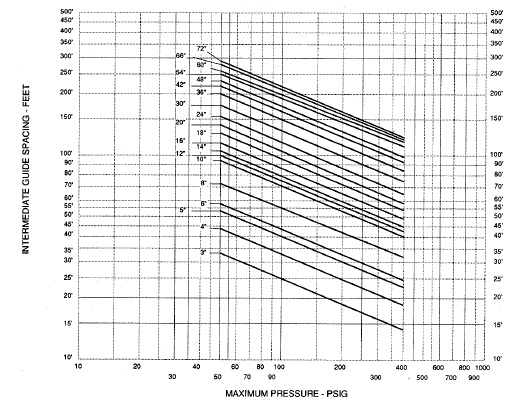
Proper pipe alignment guide placement is critical for ensuring thermal expansion is directed into the expansion joint while preventing pipeline buckling and excessive stress. US Bellows’ provided Pipe Guide Spacing Table provides engineers with a reliable pipe span chart for standard weight carbon steel pipe, along with a calculation method that considers modulus of elasticity, moment of inertia, design pressure, bellows effective area, spring rate, and axial stroke.
The first pipe guide should be located within four pipe diameters of the expansion joint, while the second should be positioned within fourteen pipe diameters of the first guide. This pipe spacing chart helps simplify accurate guide placement and supports safe, efficient operation across a wide range of piping systems and pressure conditions.
Pipe guides are necessary to assure that the thermal expansion of the pipeline is properly directed into the pipe expansion joint and to prevent buckling of the line. Additional guides located adjacent to the pipe expansion joint are necessary because of the inherent flexibility of the bellows and the compressive loading on the pipe caused by the pressure thrust of the pipe expansion joint.
The first guide must be located within a distance of four pipe diameters from the pipe expansion joint and the second guide within fourteen pipe diameters of the first guide. Additional guides should be located in accordance with the pipe guide spacing chart shown below for standard weight carbon steel pipe or calculated from the following formula:
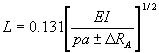
Where L = maximum intermediate guide space, (feet)
E = modulus of elasticity of pipe material, (psi)
I = moment of inertia of pipe, (in4)
P = design pressure, (psig)
a = bellows effective area, (in 2)
 = bellows spring rate, (lb/in)
 = axial stroke of bellows, (in)
Note: When a bellows is compressed in operation, use  when extended, use
FAQs
Q: What is a pipe guide, and why is it important?
A: A pipe guide is a support component that controls the direction of pipe movement caused by thermal expansion and contraction. A properly installed pipe guide helps direct movement into the expansion joint, prevents lateral displacement, and reduces the risk of pipeline buckling or excessive stress.
Q: How do alignment guides improve piping system performance?
A: Alignment guides help maintain the intended movement path of the pipeline as it expands and contracts during operation. A properly designed pipe alignment guide limits unwanted lateral movement, ensures thermal growth is directed into the expansion joint, and helps protect the piping system from instability.
Q: How is guide spacing determined in a piping system?
A: Guide spacing is determined by factors such as pipe size, material properties, design pressure, bellows effective area, spring rate, and axial movement. Engineers often reference a pipe spacing chart along with project-specific calculations to establish proper guide placement.