Usbellows logo.png

EJMA Logo

US Bellows is a Standards Subscriber | Exp: Dec 31, 2026 | See ejma.org to check verification process
Celebrating over 20 years of EJMA membership

Pressure Balanced Expansion Joints

April 25, 2019

Pressure Balanced Expansion Joints

Pressure Balanced Expansion Joint PDF

Expjt pressubal 1Expansion joints are often included in industrial piping systems to accommodate movement due to thermal and mechanical changes in the system. When the process requires large changes in temperature, metal components change size. Expansion joints with metal bellows are designed to accommodate certain movements while minimizing the transfer of forces to sensitive components in the system.

Pressure created by pumps or gravity is used to move fluids through the piping system. Fluids under pressure occupy the volume of their container. The unique concept of PRESSURE BALANCED EXPANSION JOINTS(PBEXJ) is they are designed to maintain a constant volume by having balancing bellows compensate for volume changes in the bellows (line bellows) which is moved by the pipe. An early name for these devices was “pressure-volumetric compensator”.


Pressure Balanced: Configurations 

Two general configurations of constant volume expansion joints are those which are installed where the pipe changes direction and those installed where the pipe does not change direction. (often called “in-line”). Figure 1 shown below is an example of a PBEXJ used where the pipe changes direction. The two bellows are mechanically linked so any change in volume in the line bellows due to change in its length, either compression or extension, is compensated by an opposite change in the balancing bellows. In this PBEXJ the two bellows have the same diameter so the volume does not change during compression or extension of the line bellows. Pressure thrusts are transferred to the members which tie the bellows together rather than in the piping system.


Figure 1

Figure 2

Figure 2 shows PBEXJ used when the direction of the pipe does not change. In this example two smaller bellows have opposite movement to the single larger bellows. When they are compressed, it extends. When they extend, the larger bellows is compressed. The sizes are chosen so the ratio of the mean diameter of the larger bellows to the diameter of the smaller bellows is equal to the square root of 2 and this PBEXJ maintains a constant, volume when the bellows change length. The piping designer sizes the line bellows to accommodate changes in length expected in the piping system at the point where the PBEXJ is installed. The spring rates of both PBEXJs in Fig. 1 and Fig. 2 are defined by the spring rates of the mechanically linked bellows.

Pressure is used to describe the force transmitted by a fluid to the solid boundaries it contacts. It is expressed as a force per unit area and this force is at right angles to the surface at each point. Pascal’s Principle states that pressure (a force) applied to an enclosed fluid is transmitted to every portion of the fluid and to the walls of the containing vessel. Piping designers must consider all forces operating on the system. When the fluid is imcompressible, forces can be transmitted rapidly. With a PBEXJ properly placed, forces which change the length of the bellows will not be transferred to sensitive connections of the piping to the system.

Mechanical changes caused by various factors are a major problem in piping design. During operation of an industrial process the following steps occur:

  • Process changes are made including changes in temperature, pressure, and flow rate. Certain mechanical changes such as opening or closing a valve may be part of the control system used to make process changes. This often changes the INTERNAL WORKING PRESSURE inside the piping system.
  • Other mechanical changes, such as thermal expansion of the pipe, result from the process changes.

Pressure Balanced: Applications

Engineers often specify a pressure balanced expansion joint in the piping connecting the boiler feed-pump turbine exhaust to the condenser in conventional fossil-fueled electric power generating plants. [1] Variations in operating conditions cause frequent changes in temperature, pressure and steam quality. Condensers are designed to withstand steam generator overloads without causing significant loss of electric power, but the piping system must accept the forces associated with these variations.

The major advantage of a pressure balanced joint is its ability to absorb externally imposed axial movement without imposing additional pressure loading is objectionable. [2] The force resulting from the bellows spring rates is not eliminated, but it is relatively small when compared to the pressure thrusts.

Examples included in the EJMA standards [2] point out the relation of the guides to the function of the anchors and guides to the function of the pressure balanced expansion. Figure 3 below illustrates an example using a pressure balanced universal expansion installed at a change of direction between two anchors. The pipes are guided so expansion of both pipes is toward the joint. In this example, the bellows, which are components of the universal joint, accommodate movement in both the horizontal and vertical directions.

Expjt pressubal 4


Read More

Bellows for Shell and Tube Heat Exchangers

A graphic of a heat exchanger shell bellows that US Bellows designs and manufactures

Accommodating Thermal Expansion in Heat Exchangers

In critical industrial applications, heat exchanger shell bellows are designed to manage the significant change in length called axial deflection, caused by different thermal expansion that takes place between the shell and tubes. 

In a shell and tube heat exchanger, the tubes inside heat up faster and operate at higher temperatures than the outer shell. Our heat exchanger shell bellows are flexible components built into heat exchangers to accommodate the thermal expansion and contraction that occur due to the specific design of these heat exchangers.

This differential movement, if not properly accommodated, can lead to severe stresses, potential leaks, and ultimately, system failure. 

Choosing the Right Heat Exchanger Shell Bellows: Heavy Wall Bellows vs. Thin Wall Bellows

Selecting the optimal bellows for a shell-and-tube heat exchanger is crucial for ensuring long-term performance and safety. 

US Bellows offers two primary types, each with distinct advantages:

  • Heavy Wall Bellows: These robust bellows feature a wall thickness comparable to the heat exchanger shell itself, making them incredibly durable and often eliminating the need for an external cover.

    Formed by welding flanged and flued plates, they are built to withstand demanding conditions, though a drain might be necessary for trapped fluids.
  • Thin Wall Heat Exchanger Bellows: Characterized by many small corrugations in the bellows and often reinforced with rings for higher pressure capabilities, these bellows offer superior flexibility and a more compact design. Their construction avoids welds around the circumference of the bellows, which contributes to a longer lifespan. An external cover is typically required for mechanical protection.

Both thick- and thin-wall expansion joints can provide reliable performance in shell and tube heat exchangers. However, it is important to note that the hydrostatic pressure and load (PA load) are carried by the tubes, which function like tie rods.

Both thick and thin expansion joints manufactured by US Bellows are designed per the ASME Section VIII code. Heavy-wall bellows are designed per ASME Section VIII, Div. 1 Appendix CC, and thin-wall bellows per Appendix 26 and need an ASME U-stamp to undergo stringent ASME Code inspections. 

It is only after passing the pressure testing and a thorough review of the quality documents and design calculations that the expansion joints receive the ASME stamp, as well as the U-2 manufacturer’s partial data report, duly signed by the ASME Authorized Inspector, affirming their compliance with the highest industry standards.

Precision Engineering & Quality for Heat Exchanger Components

Our commitment to excellence in heat exchanger bellows components is rooted in advanced engineering and rigorous quality control. US Bellows’ engineering processes adhere to the latest revisions of EJMA standards, ASME B31.3, ASME B31.1, and ASME Section 8, Division 1 & 2, utilizing proprietary in-house software and finite element analysis (FEA) for precise design. 

Our comprehensive quality assurance program includes extensive in-process and final inspections, with capabilities for Helium, Hydro, X-Ray, and Dye Penetrant testing to guarantee the integrity and performance of every bellows used in shell and tube heat exchangers. Trust our experienced team to deliver superior solutions tailored to your specific requirements.

Schedule time with an engineer for a free consultation. 


Ready for Reliable Thermal Management? Get a quote for your next heat exchanger project. Request a Quote Today!

Did you know that US Bellows is a Piping Technology Company?

We are proud to be a one-stop solution from expansion joints to pipe supports and engineering services. We work hard to simplify your supply chain, and ensure system reliability with quality assurance.


Read More

Air-Cooled Condenser Expansion Joints

Air-Cooled Condenser PDF

Fig0 plant


Modern power plants frequently use air-cooled condensers to return spent steam back into the cycle after it has been used to spin turbine to generate electricity. This is a critical part of the Rankin cycle, which improves power generation efficiency.

Of greatest concern for the piping designer is the thermal expansion that occurs in the major duct system that feeds the condenser from the turbine.

The first expansion joint is required at the turbine case at the exhaust to the condenser duct. This is frequently a rubber dogbone design. It serves to reduce loads transmitted via differential thermal growth from the expanding ducting and turbine casing. Generally, the restrictions on the turbine case which often must comply with NEMA 23A limits preclude the use of metallic bellows expansion joints.

Rubber dogbone expansion joints are quite simple, but can be very large and require some care in design and fabrication.

Special clamps are machined to properly mount the rubber belt. In turn these clamps are welded to the frame and provide the sealing point for the dogbone.

VIDEO: Fabrication Process Start to Finish

Fig.1: Typical Air-Cooled Condenser

Fig. 2: Aerial View of
Fig.1: Typical Air-Cooled Condenser Fig. 2: Aerial View of
Dogbone Expansion Joint Frame
Fig. 3: Clamp Details


Special clamps are machined to properly mount the rubber belt. In turn these clamps are welded to the frame and provide the sealing point for the dogbone.


Critical analyses are performed on the associated structures to ensure that there is no risk of collapse due to full vacuum conditions, which frequently occur.

Fig. 4: Turbine Exhaust Structure Fig. 5: Turbine Exhaust Structure Loading Analysis
Fig. 4: Turbine Exhaust Structure Fig. 5: Turbine Exhaust Structure
Loading Analysis

Tied Universal Expansion Joints 

The next expansion joint is required at spent steam risers to the condenser frame. This is frequently a tied universal metal bellows design. It serves to reduce loads transmitted via differential thermal growth from the expanding ducting. Tied universal expansion joints are relatively simple, but can be very large and also require some care in design and fabrication.

Fig. 6: Exhaust Riser Tied Universal Expansion Joints

Fig. 6: Exhaust Riser Tied Universal Expansion Joints

Several types of structural analyses are performed to ensure conformance with design parameters and special construction loading that may occur during erection.

VIDEO: Loading of Universal
Expansion Joint onto the
Truck for Shipment
Fig. 7: Bellows Design Calculations Fig. 8: Tie Rod Calculations


Internal pressure calculations are performed for the bellows elements, shell, and the hardware attached to the expansion joint.

Fig. 9: Shell / Hardware Interaction Under Load Fig10 shell hardward buckling
Fig. 9: Shell / Hardware Interaction
Under Load
Fig. 10: Shell / Hardware Buckling
During Vacuum Loading

Special erection considerations must be studied to ensure that the structure as defined by the customer is suitable to withstand lifting loading during installation.

Fig11 sturctural loading Fig12 sturctural loading
Fig. 11: Structural Loading
During Installation
Fig. 12: Actual Structural Loading
During Installation

As power plants have grown in generating capacity, so too have the sizes of the ducting that must service them. The units pictured below will be welded together in the field to form a tied universal expansion joint assembly.

Fig13 tied universal ej
Fig. 13: 178″ Dia. Tied Universal Expansion Joints On-Site
Fig14 tied universal ej
Fig. 14: On-Site Assembly

The final expansion joint is required at spent steam lines, which run perpendicular to the risers. This is frequently a single-hinge or single-gimbal metal bellows design. It serves to reduce loads created when the tied universal joint causes foreshortening in the duct system. Hinge expansion joints are moderately complex, but when dealing with a very large size require some care in design and fabrication.

Fig15 solar power plant
Fig. 15: Single Hinged and Tied Universal Expansion Joints
Installed at a Solar Power Plant

The bellows element is analyzed the same way as the tied universal except that the motion is angular instead of lateral. Hardware/shell interaction under loading will be a duplication of those for the tied universal except for the hinge arms and the pins, which are subject to classical design analysis.

Fig16 single hinge ej
Fig. 16: Single Hinged Expansion Joints
Fig17 hinge hardware calc
Fig. 17: Classic Hinge Hardware Calculation


Fig18 single hinge structure
Fig. 18: Single Hinge Structure Detail
Fig19 single hinge ej
Fig. 19: Single Hinged Expansion Joint Assembly
Fig20 single hinge ej
Fig. 20: Single Hinged Expansion Joints
Fig21 tied universal ej
Fig. 21: Tied Universal Expansion Joint


Read More

Expansion Joint vs Pipe Loop: Which Thermal Solution Is Best?

April 24, 2019

Expansion Joints versus Pipe Loop

When designing piping systems, effectively solving for thermal expansion is crucial. Both pipe loops and expansion joints serve this purpose, but understanding the nuances of expansion joints vs. pipe loops is essential to make the best selection.

Pipe loops, while effective, often demand significant space and can lead to increased pressure drop within the system. This can be challenging in facilities with limited footprints or where maintaining consistent flow rates is essential.

Advantages of Using an Expansion Joint Over a Pipe Loop

  • Limited Space for Pipe Loops: Expansion joints are ideal when there isn’t enough room to accommodate the large footprint required by pipe loops.
  • Need for Minimal Pressure Drop: In systems where maintaining flow efficiency is crucial, expansion joints prevent the turbulence and friction losses associated with multiple pipe elbows.
  • Handling High-Velocity or Abrasive Fluids: Expansion joints are better suited for media with high velocity or abrasive properties, reducing wear compared to traditional loops.
  • Inadequate Structural Support: When there’s no existing support to carry the weight and shape of a pipe loop, expansion joints provide a lighter, more practical alternative.
  • Low-Pressure or Large-Diameter Systems: In low-pressure pipelines or systems with large diameters, pipe loops can become unwieldy or impractical; expansion joints offer a more straightforward solution.
  • Short Construction Timelines: Expansion joints reduce installation time by eliminating the need for extensive welding, fittings, and loop supports.
  • More Cost-Effective Overall: In most cases, expansion joints have lower material, labor, and support structure costs compared to pipe loops.

Piping System Drawing Example with Expansion Joints

Piping sys with expansion joints

Piping System Drawing Example with Pipe Loops

C:documents and settingsrogersdesktopronsylv model (1)

Choosing between an expansion joint and a pipe loop depends on more than just design preference; it requires careful evaluation of system constraints, budget, and performance goals. In many cases, expansion joints offer significant advantages in terms of space efficiency, reduced material requirements, and faster installation.

For compact, cost-effective, and high-performance piping systems, expansion joints from US Bellows provide a proven solution.

Contact our engineering team today to get expert guidance on the best thermal expansion solution for your next project.

Ready to move forward? Request a quote and submit your design specs today to get started with a custom expansion joint solution for your next project.

Did you know that US Bellows is a Piping Technology Company?

We are proud to be a one-stop solution from expansion joints to pipe supports and engineering services. We work hard to simplify your supply chain, and ensure system reliability with quality assurance.

Read More

Fabric Expansion Joint Applications

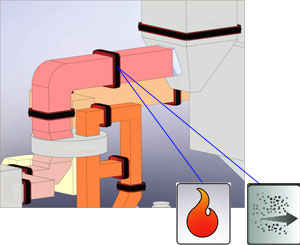
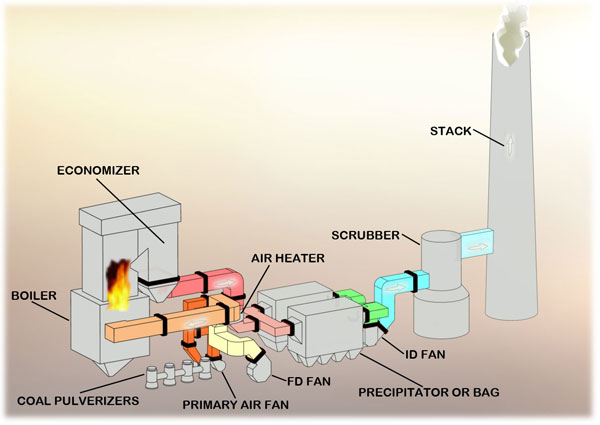
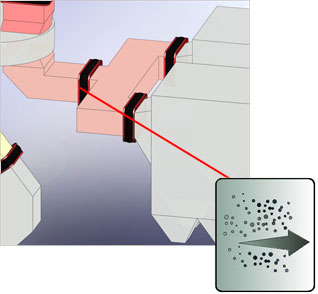
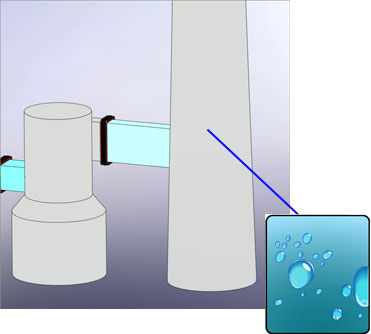
The figure below represents a typical balanced draft system with a “cold” precipitator and the fabric expansion joints being used with ducting.
**Black components are fabric expansion joints.

Fabric Expansion Joint Application Example The main sections of the ducting are as follows:

  • FD Fan to Air Preheater
  • Air Preheater to Boiler
  • Air Preheater to Pulverizer
  • Air Preheater to Inlet from Boiler
  • Air Preheater to Precipitator or Bag House
  • Precipitator or Bag House to ID Fan
  • ID Fan to Scrubber
  • Scrubber to Stack
**The examples shown are representative and
should not be used for design. The user should obtain
actual values for the particular system being considered.

Fossil Fired Power Plant

High Temperature Dirty Flue Gas Expansion Joint Applications

Similar Applications

Fossil Fired Power Plant, Gas Recirculation System, Pulp and Paper Plant, Recovery Boiler to Precipitator, Refinery Turbo-Expander to CO Boiler and CO Boiler to Precipitator, Cement Plant, Clinker Cooler to Heat Exchanger

Typical Conditions

650°F to 850° operating temperature, -10" to -25" WG pressure, Fuel gas media with heavy particulate, Boiler growth contributes to large axial or lateral expansion joint movements depending on the orientation of the joints.

Sample Data Sheet for Listed Applications
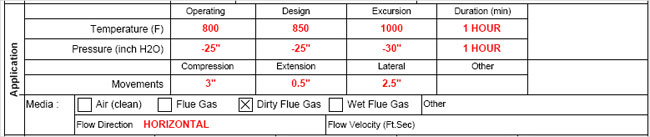
Data Sheet for High Temperature Dirty Flue Gas Expansion Joint Applications

Recommended Expansion Joint Designs

Common Design Features:
  1. Fabric Belt: Un-insulated fabric material. (FLEXXCEL HD7)
  2. Accumulation barrier: Fills expansion joint cavity to minimize the accumulation of particulate.
  3. Liner: Flow liner to retain the accumulation barrier and protect the belt from abrasion

Style 200W
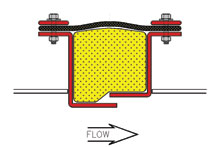
  • Design Performance: *****
  • Manufacturing Cost: $$$
  • Installation Cost: $$
Unique design features: Integral telescoping liners to retain the accumulation barrier and protect the belt from abrasion.

Style 100W
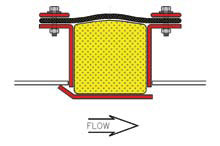
  • Design Performance: ****
  • Manufacturing Cost: $$
  • Installation Cost: $$$
Unique design features: Field weld liner.

Style 300W
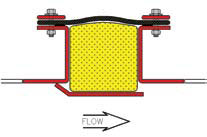
  • Design Performance: ****
  • Manufacturing Cost: $$$$
  • Installation Cost: $$$
Unique design features: Integral liner.

Style 600W
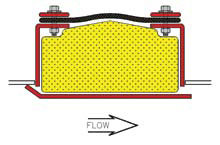
  • Design Performance: **
  • Manufacturing Cost: $$$$
  • Installation Cost: $$$$
Unique design features: Field weld liner, Ease of pre-compression for installing in breech opening, Requires belt attachment nuts to be tack welded, Leakage around belt attachment fasteners possible.

Style 700W
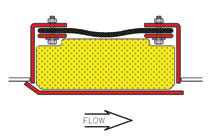
  • Design Performance: ***
  • Manufacturing Cost: $$$
  • Installation Cost: $$$
Unique design features: Belt installed and replaced from inside the duct, Field weld liner, Ease of pre-compression for installing in breech opening, Requires belt attachment nuts to be tack welded, Leakage around belt attachment fasteners possible.

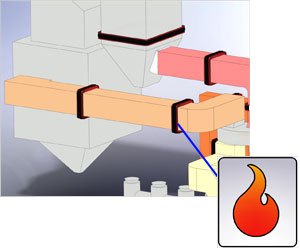
High Temperature Clean Air Expansion Joint Applications

Similar Applications

Fossil Fired Power Plant, Air Heater to Coal Pulverizers, Cement, Clinker Cooler to Heat Exchanger

Typical Conditions

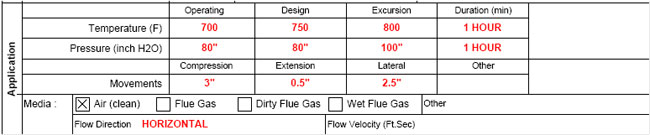
600°F to 750° operating temperature, 5" to 80" WG pressure, Clean air media, Boiler growth contributes to large axial or lateral expansion joint movements depending on the orientation of the joints.

Sample Data Sheet for Listed Applications
Recommended Expansion Joint Designs

Common Design Features:
  1. Fabric Belt: High temperature fabric belt. (FLEXXCEL HT1, HT3, or HT5 depending on maximum temperature.)
  2. Standoff: 6" minimum standoff and outboard belt attachment flanges to dissipate heat.
  3. External duct insulation: contoured around expansion joint to allow heat dissipation. (See page xx for details.)

Style 200W

  • Design Performance: *****
  • Manufacturing Cost: $$$
  • Installation Cost: $$
Unique design features: Field weld frame to duct. Integral telescoping liners to increase fabric material life.

Style 100W

  • Design Performance: ****
  • Manufacturing Cost: $$
  • Installation Cost: $$$
Unique design features: Field weld frame to duct. Field weld liner to increase fabric material life.

Style 300W

  • Design Performance: ****
  • Manufacturing Cost: $$$$
  • Installation Cost: $$$
Unique design features: Field weld frame to duct. Integral liner to increase fabric material life. Designed for large breech openings

Style 200B
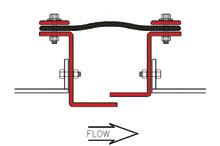
  • Design Performance: *****
  • Manufacturing Cost: $$$$
  • Installation Cost: $$$$
Unique design features: Integral telescoping liners to increase fabric material life. Bolt in design for attachment to equipment or duct flanges. Does require tacking welding nuts. Critical information required to insure proper fit-up.

Style 100B
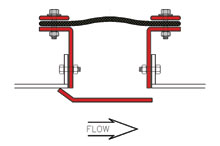
  • Design Performance: ****
  • Manufacturing Cost: $$$
  • Installation Cost: $$$$$
Unique design features: Field weld liner to increase fabric material life. Bolt in design for attachment to equipment or duct flanges. Does require tack welding nuts. Critical information required to insure proper fit-up.

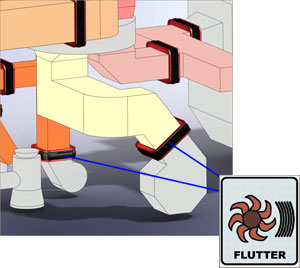
Turbulent Air Expansion Joint Applications

Similar Applications

Pulp and Paper Plant, Primary Air to Recovery Boiler

Typical Conditions

Ambient temperature, 40" to 50" WG pressure, Clean air Movement mainly limited to vibrations

Sample Data Sheet for Listed Applications
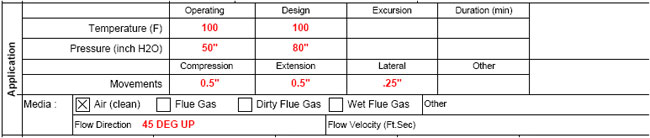
Recommended Expansion Joint Designs

Common Design Features:
  1. Fabric Belt: At fan locations, a flutter resistant fabric belt material should be used. (FLEXXCEL FF1)
  2. Standoff: Bolt-in design for attachment to equipment or duct flanges.
  3. External duct insulation: Flow liner to reduce turbulence/flutter of fabric belt material.

Style 200B

  • Design Performance: *****
  • Manufacturing Cost: $$$$
  • Installation Cost: $$$$
Unique design features: Integral telescoping liners. Does not require tack welding nuts.

Style 100B

  • Design Performance: ****
  • Manufacturing Cost: $$$
  • Installation Cost: $$$$$
Unique design features: Field weld liner. Does not require tack welding nuts.

Style 300B
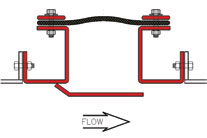
  • Design Performance: ****
  • Manufacturing Cost: $$$$
  • Installation Cost: $$$
Unique design features: Integral liner. Ease of pre-compression for installing in breech opening.

Style 400B
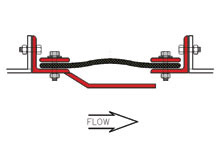
  • Design Performance: ***
  • Manufacturing Cost: $$$
  • Installation Cost: $$$
Unique design features: Integral liner. Ease of pre-compression for installing in breech opening. Requires belt attachment nuts to be tack welded.

Style 500B
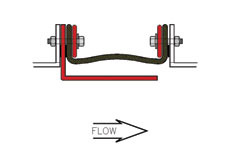
  • Design Performance: ***
  • Manufacturing Cost: $$$
  • Installation Cost: $$$
Unique design features: Bolt-on liner. Flanges on fabric belt attach directly to duct flange or equipment.

Dirty Flue Gas Expansion Joint Applications

Similar Applications

Cement Plant, Preheat Tower, Refinery, CO Boiler to Precipitator

Typical Conditions

250° F to 500° operating temperature, -35" to -50" WG pressure, Flue gas with possibly fly ash carryover through air heater, Moderate thermal movements in ducting.

Sample Data Sheet for Listed Applications
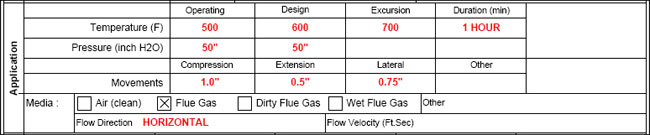
Recommended Expansion Joint Designs

Common Design Features:
  1. Fabric Belt: Un-insulated fabric material. (FLEXXCEL HD7)
  2. Accumulation barrier: Fills expansion joint cavity to minimize the accumulation of particulate.
  3. Liner: Flow liner to retain the accumulation barrier and protect the belt from abrasion.

Style 200W

  • Design Performance: *****
  • Manufacturing Cost: $$$
  • Installation Cost: $$
Unique design features: Integral telescoping liners to retain the accumulation barrier and protect the belt from abrasion.

Style 100W

  • Design Performance: ****
  • Manufacturing Cost: $$
  • Installation Cost: $$$
Unique design features: Field weld liner.

Style 300W

  • Design Performance: ****
  • Manufacturing Cost: $$$$
  • Installation Cost: $$$
Unique design features: Integral liner.

Style 600W

  • Design Performance: **
  • Manufacturing Cost: $$$$
  • Installation Cost: $$$$
Unique design features: Field weld liner, Ease of pre-compression for installing in breech opening, Requires belt attachment nuts to be tack welded, Leakage around belt attachment fasteners possible.

Style 700W

  • Design Performance: ***
  • Manufacturing Cost: $$$
  • Installation Cost: $$$
Unique design features: Belt installed and replaced from inside the duct, Field weld liner, Ease of pre-compression for installing in breech opening, Requires belt attachment nuts to be tack welded, Leakage around belt attachment fasteners possible.

Turbulent Flue Gas, Wet Gas Expansion Joint Applications

Similar Applications

Fossil Fired Power Plant, Re-heater to chimney, Pulp and Paper Plant Induced Draft Fan to Chimney, Refinery, Steam Generator to Stack

Typical Conditions

250° F to 500° F operating temperature, -35" to +50" WG pressure, Minimal particulate downstream of precipitator. Potential for wet conditions.

Sample Data Sheet for Listed Applications
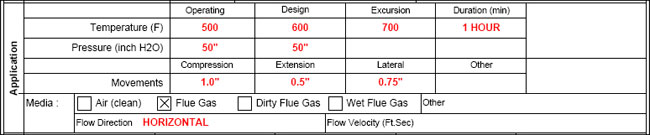
Turbulent Flue Gas, Wet Gas Expansion Joint Applications Data Sheet

Recommended Expansion Joint Designs

Common Design Features:
  1. Fabric Belt: At fan locations, the belt material should have a high resistance to flutter. (FLEXXCEL FF1)
  2. Frame Attachment: Bolt-in design for attachment to equipment or duct flanges. (If equipment or duct flanges are not present, weld in designs are recommended.)
  3. Liner: Flow liner to reduce turbulence/flutter of fabric belt material.

Style 200B

  • Design Performance: *****
  • Manufacturing Cost: $$$$
  • Installation Cost: $$$$
Unique design features: Integral telescoping liners. Does require tack welding nuts.

Style 100B

  • Design Performance: ****
  • Manufacturing Cost: $$$$
  • Installation Cost: $$$$
Unique design features: Field weld liner. Does require tack welding nuts.

Style 300B

  • Design Performance: ****
  • Manufacturing Cost: $$$$$
  • Installation Cost: $$$$
Unique design features: Integral liner. Ease of pre-compression for installing in breech opening. Does not require tack welding nuts.

Style 400B

  • Design Performance: **
  • Manufacturing Cost: $$$$
  • Installation Cost: $$$$
Unique design features: Integral liner. Ease of pre-compression for installing in breech opening. Requires belt attachment nuts to be tack welded. Not recommended in negative pressure applications before ID fan.

Style 500B

  • Design Performance: **
  • Manufacturing Cost: $$$
  • Installation Cost: $$$
Unique design features: Bolt-on liner. Flanges on fabric belt attach directly to duct flange or equipment. Not recommended in negative pressure applications before ID fan.

Low Temperature Wet Flue Gas Expansion Joint Applications

Similar Applications

Fossil Fired Power Plant, Scrubber Bypass to Stack and Scrubber to Re-heater Pulp and Paper Plant, Scrubber Inlet and Scrubber to Re-heater

Typical Conditions

120° F to 350° F operating temperature, +5" to +15" WG pressure, Minimal particulate. Highly corrosive wet gas, Minimal movements.

Sample Data Sheet for Listed Applications
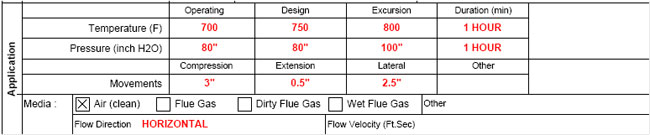
Recommended Expansion Joint Designs

Common Design Features:
  1. Fabric Belt: Fabric material should have the maximum chemical barrier due to corrosive conditions. (FLEXXCEL HC40)

Style 100W

  • Design Performance: *****
  • Manufacturing Cost: $$
  • Installation Cost: $$$
Unique design features: Welds to duct.  

Style 300W

  • Design Performance: ****
  • Manufacturing Cost: $$$$
  • Installation Cost: $$$
Unique design features: Ease of pre-compression for installing breech opening. Does not require tack welding nuts.  

Style 100B

  • Design Performance: ****
  • Manufacturing Cost: $$$
  • Installation Cost: $$$$
Unique design features: Bolts to duct. Does require tack welding nuts.  

Style 500B

  • Design Performance: **
  • Manufacturing Cost: $$$
  • Installation Cost: $$$
Unique design features: Flanges on fabric belt attach directly to duct flange or equipment
Read More

Clamshell Bellows Replacement for a Heat Exchanger Expansion Joint

By John Demusz

June 24, 2010

Most fixed tube heat exchangers have an expansion joint on the shell side of the exchanger. The shell side expansion joint compensates for the differential thermal growth between the tube and the shell under operating conditions. If the expansion joint would start to leak, it can cause serious operational and safety issues. Replacing a bellows in a heat exchanger is viewed as an extremely expensive process since the tubes must be removed from the tube sheet to replace the bellows.

US Bellows can retrofit your heat exchanger bellows without removing the tubes from the tube sheet. Our “clam shell technology” enables US bellows to remove the existing leaking bellows and replace it by installing a clam shell bellows. The clam shell bellows is fabricated by removing the existing bellows and obtaining precise dimensions to correctly fabricate a new bellows. The new bellows will be formed to the exact dimensions of the heat exchanger then cut into two pieces. Both halves of the bellow will be installed on the exchanger by welding the two halves together. The longitudinal bellows welds will be dye-penetrant examined for quality assurance. The new bellows replacement can also be hydro-tested in our facility.

US Bellows/Sweco Fab. Maintain ASME code U Stamp and R stamp which are renewed every three years. Materials or construction meet our customer’s specific requirements for all types of media, pressure, and temperature conditions. Clam shell bellows can save thousands of dollars.

Read More

Early Warning Detectors for Expansion Joint Failure

By John Demusz
September 15, 2010

Frequently operating plants with critical applications desire the ability to monitor the condition of a bellows element, so if a problem arises, timely plans can be made to replace the bellows. The two-ply testable bellows element has this ability with two unique features. First, both plies are redundant and capable of withstanding the system pressure and temperature. Second, the space between the plies can be monitored for changes in pressure, so that if a leak were to develop on the inner ply, the outer ply will continue to operate and the system pressure would be indicated by the activation or the orange pop top. The orange top remains passive until there is a leak in the inside ply causing pressure to build up between the plies causing the early warning orange top to activate and pop up.

Early warning detector drawing

Features:

    • Acts as an early warning of a bellows leak when the orange top pops up.
    • Two-ply bellows are designed for 100% redundancy. Each ply is designed to take the full pressure and temperature.
    • The critical piping system continues to operate while the plans for replacement are formulated.
    • Eliminates downtime in critical high-risk piping systems where leaking bellows could cause an outage and shutting down the plant until the bellows can be replaced.

Cost Savings:

The two-ply bellows with a leak detector will add 15% to 30% to the initial cost of the bellows itself. This is a real cost saving considering the effect of a failed bellows in a critical piping system that could shut down an operating plant. By using the orange pop top, the end user minimizes potential downtime in high-risk services where a bellows failure could cause an unscheduled shutdown.

Read More

Types of Metallic Bellows Deflections

This section describes the different types of expansion joints available, how they function, what types of deflections they can accept, and what types of forces and movements they can and cannot resist. In order to properly apply expansion joints to piping systems, it is necessary that both the piping specialist and the expansion joint designer each understand how the piping flexes and how the various expansion joint types function and what they are capable of doing. It may be relatively easy to visualize that deflections may result from thermal expansion or the movements and vibrations of equipment and structures; however, all expansion joints do not accept the same types of deflection. Many can accept certain loads and moments, while others are incapable of resisting externally applied forces. Understanding the type, magnitude, and direction of these forces and deflections is critical, not only to the safety of the system, but to its cost. With today’s piping flexibility computer programs, determining where stresses are excessive, and if expansion joints may be necessary, is not a simple task.

The placement of expansion joints, and their proper selection, still depends upon the designer’s experience, understanding of how expansion joints work, and how the piping system must be anchored and supported when expansion joints are used. These deflections can include axial, lateral, angular, torsional, combination, or cyclic and all occurring simultaneously. Axial deflection refers to movement that is parallel to the centerline of the expansion joint. Lateral deflection refers to movement in a perpendicular direction to the center line. Angular Deflection is when the expansion joint is bending around its center. Torsional Deflection is when the bellows is twisting on one end in the opposite direction of the other end. Combined deflections are a mixture of another of the other types of deflections. Cyclic deflections refer to the life cycle or the number of deflections a bellow can or will handle.

Axial Deflection

Axial deflection refers to movement being parallel to the centerline of the expansion joint. Compression is the axial deflection which will shorten the bellows length, while extension is the axial deflection which stretches the expansion joint. Often confusion occurs because thermal expansion in the piping will cause the expansion joint to be compressed. The specification for an expansion joint should always state the movements as they affect the expansion joint, and not as they are produced by the system. Piping which is operating at temperatures lower than ambient, such as in cryogenic systems, will contract, causing the expansion joint to stretch or experience extension.

Axial deflection

Lateral Deflection

Lateral deflection refers to the direction perpendicular to the centerline of the expansion joint (in any plane) and is also known as “parallel offset” and “transverse”. This movement occurs when both of the ends of the expansion joint remain parallel to each other, while their centerlines are being displaced, or no longer coincident. When analyzing the deflections in a piping system, it is not uncommon to find that different lateral deflections can occur in more than one plane. Since an expansion joint is round, these various deflections must be resolved into a single resultant lateral deflection, in order for the bellows to be properly selected in terms of the rated lateral deflection shown in our catalog. The planes of the various deflections must also be clearly understood if the expansion joint is to contain structural components such as hinges, which may inhibit movements in certain directions, and if the individual deflections can occur separately during the life of the expansion joint.

Lateral deflection

Angular Deflection

When an expansion joint experiences bending about its center, which is on the centerline and halfway between the ends of the bellows, this deflection is referred to as angular. It can occur in any plane that passes through the centerline, but the plane should be clearly indicated if the expansion joint is more complicated than the simplest type, i.e., only a bellows with flanges or pipe ends. As in lateral movements, piping analyses may reveal angular deflections occurring in more than one plane. With angular deflection, the basis for the proper selection is the maximum of the various deflections, and not the vector sum as in the lateral case. Multiple angular deflections in multiple planes produce a single angular deflection in a single resultant plane. As in lateral deflection, this plane must be understood if structural components are to be used.

Angular deflection

Read More

Two-ply Testable Bellows

U.S. Bellows designs two-ply bellows with 100% redundancy; therefore, if a leak occurs in the inner ply, the outer ply is designed for the full pressure and temperature. This design allows for the critical piping system to continue operating while plans for replacement can be formulated. This can prevent unexpected shut-downs saving valuable time and money.

Two-ply bellows also make it possible to pressure test and inspect for leaks during field inspections and in some cases, if conditions permit, the expansion joint can be tested while in service. Universal, hinged and gimbal are some of the common types of expansion joints that include two-ply bellows. Sometimes a wire mesh is used between the bellows to ensure flow equalization between the plies of the bellows.

Most expansion joints in oil refineries, especially FCC units use two-ply bellows, but they are also ideal for regenerated catalyst standpipe, spent catalyst standpipe, recirculation cooled catalyst flue gas piping and hot gas expanded piping. Contact our team to have your single bellows expansion joint refurbished to include two-ply bellows.

Two ply bellows 86076 44″ Hinged Expansion Joint with Refractory-lining and Two-ply Bellows

  • Designed with two-ply Inconel® 625 LCF bellows, 5″ thick refractory-lining, and 2″ thick attachment rings for part of a reactor piping system in a synfuels plant
  • Pneumatically tested between the bellows plies and the complete expansion joint
  • Thermal and structural Finite Element Analysis (FEA) was performed for the bellows operating temperature
Two ply bellows 70679 55″ Refractory-lined Universal Gimbal Expansion Joint with Two-ply Bellows

  • Designed for a spent catalyst standpipe in an FCC unit & includes slotted hinges
  • 163″ O.A.L and 60 PSIG at 1020°F, A516 GR 70 pipe and two Inconel® 625 LCF two-ply bellows
  • 100% dye penetrant tested, 100% x-ray tested, pressure tested, pneumatic and vacuum tested between the bellows plies and the complete expansion joint
Two ply bellows dec2001 44″ Universal Expansion Joint with Refractory-lining and Two-ply Bellows

  • Designed for a chemical plant in Venezuela 44″ diameter and 100 PSIG at 1000°F
  • 321 SS two-ply testable bellows, A-387 GR 11 weld ends, 5″ vibra cast and 1″ abrasion resistant refractory
  • Pneumatically tested between the bellows plies and the complete expansion joint
Read More

Advantages of Fabric vs. Metal Expansion Joints

Fabric Hinged expansion joint type
Reasons to choose a fabric pipe expansion joint Reasons to choose a metal pipe expansion joint
  • Good for high temperature applications
  • High movement capabilities
  • No size restraints
  • Less expensive to design and fabricate
  • Generally low cost with quick delivery on larger sizes
  • Easy to repair and preset
  • Accomodates torsional movement
  • Maintenance Free
  • Non-Combustible
  • Withstand a large range of temperatures from high temperature to cryogenic
  • Can be used for high pressure services
  • Used for a variety of process conditions including air, steam, liquid, cryogenic, etc.
  • Does not allow leakage of gases or liquids
  • Two-ply testable bellows
Read More