
Lateral deflection refers to perpendicular movement in a pipe expansion joint where both ends remain parallel while their centerlines become displaced, a condition also known as lateral offset or transverse movement. At US Bellows, we help engineers accurately calculate resultant lateral deflection by combining multi-plane displacements into a single value for proper bellows selection. Because lateral expansion joints can deflect in any radial direction, careful analysis is essential to ensure movement remains within rated limits, the expansion joint has unobstructed range of motion and to prevent premature fatigue failure. Our engineering team applies EJMA standards to specify each expansion joint according to the required deflection range, cycle life, and bellows convolution geometry.
Lateral Deflection: Parallel Offset & Transverse Movement Explained
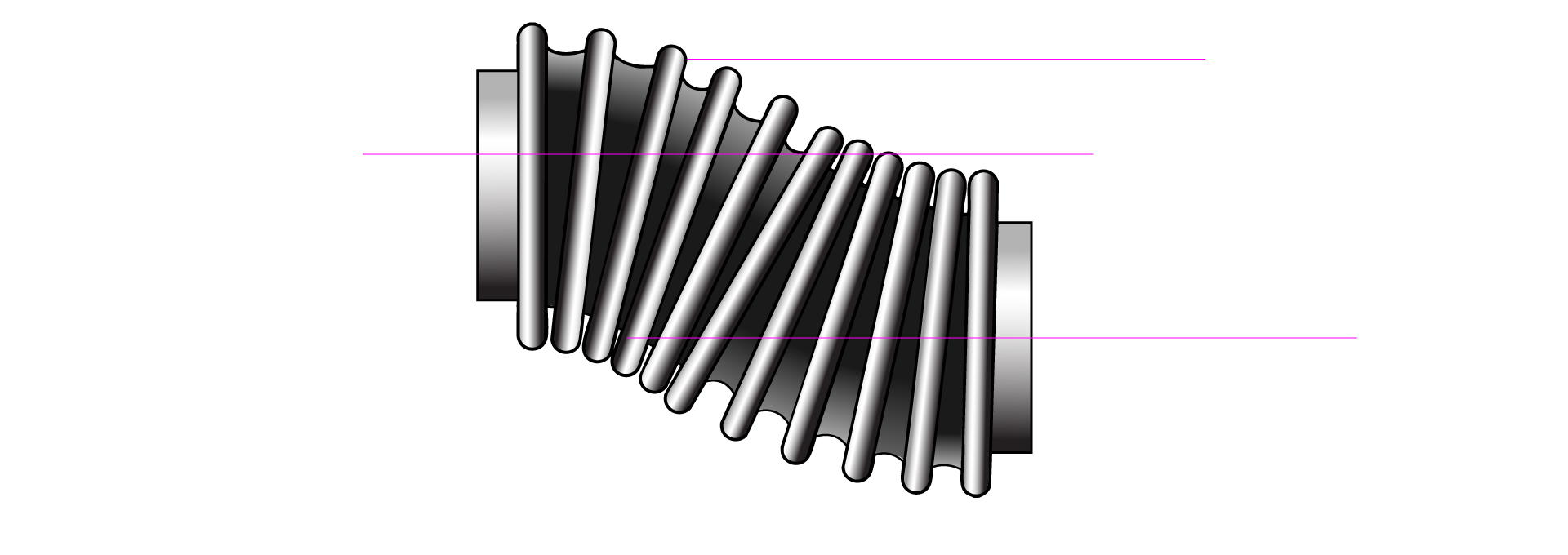
Lateral refers to the direction perpendicular to the centerline of the pipe expansion joint (in any plane). Other terms for this deflection are parallel offset and transverse.
This movement occurs with both ends of the pipe expansion joint remaining parallel to each other, with their centerlines being displaced or no longer coincident.
When analyzing the deflections in a piping system, it is not uncommon to find that different lateral deflections can occur in more than one plane.
Because an expansion joint can deflect in any radial direction, multiple lateral displacements must be combined into a single resultant value when selecting a bellows against its rated lateral deflection. See more information in our catalog.
Calculating Resultant Lateral Deflection
The magnitude of the resultant lateral deflection (D) is calculated using the formula:
D = √(x² + y²)
where x and y are the component lateral deflections in orthogonal planes (e.g., horizontal and vertical).
When structural components such as hinges are included, the direction of lateral movement must be carefully considered, since these components restrict motion to specific planes. It is also important to determine whether lateral deflections may occur independently during operation.
Excessive lateral deflection beyond rated limits can induce non-uniform stress in the bellows convolutions, leading to premature fatigue failure. Allowable lateral deflection ratings are established per EJMA standards and are closely tied to convolution geometry and expected thermal cycles. Expansion joints are typically specified with a lateral deflection range based on cycle life expectations and convolution geometry.
Request an engineering consultation or view our product catalog
Did you know that US Bellows is a Piping Technology Company?
We are proud to be a one-stop solution from expansion joints to pipe supports and engineering services. We work hard to simplify your supply chain, and ensure system reliability with quality assurance.
FAQs
Q: What is lateral deflection in a pipe expansion joint?
A: Lateral deflection refers to perpendicular movement where both ends of the expansion joint remain parallel but their centerlines become displaced, also known as parallel offset or transverse movement.
Q: Can lateral movement occur in more than one plane?
A: Yes, lateral deflection can occur in multiple planes simultaneously. These must be combined into a single resultant value using the formula D = √(x² + y²) for accurate bellows selection.
Q: What happens if an expansion joint exceeds its lateral movement rating?
A: Exceeding the allowable movement rating can place excessive stress on the bellows convolutions, increasing the risk of fatigue and premature failure. Proper selection of lateral expansion joints helps ensure movement remains within EJMA-recommended limits and supports long-term performance.