

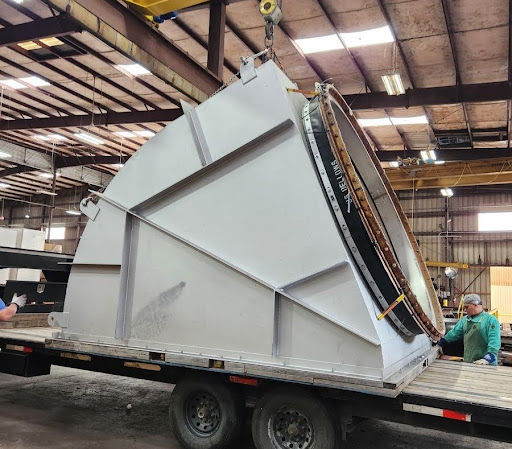
US Bellows redesigned and refurbished a custom fabric expansion joint for a large, refractory-lined refinery transition-duct assembly, adapting the connection geometry to revised installation requirements. The ductwork is part of the Air-Preheater (APH) duct system, which routes cooled flue gas out the stack.
The project combined a specially configured fabric boot, replacement components, and challenging fabrication work to prevent damage to the refractory on an assembly weighing more than 17,000 pounds.
Project at a Glance
| Feature | Project Details |
| Application | Discharge flue gas duct system |
| Design temperature | 600°F, with 2.0 in. thick refractory |
| Expansion joint | Custom T-shaped fabric boot with insulation, stainless steel liners, and carbon steel shell and hardware |
| Original pipe-end diameter | 105 inches |
| Required movement | 2 in. compression; 1/2 in. extension; 3/8 in. lateral |
| Duct assembly envelope | Approximately 12 ft long x 10 ft wide x 9 ft tall |
| Duct assembly weight | Approximately 17,000 lb |
| Project scope | Evaluation, redesign, remanufacturing, and assembly onto existing ductwork |
The Application
- The ductwork joint was originally designed and manufactured in 2020 for the APH duct system, which handles cooled flue gas.
- Its job was to absorb thermal movement, minimize vibration, and accommodate duct misalignment.
- One end connects to a 105-inch-diameter pipe on an elbow duct. The other end is bolted to a guillotine damper through a substantially larger flange.
- That unusual connection geometry, limited installation space, and the specified axial and lateral movements called for a custom solution.
- US Bellows developed a T-shaped fabric boot with two layers of insulation pillows enclosed by stainless steel liners, along with the pipe-end and mounting components.
Redesigning for Revised Field Requirements
The customer shipped the duct and the remaining expansion joint components to US Bellows after installation difficulties and the discovery of missing components. Inspection found:
- The fabric materials were no longer serviceable.
- Most metal components could not be reused.
- The flange-side connection needed to be substantially larger than the original design.
The work therefore extended beyond a straightforward fabric replacement. US Bellows redesigned and remanufactured the assembly to suit the revised connection dimensions and fit the existing duct, while still meeting the turnaround schedule.
Fabricating Around a 17,000-Pound Duct Assembly
- Welding the pipe-end connection to the existing duct was the major fabrication challenge.
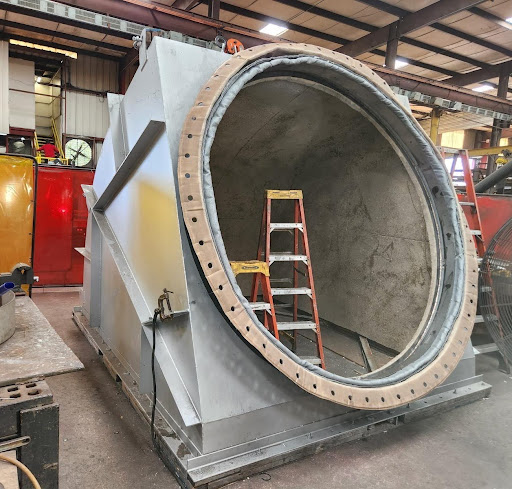
- The refractory-lined assembly measured approximately 12 feet long, 10 feet wide, and 9 feet tall, and weighed near 17,000 pounds.
- Its size, weight, and restricted access to the lower welding area required careful handling and positioning.
- The team took care not to damage the internal refractory during handling, fabrication, and welding.
- The duct was lifted to give access for the necessary welding, which let the shop team integrate the redesigned expansion joint with the existing equipment.
A Complete Assembly, Ready for Installation
- US Bellows completed the redesigned expansion joint and assembled it onto the duct.
- The required delivery for the refinery Turn-around was met.
- The customer’s flange was also attached before shipment, as requested.
Refurbishment can involve much more than replacing a flexible element. Revised mating dimensions, component condition, access limitations, and the handling requirements of large ductwork all influence the final solution.
Practical Considerations for Similar Refurbishments
- Verify both mating connections. Confirm current flange dimensions, pipe-end geometry, and available installation space before finalizing the replacement design.
- Assess the complete assembly. Review the condition of the fabric, insulation, liners, and metal components instead of assuming the original hardware can be reused.
- Confirm movement and service requirements. Establish the required axial and lateral movements alongside temperature, pressure, and process-media requirements.
- Plan handling and weld access. Account for duct weight, refractory lining, lifting arrangements, and access restrictions before fabrication begins.
Related Work
- Rectangular fabric expansion joints for a flue gas application at an oil refinery in Texas.
- A universal expansion joint refurbished for a manufacturing facility in Tennessee.
Refurbishing Fabric Joints on Large Ductwork?
US Bellows provides custom fabric expansion joint design and refurbishment solutions for industrial ductwork. Schedule time with an engineer to discuss your application, connection geometry, and installation requirements, or request a quote.
Upcoming Live Webinar
Sign-up for a Live Technical Webinar…
No upcoming webinars. Please check later.
View video recordings from past webinars…
Online Course
Expansion Joint Application and Design
Our Expansion Joint course was developed for the following disciplines…
- Piping system designers that may decide to use expansion joints
- Expansion joint designers use the information provided by piping system designers to determine the best design to meet the requirements.
- Designers that use modern software systems to evaluate different options
- Engineers / Managers: field, maintenance, process, operations, construction, surveyors
*This online course is approved for 8 hrs. P.E. Credits
Register Now