

Thermal expansion in piping systems is a persistent engineering challenge. Especially in high-temperature process, power applications, seismic zones, and emerging facility types like battery manufacturing plants and data centers. In all of these, pipe runs have to accommodate axial growth and lateral movement without putting excessive stress on anchors, supports, and connected equipment.
This article looks at three common ways to manage that movement: the conventional pipe loop, the traditional bellows-type expansion joint, and the U-Loop (or V-Loop) expansion joint, a hybrid of the two.
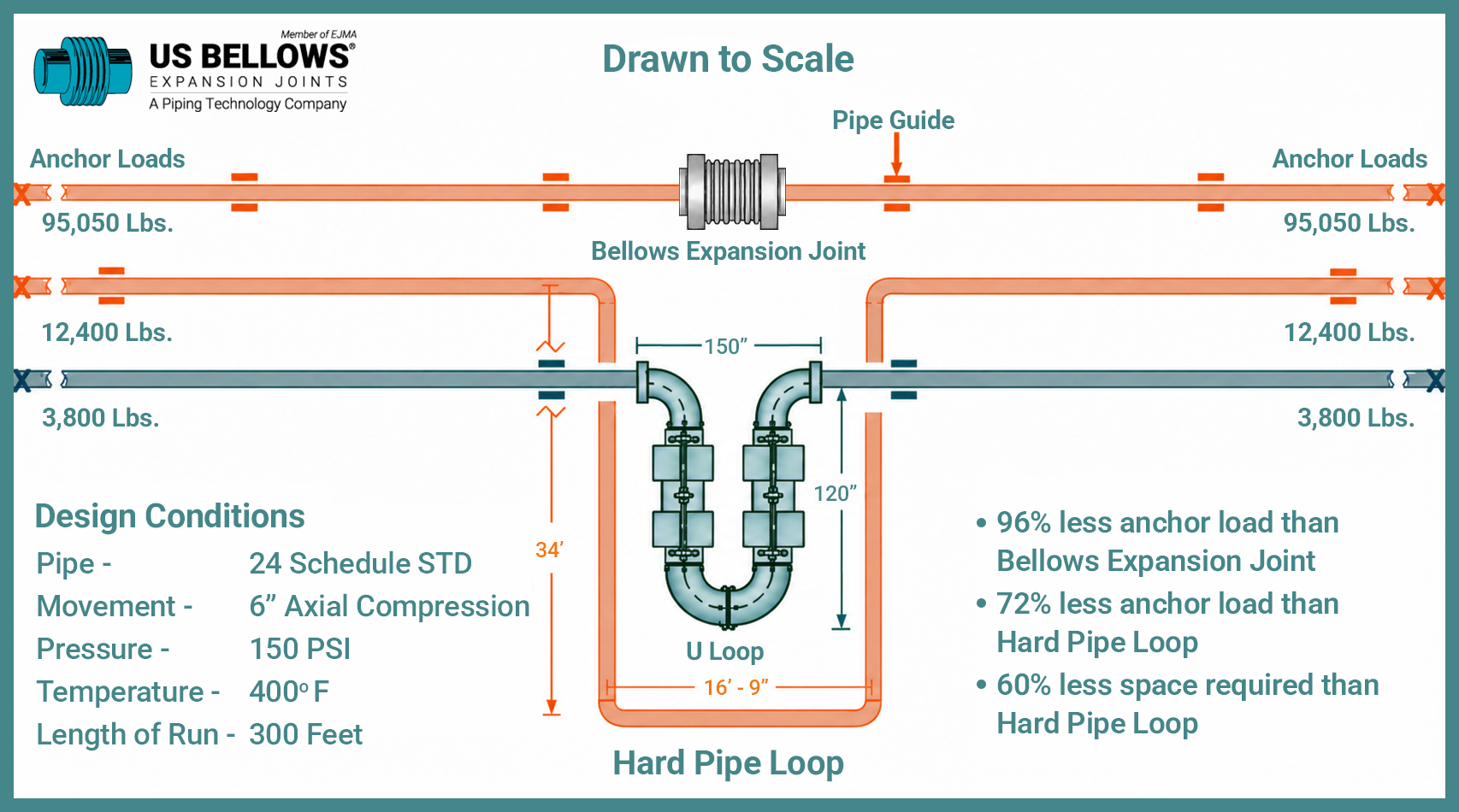
The Pipe Loop: Maximum Reliability & Lowest Maintenance
A pipe loop is built entirely from standard pipe and fittings, bent into a shape that flexes as the pipe heats and grows. Because it uses no specialized components, it carries two real advantages:
- The highest reliability of the three options, since there is no bellows to fatigue.
- The lowest ongoing maintenance burden, since there is nothing built to a fixed cycle life that needs periodic replacement.
The tradeoff is size and cost:
- It needs significant physical space to bend through.
- It uses more material and support structure than a compact joint.
- It is best suited to primarily axial movement, not combined lateral or angular movement.
- US Bellows’ comparison of the two approaches confirms this directly: expansion joints are recommended specifically when there “isn’t enough room to accommodate the large footprint required by pipe loops.”
- That same comparison notes pipe loops introduce more pressure drop, from the extra length and elbows in the flow path.
In practice, this rules a pipe loop out for most congested mechanical rooms, retrofits, or overhead routing corridors.
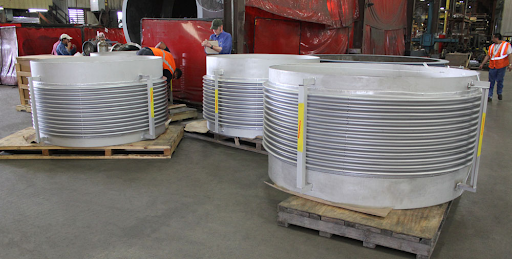
The Traditional Bellows Expansion Joint: Compact but Constrained
Where a pipe loop uses distance to absorb movement, a bellows expansion joint uses a flexible metallic bellows instead, absorbing that same movement inside a short, compact section of the line.
That compactness comes with real trade-offs:
- A finite fatigue life: The bellows is rated for a specific number of movement cycles, not unlimited service. Misalignment or improper installation during or after commissioning can shorten that life.
- Higher Thrust Loads: Anchors will need to be designed for the pressure thrust, as well as follow the guiding requirement.
- Ongoing upkeep: It requires periodic inspection and eventual replacement, unlike a pipe loop’s fixed piping.
The U-Loop (V-Loop) Expansion Joint: A Hybrid Middle Ground
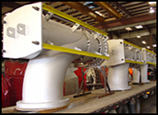
The U-Loop, sometimes built as a V-Loop, combines a shortened pipe loop geometry with bellows elements nested inside it. It is an industry-first design that integrates bellows directly into the loop structure, rather than treating the loop and the joint as separate choices. Together, they significantly reduce the footprint, anchor loads, guiding requirements, and costs.
Two things distinguish it from a standalone bellows expansion joint:
- The loop geometry itself absorbs some of the movement, so the bellows inside it can be smaller and the overall assembly more compact than a full-size pipe loop, while needing less specialized anchoring than a bare bellows joint.
- Built-in tie rods carry the pressure thrust internally. US Bellows’ U-Loop product page states this “significantly reduces the requirement for numerous anchors,” so the joint absorbs its own pressure load instead of pushing that job onto external anchors, while still keeping the flexibility of a bellows joint.
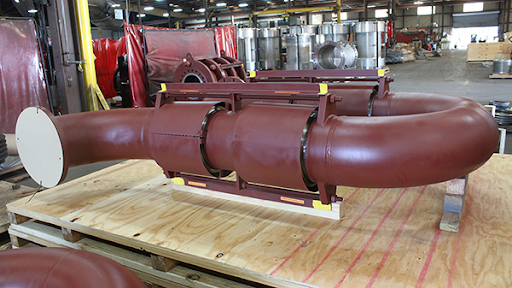
This combination is why U-Loops are specified for seismic and high-growth facility applications. A PTP article on seismic bracing for data centers describes nested U-Loop configurations handling thermal expansion and seismic movement at the same time, paired with trapeze-hanging supports and guides to keep the piping stable during shaking. US Bellows has also documented a real project on a large-scale battery manufacturing facility: a case study describing:
- 200+ expansion joints from 4 to 36 inches in diameter.
- More than 400 product configurations and over 6,000 total units.
- Delivery in about five months, across two production buildings covering chilled water, steam, nitrogen, compressed air, and condensate lines.
- A custom nested Super U-Loop configuration, chosen specifically because “large pipe loops were impractical in congested mechanical corridors and overhead routing areas.”
Comparing the Three
| Factor | Pipe Loop | Bellows Expansion Joint | U-Loop / V-Loop |
| Footprint | Largest | Smallest | Moderate |
| Pressure thrust | Contained by the pipe itself | Must be carried by external main anchors | Absorbed internally by tie rods, reducing anchor needs |
| Movement handled | Mainly axial | Axial, lateral, or angular depending on design | Thermal movement and seismic displacement together |
| Cost Considerations | Moderate/High. Depending on the weight, additional support may be needed | Moderate/ High. Although the Bellows is inexpensive, the anchors and guides may bear a significant cost | Moderate Low anchor loading and minimal guiding requirement |
| Maintenance | Lowest | Periodic inspection and eventual replacement | Periodic inspection, similar to a standalone bellows joint |
Choosing the Right Option
There is no single correct answer; the right choice depends on the constraints of the specific system:
- A pipe loop is the most reliable option wherever there is enough space, the budget can accommodate it, and there’s only axial movement in consideration
- A bellows expansion joint is the right call in tight layouts, provided the anchor and guide system it depends on is properly engineered from the start, not treated as an afterthought.
- A U-Loop or V-Loop is worth considering specifically when a project needs the compactness of a bellows joint but cannot support the anchor loads a standalone bellows joint would require, or where thermal and seismic movement both need to be managed in the same run.
The specifics of any one system, pipe size, operating pressure, movement magnitude, and site constraints, still warrant a conversation with an expansion joint manufacturer before a final selection is made.
Space, Seismic, or Simplicity: Which Constraint Is Driving Your Design?
If your layout is fighting you on room, or your site sits in a seismic zone, or you’re just trying to avoid an anchor system the size of the piping run itself, the right answer isn’t the same for every project. Schedule time with an engineer to walk through your specific constraints before committing to a design.
Ready to size a solution for your project? Request a quote, and our engineering team will follow up with pricing and lead time.
Upcoming Live Webinar
Sign-up for a Live Technical Webinar…
U.S. Bellows - Expansion Joints In-depth Webinar
Date: Thursday, October 15, 2026 - Register for 10:00 am OR 2:00 pm
*Note: Time Zone is CDT * Central Daylight Savings Time / GMT -5h
Live Webinars are 1 PE/PDH Credit for TX Professional Engineers
Get to know U.S. Bellows from introducing our team and manufacturing capabilities to exploring design details in technical drawings for large-scale projects. View case studies that lead to the creation of new standards and designs. Learn about cost-saving measures for expansion joint failures and how to prevent future problems.
Upcoming Webinars:
October 8th: Pipe Clamp Design, Application & Installation Webinar 10:00 am OR 2:00 pm
October 22nd: Field Service: Problem Resolution Live Webinar 10:00 am OR 2:00 pm
October 29th: Fabric Expansion Joints Webinar by U.S. Bellows, Inc. 10:00 am OR 2:00 pm
View video recordings from past webinars…
Online Course
Expansion Joint Application and Design
Our Expansion Joint course was developed for the following disciplines…
- Piping system designers that may decide to use expansion joints
- Expansion joint designers use the information provided by piping system designers to determine the best design to meet the requirements.
- Designers that use modern software systems to evaluate different options
- Engineers / Managers: field, maintenance, process, operations, construction, surveyors
*This online course is approved for 8 hrs. P.E. Credits
Register Now