

 Metal flanges are a cornerstone of modern industrial piping systems, but their role extends beyond just connecting pipes. They are an essential, pressure-resistant component of expansion joints, which manage thermal movement and stress in piping systems. Industrial piping designers need to understand and focus on the cooperative relationship between metal flanges and expansion joints.
The Role of Flanges in Piping Systems
Metal flanges, in layman’s terms, are rings with holes (for bolting) that create secure, leak-proof connections between pipes, valves, and other equipment. They are essential for:
- Reliability & Durability: Made from high-strength materials such as carbon and stainless steel, flanges withstand extreme pressures and temperatures.
- Leak Prevention: When paired with gaskets and properly bolted, they form a tight seal, preventing the escape of fluids and gases.
- Maintenance & Flexibility: Flanged connections allow for easy piping assembly and disassembly, simplifying inspections, repairs, and system modifications.
How Flanges Enable Expansion Joints
Metal flanges add to the functionality of expansion joints because they:
- Provide a Secure Connection: Flanges ensure the expansion joint is securely fastened to the adjacent piping. This prevents it from being dislodged by the forces it’s designed to absorb.
- Facilitate Installation and Replacement: Using flanges on an expansion joint makes installation and future replacement much simpler and faster than a welded connection. This reduces downtime and labor costs during maintenance.
- Ensure System Safety: A well-matched flange connection on an expansion joint ensures that the component can safely handle the system’s pressures and temperatures without leaks.
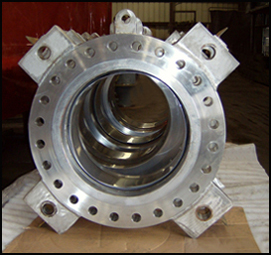
Real-world example: Single Flanged Expansion Joints for a Leading Manufacturer
Common Challenges and Solutions. Even with their durable design, flange connections on expansion joints can face issues. Misalignment and thermal stress are two common culprits. If pipes aren’t correctly aligned before the flange connection is made, it introduces stress on the joint; also, repeated thermal cycles can loosen bolts over time.
To prevent these issues, it is essential to:
- Ensure total alignment during installation.
- Implement a schedule for periodic bolt retightening in systems that undergo thermal cycles.
By understanding the vital relationship between metal flanges and expansion joints, engineers can design more reliable piping systems. These two components work together to ensure that a system can safely handle the stresses of industrial operations.
Flanges, Welds, and Expansion Joints
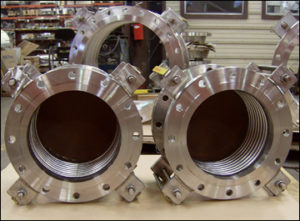 While flanges are designed to resist stress, piping systems often undergo significant movement due to temperature fluctuations. This is where expansion joints come in. An expansion joint is a flexible component designed to accommodate thermal expansion and contraction, as well as vibration.
A key point is that the bellows of an expansion joint will either have metal flanges or welded pipe ends to connect to the rest of the piping system. With a flanged connection, assembly and disassembly are easy. Unlike a permanent weld, which requires extensive work and downtime for changes or repair, a flanged joint can be unbolted, allowing for simple inspection, maintenance, and replacement.
When integrated with an expansion joint, flanges can extend beyond static connection points, delivering the versatility they are known for in demanding chemical processing and other mixed-media environments. Here’s a chart that illustrates the difference between a permanent weld (welded attachments) and a flanged connection (flanged attachments).
Weld vs. Flange: A Critical Choice
|
Consideration |
Welded Attachments |
Flanged Attachments |
| Strength | Creates a permanent joint that offers durability and strength. The strength of the joint connection depends on the weld quality. | Depends on proper bolt tightening and gaskets, may be impacted by vibrations and stress |
| Upfront Cost & Weight | Lower for carbon steels and common stainless steels. The weight will be lower than that of Flange connections. | Higher. As the diameter of the pipe increases, the weight and cost of the Flanges increase |
| Leak Prevention | Eliminates Leak Paths Associated with Gaskets | Potential for leaks due to gasket degradation or improper installation |
| Maintenance | Limited ease of maintenance, requires pipe cutting and re-welding for repairs or changes | Easily disassembled for inspections, replacement, or repair, reduced labor and maintenance costs |
| Installation Cost and Time | Higher initial costs and time due to the need for fitting, welding, and QC inspections of the welds. | Quicker installation and lower up-front costs |
| Primary Applications | Preferred for corrosive media where a permanent seal works best | Good for environments where welding is not allowed, and regular maintenance is required |
Perfect Your Piping Design and Performance….Partner with US Bellows
Are you seeking the ideal expansion joints to complement your flanged piping? Partner with US Bellows. Our expert team specializes in designing and manufacturing top-quality expansion joints that complement your flanged connections.
Get a Quote on Custom Expansion Joints
Upcoming Live Webinar
Sign-up for a Live Technical Webinar…
Fabric Expansion Joints Webinar by U.S. Bellows, Inc.
Date: Thursday, October 29, 2026 - Register for 10:00 am OR 2:00 pm
*Note: Time Zone is CDT * Central Daylight Savings Time / GMT -5h
Live Webinars are 1 PE/PDH Credit for TX Professional Engineers
Get to know U.S. Bellows from introducing our team and manufacturing capabilities to exploring design details in technical drawings for large-scale projects. View case studies that lead to the creation of new standards and designs. Learn about cost-saving measures for expansion joint failures and how to prevent future problems.
Upcoming Webinars:
October 22nd: Field Service: Problem Resolution Live Webinar 10:00 am OR 2:00 pm
View video recordings from past webinars…
Online Course
Expansion Joint Application and Design
Our Expansion Joint course was developed for the following disciplines…
- Piping system designers that may decide to use expansion joints
- Expansion joint designers use the information provided by piping system designers to determine the best design to meet the requirements.
- Designers that use modern software systems to evaluate different options
- Engineers / Managers: field, maintenance, process, operations, construction, surveyors
*This online course is approved for 8 hrs. P.E. Credits
Register Now