


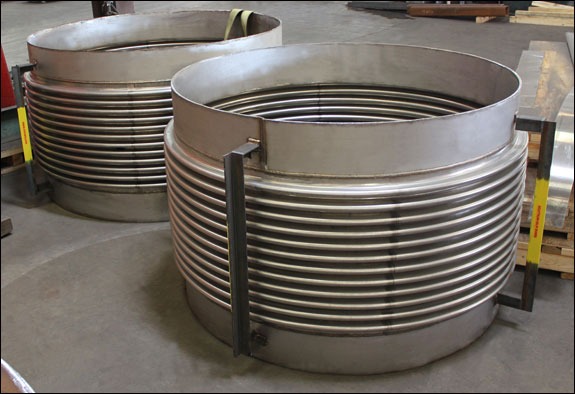
When specifying expansion joints for industrial piping, or any application, understanding the anatomy of the flexible element is essential. A common question from engineers is what convolutions are and how they function. Convolutions are the specific folds or corrugations formed into the thin metal cylinder of the bellows.
These engineered ridges give the expansion joint its flexibility, allowing it to compress, extend, or deflect angularly in response to thermal expansion and mechanical movement.
By incorporating precisely designed convolutions, the bellows can safely contain the pressure of the system while maintaining a tight seal and absorbing the thermal movement of the line, ensuring the long-term reliability of the piping infrastructure.
FAQs
Q: How do convolutions manage thermal expansion in pipelines?
A: As the pipe expands or contracts due to temperature changes, the convolutions flex, compressing or extending, to absorb the movement without transferring destructive stress to the surrounding structural steel or equipment.
Q: Does the shape or depth of the convolutions affect system performance?
A: Yes, the precise profile, height, thickness, and pitch of the convolutions directly dictate the expansion joint’s flexibility, maximum pressure rating, and overall cycle life.
Q: Why are engineers often asking what convolutions are when replacing older piping components?
A: Understanding the exact physical limits and movement capabilities of an existing expansion joint and its convolutions helps engineers correctly size and select the appropriate replacement bellows, preventing premature mechanical fatigue and system failure.